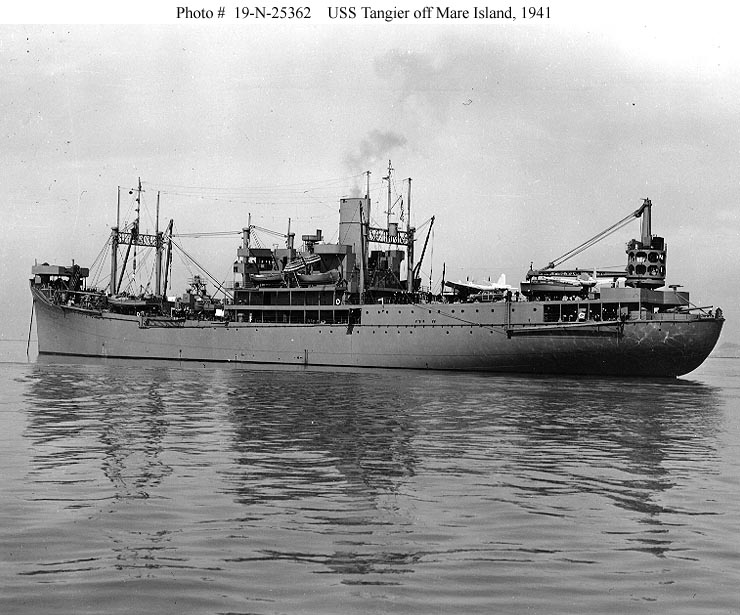
The ship
USS Tangier (AV-8) is the second ship of the name. DANFS says the name is an island and a sound in the lower Chesapeake Bay, the island in Virginia and the sound in Maryland. She was laid down on 18 March 1939 as the merchant ship Sea Arrow, Maritime Commission hull 51, by the Moore Dry Dock Company at Oakland, California. She was launched on 15 September 1939, sponsored by Mrs. Joseph R. Sheehan, and renamed Tangier on 3 June 1940. The Navy acquired her on 8 July 1940 and commissioned her in ordinary that day. Clifton Sprague had her. DANFS gives the name as Comdr. Clifton A. F. Sprague. NavSource prints Clifton Albert Frederick Sprague and carries the tour through 25 April 1942, so he still had her at Pearl Harbor. She stayed at Oakland for the conversion. Full commission was 25 August 1941. A HyperWar dimensions sheet prints the commissioning date as 8 July 1940, which is the ordinary date.
The DANFS reprint heads the measurements as 11,760 tons trial, length 492 feet 1 inch, beam 69 feet 6 inches, draft 23 feet 9 inches limiting, 18.4 knots trial, complement 1,075, and the guns as one 5-inch, four 3-inch, and eight 40 mm. It marks the class as Tangier and the hull as a C3 cargo ship. Shipscribe prints 8,973 tons light and 14,200 limiting, the same length and beam in decimals, 18.4 knots, and 8,500 horsepower on one De Laval turbine. A HyperWar dimensions sheet, separate from the DANFS reprint, prints 17,606 tons full load, 492 feet, draft 28 feet 6 inches loaded, and 16.5 knots. The numbers are left with the sheets that print them.
Pearl Harbor
After shakedown she was tender to Patrol Wing 2 in Hawaii. She arrived at Pearl Harbor on 3 November 1941 and moored abaft Utah (AG-16), the old battleship then used as an antiaircraft training ship. At 0755 on 7 December the first of two waves of Japanese carrier planes came in. Her general alarm sounded three minutes later, and by 0800 her guns were firing. The reprint uses the word meatball for the markings. Her gunners claimed three planes and hits on a midget submarine that had got into the harbor. She and Curtiss (AV-4) shelled that submarine. Monaghan (DD-354) finished it, ramming and then dropping depth charges. By 0920 the planes were gone. Tangier began taking survivors off the capsized Utah. The Naval Historical Center ship page says a Japanese bomb exploded nearby and damaged her slightly. The DANFS reprint does not describe damage to her.
Wake, then Noumea
By the middle of December she was loaded with supplies, ammunition, and equipment for the garrison on Wake. She waited two days while Saratoga (CV-3) came up from San Diego. Saratoga entered Pearl Harbor on 15 December. Tangier left that afternoon with Neches (AO-5) and a destroyer division. Saratoga caught the convoy on the 17th. The relief was ordered back. Wake fell on 23 December. Tangier went by Midway, put ashore the men and equipment of Marine Fighting Squadron 221, took civilian evacuees on board, and was back at Pearl Harbor on 31 December.
On 11 February 1942 she sailed, by Pago Pago and Suva, for New Caledonia, and reached Noumea on 3 March. She relieved Curtiss as tender for six flying boats. For three and a half months the PBYs searched north of New Caledonia, almost to the lower Solomons. Between late April and early May the number of planes went to twelve, ahead of a fleet action in the Coral Sea. When the battle came, the planes rescued survivors of Sims (DD-409) and Neosho (AO-23), sunk on 7 May, and of the torpedoed Greek freighter Chloe. The search went on until 13 May. The reprint calls Coral Sea a tactical victory for Japan and a strategic victory for the United States, and it prints the two carriers kept out of the next fight as Shokoku and Zuikaku. Shokoku is the reprint's spelling. The damaged carrier is Shokaku.
On 30 May two of her seaplanes were forced down at sea for lack of fuel, and a third crashed near Mare Island in the Loyalty group. Those are the reprint's words for that place. It is not the California yard in the photograph. Meredith (DD-434) went out to the two planes at sea. One was refueled and flew home. The other could not take off and was sunk. The crew of the third plane reached the island. On 20 June Curtiss relieved her. She reached Pearl Harbor on 4 July and San Francisco on 15 July for overhaul.
New Guinea and Morotai
The overhaul finished in September. She loaded aviation equipment at Alameda and went out by Pearl Harbor and Suva to Espiritu Santo, arriving on 29 February 1943. She tended seaplanes there until 12 August, reached Pearl Harbor on the 28th, and during September and October made two voyages to American Samoa and one to San Diego. She was back at Espiritu Santo with aviation cargo on 6 November, and in San Diego again on 3 December for another overhaul.
She sailed west on 21 February 1944, reached Espiritu Santo on 8 March, and on 21 March at Brisbane became flagship of Commander, Aircraft, Seventh Fleet. DANFS does not name the admiral. Two days later she went north. After Milne Bay and Langemak Bay she anchored in Seeadler Harbor, Manus, on 31 March, and stayed three months while her Catalinas worked the landings at Wakde, Noemfoor, and Biak. On 31 July she moved to Woendi, off Biak. On 19 September she sailed for Morotai, arrived on the 21st, and supported that landing under intermittent air attacks until 1 December. The reprint does not say she was hit. Currituck (AV-7), in her own history, carried men and airplane spare parts to Tangier from Manus to Morotai. Tangier was back in Seeadler Harbor on 6 December.
The Philippines, then the reserve fleet
She touched Woendi on 22 and 23 December, entered Kossol Roads in the Palaus on Christmas Day, and arrived in San Pedro Bay, Leyte, on 29 December. Her planes worked the Philippines for almost a month, including the Lingayen landings and strikes on the smaller islands. The reprint says their main work looks to have been air-sea rescue for those strikes. She left Leyte on 24 January 1945 and reached Lingayen Gulf three days later. From there the Catalinas and Mariners flew night barrier patrols of Luzon Strait and the South China Sea, and night searches and antishipping flights along the China coast near Formosa. On 12 February she moved to Mangarin Bay, Mindoro, for day searches over the South China Sea as far as French Indochina and Hainan. She left Mangarin Bay on 7 March, was in Subic Bay the next day, and on 12 March anchored in Cabalitian Bay, off Cabalitian Island. The reprint spells it Cabalitian. For three months the planes searched and flew antishipping missions toward Hong Kong, Swatow, and Formosa.
She left Cabalitian Bay on 17 June, reached Subic Bay the next day, then Manila Bay, and sailed from Manila on 25 June. Pearl Harbor on 10 July, San Francisco on the 20th, and an overhaul at Moore Dry Dock. The war was over while she was in the yard. On 24 September she sailed again, by Adak, and was near Yokosuka in the second week of October. After two months of occupation duty in Japan she went to Kowloon Bay in December for air-sea rescue, patrol, and courier work. In January 1946 she was back in Japan. Late in February she moved from Sasebo to Okinawa and stayed until late March. She sailed for home on the 22nd, called at Pearl Harbor early in April, took the Panama Canal in the middle of the month, reached Norfolk on 29 April and Philadelphia on 1 May, went back to Norfolk and to Yorktown, and returned to Philadelphia on 11 May to inactivate. DANFS says she was out of commission, berthed with the reserve fleet at Philadelphia, by January 1947. The Naval Historical Center ship page says she decommissioned there in February 1947. Shipscribe prints 5 August 1946. Struck on 1 June 1961. DANFS says she was sold to the Union Minerals and Alloys Corporation for scrap on 17 November 1961. Shipscribe prints a Maritime Administration sale on 10 January 1962. DANFS gives her three battle stars and does not name them in that line.
The photograph is Bureau of Ships 19-N-25362, off Mare Island, California. The print header says USS Tangier, 1941. The Naval Historical Center dates it about August 1941 and notes OS2U seaplanes on the after deck.