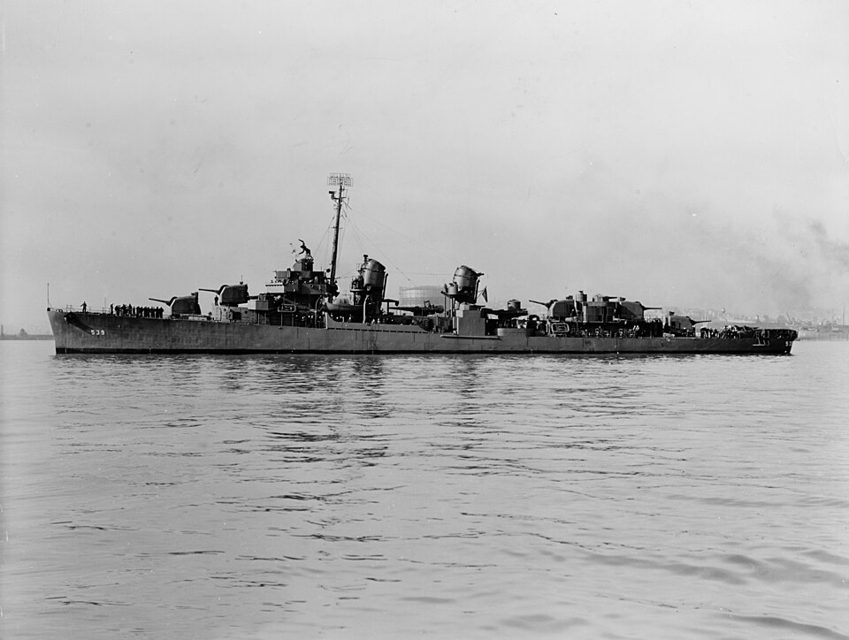
USS Tingey (DD-539) was a Fletcher-class destroyer. She was launched on 28 May 1943 and commissioned on 25 November 1943, with John Odgers Miner in command from that day.
Workups along the west coast ended on 2 February 1944, when she sailed from San Francisco for the Pacific. February and March went to drills out of Pearl Harbor. Early in April she guarded a convoy bound for the Marshalls. On 13 April she left Majuro to join Rear Admiral Marc A. Mitscher and the fast carriers, then designated Task Force 58. Later that month, while the carriers struck Eton and Dublon in the Truk Islands, Japanese aircraft engaged the formation and Tingey took casualties. She stayed in the screen of Battleship Division 7. On 29 April she kept station as a cruiser unit shelled Satawan Island. On 1 May she joined the shelling of Tumu Point, meant to deny that place to Japanese submarines and aircraft.
On 15 May she left Majuro with Rear Admiral Alfred E. Montgomery’s carrier group, bound for Marcus and Wake. Early in June she steamed with Task Force 58 toward the Philippine Sea and, over the following week, worked near Saipan and Tinian in the Battle of the Philippine Sea. Planes from the group hit Guam and Rota again and again and broke the massed air attacks Admiral Jisaburo Ozawa launched on 19 June, the action later called the Great Marianas Turkey Shoot. The same month brought strikes on Pagan Island. On the last day of June she sailed from Eniwetok with Rear Admiral Ralph E. Davison’s carrier group for raids in the Bonins, then returned to the Fifth Fleet off Saipan to cover the Marianas invasion. On 21 July the carriers flew ten missions while troops went ashore on Guam. After topping off at Saipan she moved to the northern Palaus for sweeps and strikes, then screened Rear Admiral Gerald F. Bogan’s carriers as they attacked concentrations on Guam. Upkeep and inspection at Eniwetok followed, and she put to sea again late in August.
In the first two weeks of September she covered carrier raids on Leyte, Bulan, and Samar, then went on to Luzon. Off the Philippines she met enemy aircraft at night while the carriers struck targets ashore. After taking on fuel and stores at Tanapag Harbor she shifted to Ulithi and ran antisubmarine patrols. October found her still with Mitscher’s fast carrier force. On 17 and 18 October she covered attacks aimed at Visayan Island, and on the 24th carrier planes went into the Battle of the Sibuyan Sea. On the night of 25/26 October, while the ships lay off San Bernardino Strait, she joined the group’s battleships and cruisers in sinking the Japanese destroyer Nowaki. Nowaki had lagged behind Admiral Takeo Kurita’s Center Force as that force drew away from the Battle off Samar. Tingey next turned north for attacks in Manila Bay, then in the first week of November came back against Luzon and Bicol.
She left Ulithi on 14 November and headed for the Philippines. On 18 December a typhoon caught the force and took three destroyers. The search that followed recovered no survivors. Heavy weather and rough seas caused the carriers to cancel planned blows at Luzon and return to Ulithi. On 30 December 1944 the group struck Formosa and Luzon. In January 1945 Tingey entered the South China Sea for attacks on French Indochina and Hong Kong, then went back to Ulithi.
February brought Operation Jamboree, the carrier raids on Tokyo Bay, and enemy air attacks while she screened ships during the Iwo Jima landings. In March she accompanied carriers striking Kyushu and Okinawa. On the 19th, enemy aircraft bombed USS Franklin (CV-13), leaving the carrier on fire and heavily damaged. Tingey took survivors aboard and escorted her to Ulithi. Through April and May, air attacks came often as Tingey screened carriers flying close support for troops on Okinawa. She was credited with three assists, brought down one Japanese raider, and recovered aircrew from USS Essex (CV-9) and USS Bunker Hill (CV-17). Those attacks continued off Okinawa through May. On 13 May she made a short run north to Kyushu for another round of strikes. Most of June she spent in upkeep in the Philippines, then crossed to San Francisco. On 9 July she arrived at Mare Island Naval Shipyard and remained until the war ended. She was decommissioned in March 1946.
The Korean War brought her back into commission on 27 January 1951. About two months of duty out of San Diego followed. After a short stay at Pearl Harbor in May she steamed for Korea by way of Sasebo and Yokosuka. F9F-2B jets flew over her off Korea that year. Between August and December 1951 she operated off Wonsan on the east coast, giving gunfire support to United Nations troops, patrolling for mines, and bombarding the shore near Hungnam. Many targets ashore were destroyed. In December she covered commando raids by Republic of Korea forces, then sailed for Yokosuka on 4 December.
The first half of 1952 she spent at San Diego. On 11 July she sailed, calling at Midway and Pearl Harbor, and set out again for Korea. On 13 August she was back on the east coast, firing for Republic of Korea troops, searching for submarines, and running night patrols from Nan Do across to the peninsula. Over that half-year cruise she carried out fire missions against troops, rail lines, and enemy batteries and mortar pits. She left Korea on 26 January 1953 and entered San Diego on 16 February. In mid-August she deployed once more to the western Pacific, reached Korean waters on 10 November 1953, and operated from Sasebo. She had survived the war. In May 1966 the ship was sunk as a target.