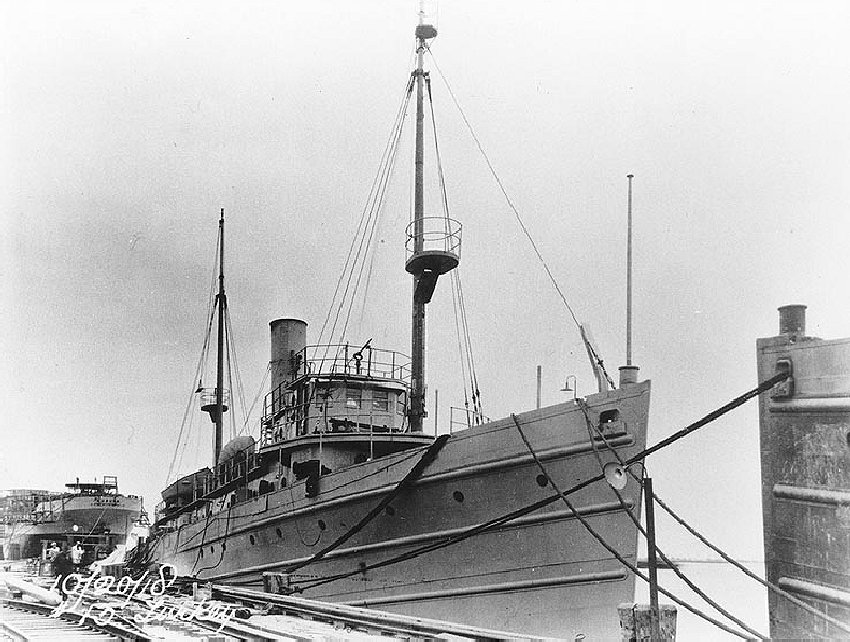
Turkey, Minesweeper No. 13, was a Lapwing-class minesweeper, the first Navy ship of the name. DANFS gives her 840 tons, a length of 187 feet 10 inches, a beam of 35 feet 5 inches, a draft of 8 feet 10 inches, 14 knots, a complement of 85, and two 3-inch guns. The Chester Shipbuilding Company at Chester, Pennsylvania, laid her down on 19 August 1917. She was launched on 30 April 1918, sponsored by Mrs. W. T. Smith, and commissioned on 13 December 1918 with Lieutenant John H. McDonald in command. She was finished too late for the fighting of the First World War.
She went to the North Sea to help clear the mine barrage the Allies had laid between the Orkneys and Norway. She reached Kirkwall on 20 April 1919. On the second sweeping operation, which ran from 8 to 29 May, a mine exploded directly beneath her on 16 May. She crept to Lyeness, at Scapa Flow, and was drydocked. She was repaired in time for the fifth operation, which began on 22 July. Eight days later a condenser failed. A unit taken from the disabled Pelican, Minesweeper No. 27, put her back to work in mid-August. She fouled another mine in her sweep gear. It exploded close aboard and did minor damage, which she repaired at sea. By the 16th her group had swept 1,373 mines. Weather slowed the clearing of group 13, begun on 5 September. Oriole, Minesweeper No. 7, had a mine explode in a kite. Swan, Minesweeper No. 34, came alongside Turkey for more sweep wire, and the sea slammed the two ships together. Swan had to go in for repairs. The barrage was finished in November 1919. On 25 November Turkey and 34 sister ships were detached. She fueled at Brest, then exhausted her fuel in heavy weather off the Azores. The destroyer tender Panther towed her to Bermuda. She then operated out of New York in the 3d Naval District.
DANFS says that on 17 July 1920 she was designated AM-17. NavSource says she was designated AM-13 on 17 February 1920. The Navy's list of ships present at Pearl Harbor on 7 December 1941 carries her as AM-13, and that is the hull used for her. In 1921 she joined the Pacific Fleet Train at Pearl Harbor, in Mine Divisions 4 and 6, and was decommissioned there on 12 April 1922. She came back to the west coast in September 1937, was fitted out at the Mare Island Navy Yard, and was recommissioned there on 15 August 1938. She operated from San Pedro through 1939. As the fleet moved to Pearl Harbor in late 1939 and early 1940, she followed, and she was still there in 1941. Lieutenant Commander Thompson Fletcher Fowler, Naval Academy class of 1925, had her from 30 June 1941.
On 7 December 1941 she was at the Coal Docks in a nest of minesweepers. Fowler's report of 17 December, written at Pearl Harbor to the Commander-in-Chief, Pacific Fleet, says the commanding officer was not on board when the attack opened. Ensign R. J. Melchor, USNR, was the duty officer. Fowler describes him as duty officer and, for that morning, the officer in charge until the executive officer arrived. Boatswain J. Eikam, USN, the executive officer, saw diving planes about 0750 and reached the ship about twenty minutes later. He found general quarters already set, the ship preparing to get underway, and the guns already firing. Melchor's deck log puts an explosion and diving planes at about 0753. The guns were manned at 0755 and opened on low-flying dive bombers from the southwest, a flight he estimated at about eighteen. About five minutes later a second flight of about eighteen passed overhead, out of the guns' bearing, toward the Navy Yard, and about nine torpedo planes followed the channel over Hospital Point toward the yard. About 0820 a formation he estimated at about twenty-five heavy bombers, at about 12,000 feet, came from the west, and about seven bombs fell in the West Loch area. About 0820 the outboard ship cleared the nest. Turkey got underway and anchored in the stream. Fowler came aboard after she had backed clear. The ship was never under attack. Shrapnel and spent machine-gun bullets fell on and near her. She had no casualties and no material damage. She fired 37 rounds of 3-inch/50 antiaircraft and about 2,350 rounds of .30 caliber. One plane, fired at only by the four minesweepers, was seen to smoke, lose altitude, and pass out of sight. Fowler wrote that it was believed the plane was destroyed, and that no claim could be made by any one vessel because all of them were firing.
DANFS, which does not name the ensign, says a Naval Reserve ensign of six months' sea duty led the defense until the commanding officer returned, that two Lewis guns on the pilot house and Springfield rifles were used as well as the 3-inch battery, and that she backed clear twenty minutes after the raid began. After the planes left, DANFS says she and her sisters worked on the salvage of the battleships off Ford Island until 1 April 1942, when she left for Samoa. She relieved Kingfisher (AM-25) as station ship, swept, escorted locally, towed targets for Marine shore batteries, and supported Marine raider landing exercises. On 1 June 1942 she was reclassified as an ocean-going tug, AT-143. On 14 April 1943 she visited Bowditch Island and found two castaways who had been there nearly a month and had been treated well. After repairs from 21 to 30 April she was station ship at Tutuila. She was at Pearl Harbor in June, had a major overhaul at Mare Island, and was back at Pearl Harbor on 20 October. Through January 1944 she towed targets and recovered practice torpedoes with Service Squadron 6, then was under repair at Pearl Harbor from 1 March to 24 April.
On 10 May 1944 she left for the Marshalls with Preserver (ARS-8), towing YOGL-7 and YW-68, and reached Majuro on 25 May. She then took YF-412 and YF-383 to Kwajalein with ATR-46, arriving on 1 June, and returned to Majuro. On 15 May 1944 she had been reclassified as an old ocean tug, ATO-143. On 4 June she replenished ammunition for Santa Fe (CL-60), Biloxi (CL-80), and Mobile (CL-63). Through the summer she towed barges among Majuro, Kwajalein, and Eniwetok. DANFS spells that atoll Kniwetok. She had an overhaul alongside Ajax (AR-6) at Majuro from 29 August to 2 September and reached Ulithi on 5 October. On 17 October she went to Ngulu to help Montgomery (DD-121), mined that day, and was back at Ulithi on the 23d. On 27 October she helped the torpedo-damaged Houston (CL-81) into the harbor. Houston had been hit off Formosa by an aircraft-launched torpedo. While Turkey was towing YOG-21 alongside Essex (CV-9), her foremast caught a flight-deck radio antenna brace and broke in three places. On 21 November she helped fight the fire on Mississinewa (AO-59), which a manned torpedo had struck. The oiler rolled over and sank about three hours later. DANFS calls her the war's first victim of the kaiten.
She had a short overhaul at Ulithi in December 1944, fueled carriers there in January 1945 except for a drydocking from 9 to 13 January, and in early February helped the preparations for the Iwo Jima landings. DANFS spells the island Iwp Jima. She went by Kossol Roads, in the Palaus, to San Pedro Bay, Leyte, then did harbor work at Ulithi from March through May. On 7 May she sailed for Leyte as retriever for a tow convoy and reached San Pedro Bay on 13 May. From 7 June she had ten days of upkeep alongside Prometheus (AR-3). She ran between Leyte and Ulithi through mid-August, stopped at Kwajalein on the 24th, left for Hawaii on 30 August, reached Pearl Harbor on 11 September, and went on to San Francisco. She was decommissioned on 6 November 1945, struck on 28 November 1945, and sold and delivered to the Hawley Forge and Manufacturing Company of San Francisco on 30 December 1946. She received one battle star.
A note on sources. The career follows the Dictionary of American Naval Fighting Ships entry for Turkey I, and the 7 December account follows the ship's action report of 17 December 1941, with enclosures by Ensign R. J. Melchor and Boatswain J. Eikam, signed by T. F. Fowler. The report is the Navy's published copy of the original in the Modern Military Branch at the National Archives in College Park. The hull AM-13 is NavSource's designation date of 17 February 1920 and the Navy list of ships present. DANFS prints AM-17 and the date 17 July 1920. DANFS does not give the ammunition count, the West Loch bombs, or Fowler's refusal of a single-ship claim for the smoking plane. The report does not mention Lewis guns or Springfield rifles, which are in DANFS. The other minesweepers' reports describe the nest and the times in their own words, and those accounts are not folded into this one. Commanding officers and their dates are NavSource's list.