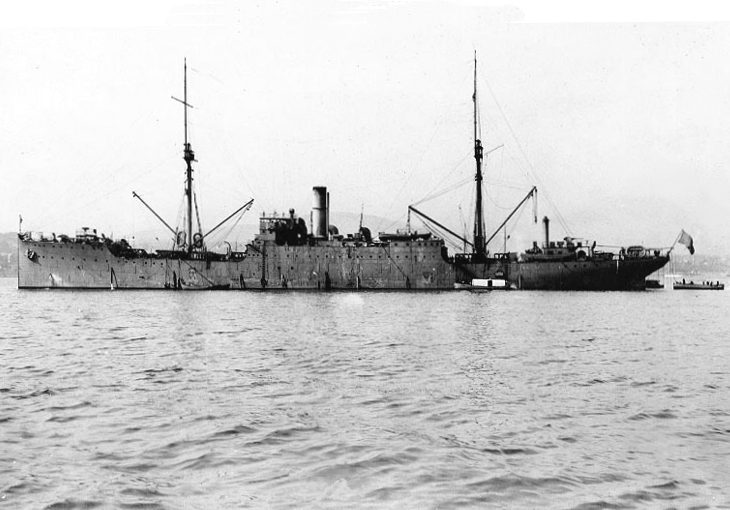
Vestal began as a collier. Her construction was authorized on 17 April 1904 under the name Erie, Fleet Collier No. 1, and she was renamed Vestal in October 1905, well before the New York Navy Yard at Brooklyn laid her keel on 25 March 1907. She was launched on 19 May 1908 and placed in service at her builders' yard on 4 October 1909 with a civilian crew of the Naval Auxiliary Service. The Dictionary of American Naval Fighting Ships gives her a displacement of 12,585 tons, a length of 465 feet 9 inches, a beam of 60 feet 1 inch, a mean draft of 26 feet, and a speed of 16 knots. As a collier she coaled the fleet along the Atlantic coast and in the West Indies, and made one voyage to Europe to coal Atlantic Fleet ships in those waters. She was taken out of service at the Boston Navy Yard on 25 October 1912.
Boston converted her into a fleet repair ship, a floating set of shops that could mend other vessels away from a navy yard. She was commissioned there on 3 September 1913, Commander Edward L. Beach in command. She left the yard on 26 October, shook down off Hampton Roads from 29 October to 10 November, coaled at Key West on 14 November, and went on to Pensacola, her base as repair ship for the Atlantic Fleet. In the spring of 1914 she joined the fleet at Vera Cruz after the American occupation of the port in April, and she gave repair services there from 2 May to 20 September. She then escorted the cruiser Salem to Boston, operated off the Virginia capes and at Guantanamo Bay, and returned to Boston on 10 June 1915. She rejoined the fleet at Narragansett Bay on 19 May 1916.
After the United States entered the First World War in 1917 she crossed to British waters. Through the rest of the war and into 1919 she repaired and overhauled the ships of the American destroyer flotilla based at Queenstown, on the south coast of Ireland. Home again in 1919, she served the Scouting Force and the Battle Fleet. In the Navy-wide assignment of hull numbers on 17 July 1920 she became AR-4. In 1925 a major overhaul converted her from coal to oil.
That same year she took part in the salvage of the submarine S-51, rammed and sunk by the steamer City of Rome on 25 September 1925. Vestal worked on the wreck from October to early December 1925 and again from 27 April to 5 July 1926, and in that second period the submarine was raised. She joined the Pacific Fleet in 1927 and went through the yearly fleet problems. When the fleet stayed in Hawaiian waters after Fleet Problem XXI in the spring of 1940, she was based at Pearl Harbor. After an overhaul at Mare Island she came back to Pearl Harbor. Commander Cassin Young took command on 10 October 1941.
On 6 December 1941 she moored alongside Arizona at berth F-7 off Ford Island, to give the battleship her scheduled tender upkeep from 6 to 12 December. At 0755 on the 7th Vestal went to general quarters, manning every gun from the 5-inch broadside battery to the .30-caliber Lewis guns on the bridge wings. Her 3-inch gun opened fire at about 0805. At about the same time two bombs, probably meant for the battleship inboard, hit her. One struck the port side, went down through three decks and a crew's space, and exploded in a stores hold. The fires it started forced the flooding of the forward magazines. The other hit the starboard side, passed through the carpenter shop and the shipfitter shop, and left a ragged hole about five feet across in her bottom. The 3-inch gun jammed after three rounds.
At about 0820 Arizona blew up. A torpedo had passed under Vestal's stern into the battleship, and a bomb set off her forward magazines. The blast cleared Vestal's deck and threw men overboard, Young among them. He swam back, countermanded an order to abandon ship that someone had given, and ordered her underway. The engineer officer had already anticipated the order and had steam coming up. Burning oil from Arizona set fires aft and amidships. At 0845 men forward cut the mooring lines. Steering by her engines alone, she got clear with the help of a tug, which the Naval History and Heritage Command identifies as Hoga, pulling her bow away from the fire. She was listing to starboard and taking water aft.
At 0910 she anchored in 35 feet of water off McGrew's Point. With the draft aft at 27 feet and the list at six and a half degrees, Young changed his mind. "Because of the unstable condition of the ship," he wrote in his report, "(the) ship being on fire in several places and the possibility of further attacks, it was decided to ground the ship." She got underway at 0950 and grounded on Aiea Shoal. NavSource records her losses that day as nine killed, seven missing and nineteen wounded. Young received the Medal of Honor. In his report he wrote that the conduct of all officers and enlisted men "was exemplary and of such high order that I would especially desire to have them with me in the future engagements."
Damaged as she was, she sent repair parties to the overturned Oklahoma, where welders cut into the hull to free men trapped inside. Yard help was scarce, so her own crew went to work on her. Within a week they had pumped out the oil and water below the waterline and cleared the gutted holds, the work that had to come before any rebuilding. Young left her on 19 January 1942. Commander Watson T. Singer relieved him.
After repairs and alterations, she was ordered on 12 August 1942 to the South Pacific and reached Tongatabu, in the Tonga Islands, on the 29th, three weeks after the Guadalcanal landings. In 60 days there she completed 963 jobs for some 58 ships and four shore activities. South Dakota came in after grounding on an uncharted reef on 6 September. Six of Vestal's divers worked from 1600 that day to 0200 on the 7th and found splits along some 150 feet of her bottom. By the morning of the 8th the repair ship's men and the battleship's crew had patched her well enough to go home. When Saratoga came in after the torpedo hit of 31 August, Vestal's divers and the tug Navajo braced the hole, the flooded fireroom was pumped out, and tons of cement went into the breach. Within 12 days of her arrival the carrier left for the United States. North Carolina, torpedoed on 15 September, was also among her jobs.
She sailed on 26 October for the New Hebrides, was diverted, and reached Noumea on 31 October, just after the Battle of the Santa Cruz Islands. A bomb had buckled a 30-by-60-foot section of Enterprise's flight deck aft and flooded the after elevator machinery room. The carrier was ordered to sea before the work was done and took two Vestal officers and a large repair party with her. They worked until two hours before she went into action again, and they were included in the Presidential Unit Citation to the Enterprise. South Dakota had taken a bomb on a 16-inch turret and collided with the destroyer Mahan, which holed her starboard side and left an anchor in her wardroom. Vestal's men listed her to patch the hole at the waterline, took out the anchor, and repaired the shrapnel damage, sprung hatches and fire mains. She was back in action in five days. At Noumea Vestal completed 158 jobs on 21 ships.
She left Noumea on 13 November, reached Espiritu Santo three days later, and stayed a year. In those twelve months she did some 5,603 jobs on 279 ships and 24 shore activities. The ships included San Francisco, ripped up in the night battle off Savo Island on 13 November 1942; New Orleans; Pensacola, with a torpedo hole 24 by 40 feet, a flooded after engine room and two broken propeller shafts; HMAS Achilles; the cargo ship Alchiba; St. Louis; HMAS Hobart; the transport Zeilin; Tappahannock; HMNZS Leander; and twelve LSTs. Pensacola's stern, after Tassafaronga, was held on by a few frames, some plating and one shaft. "Never had an AR (repair ship) been presented with such a task," her commanding officer recalled. The hole was plugged and braced, three propellers of about seven tons each were pulled to cut the drag, one with a dynamite charge and one by burning through its shaft, and the cruiser went to a navy yard. Minneapolis, torpedoed with 75 feet of her bow gone, followed. Vestal herself had repairs only once in that year, from 27 May to 2 June 1943.
She left Espiritu Santo on 18 November 1943 and reached Funafuti, in the Ellice Islands, on the 22nd. There she did some 604 major jobs for 77 ships and eight shore activities, the largest on the light carrier Independence. Sailing for Makin on 30 January 1944, she was diverted to the Marshalls and reached Majuro on 3 February. Washington was there with heavy collision damage forward. The estimate was 30 days. Working round the clock, Vestal finished in ten, and the battleship went to Pearl Harbor for permanent repairs.
Vestal then needed work herself, new evaporators above all. She went by way of Pearl Harbor to Mare Island, where she was overhauled, altered and repainted, and she left on 8 September 1944 for the Carolines. At Eniwetok she took in tow a cement barge, Chromite, and the ammunition barge YF-254. She reached Ulithi on 15 October 1944. There she completed 2,195 jobs for 149 ships, among them 14 battleships, nine carriers, five cruisers, five destroyers and 35 tankers. Her largest job was the light cruiser Reno, torpedoed by the submarine I-41 on the night of 3 November.
She sailed for the Marianas on 25 February 1945 and reached Saipan two days later. For more than two months she worked mainly on the amphibious craft used at Iwo Jima. She arrived at Kerama Retto, off the southwest tip of Okinawa, on 1 May. That month she went to general quarters 59 times for suicide attacks. The best defense was a smoke and fog screen made by all the ships together. Vestal had two boats fitted with fog generators, and smoke pots were thrown over her bow. Sentries watched for swimmers carrying charges. Her main work there was destroyers, including the kamikaze-damaged Newcomb and Evans. On 23 June she shifted to Nakagusuku Wan, later Buckner Bay, and stayed there through the end of the war. She had sortied from the bay to evade typhoons on 19 July and 1 August.
Typhoons were the danger after the surrender. She sortied again on 16 September and rode out 68-knot winds. On the 28th, under Captain Harold J. Pohl, she led two merchant ships out, took over a four-ship convoy, and brought all seven back to Buckner Bay on the third day. On 7 October she cleared the harbor entrance at 1600 ahead of a great storm, with Beaver and three merchantmen in company, and steered evasive courses through seas reported as high as 40 feet while the typhoon struck Okinawa on 9 October. At 1405 on the 10th, heading back, her lookouts saw life rafts. They held survivors of LSM-15, which had gone down in the night. Vestal put about, made a lee, and lowered a motor whaleboat, which took 17 men off the first raft. Fifteen more climbed her nets, two officers and 30 men in all. She entered Buckner Bay at dusk and went back to repairing the fleet.
She then supported the occupation of China and Japan and returned to the United States. Her disposal was put off so she could do decommissioning work on ships sent to the Thirteenth Naval District. She was decommissioned at the Puget Sound Naval Shipyard on 14 August 1946 and struck from the Navy list on 25 September 1946. Stripping began on 20 May 1949. Her hulk was sold on 28 July 1950 to the Boston Metals Company of Baltimore and scrapped. She received two battle stars for her service in the Second World War.
A note on sources. The career, the figures, the 7 December times and the quotations from Young's report and from later commanding officers follow the Dictionary of American Naval Fighting Ships entry for Vestal. DANFS places Queenstown in Northern Ireland; Queenstown, now Cobh, is in County Cork, and it is given that way here. The tug that helped her clear Arizona is named as Hoga by the Naval History and Heritage Command's page for Vestal's bell; DANFS says only "a tug." The casualty figures, the commanding officers and their dates are NavSource's. DANFS does not give the date of the move from Saipan or name the typhoon of 9 October. The name of the officer who gave the abandon-ship order is not recorded in the sources used.