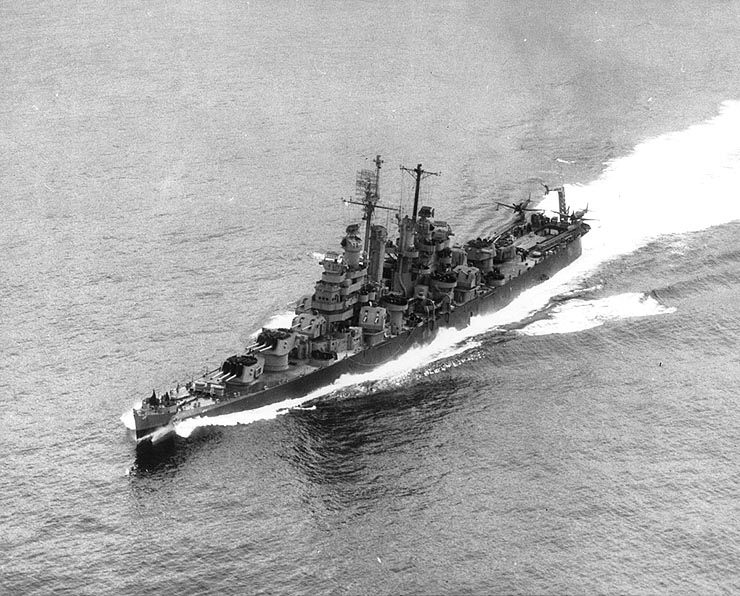
Vincennes (CL-64) was a Cleveland-class light cruiser, the third Navy ship named for the city in Knox County, Indiana, and the ship that carried on the name of the heavy cruiser Vincennes (CA-44), lost at the Battle of Savo Island in August 1942. She was laid down as Flint (CL-64) on 7 March 1942 at Quincy, Massachusetts, by the Bethlehem Shipbuilding Company's Fore River plant, and renamed on 16 October 1942. She was launched on 17 July 1943, sponsored by Mrs. Arthur A. Osborn, the former Miss Harriet V. Kimmell, who had sponsored the first cruiser of the name. The Navy commissioned Vincennes (CL-64) on 21 January 1944. NavSource lists Captain Allen Dudley Brown in command from that day and ends his command in 1944 without a month or day. The hull line gives 10,000 tons, a length of 610 feet 1 inch, a beam of 66 feet 6 inches, a draft of 20 feet, 33 knots, a complement of 992, twelve 6-inch guns, twelve 5-inch guns, twenty-four 40-millimeter guns, twenty-one 20-millimeter guns, and four aircraft.
She fitted out at the builders' yard into late February. From 25 February to the last day of March 1944, Vincennes (CL-64) shook down in the British West Indies, principally in the Gulf of Paria near Trinidad, with brief stopovers in the Chesapeake. After post-shakedown repairs she became flagship of Cruiser Division 14. Rear Admiral Wilder D. Baker embarked on 14 April with his staff. The other ships of the division were Miami (CL-89) and Houston (CL-81). She left Boston on 16 April, transited the Panama Canal, and reached Pearl Harbor on 6 May. During the training that followed, Admiral Chester W. Nimitz came aboard Vincennes (CL-64) and presented Baker a Navy Cross earned for directing bombardment in the Aleutians.
Vincennes (CL-64) left Pearl Harbor on 24 May 1944 and reached Majuro six days later. A week after that she sailed with Task Force 58 under Vice Admiral Marc A. Mitscher. On 10 June, screening the first strikes on the Bonins, she shot down a Mitsubishi G4M Type 1 land-attack plane, a Betty. She supported carrier strikes on Saipan and Pagan on 12 and 13 June, and on the 16th she was with the group that made the first air strikes on Iwo Jima. In the Battle of the Philippine Sea her gunners helped the barrage that broke up several persistent attacks.
On 23 June 1944 Baker shifted his flag to Miami. Vincennes (CL-64) went to Eniwetok for engineering repairs, anchored on the 27th, and finished the work by the end of the month. Baker broke his flag in her again on 7 July. She left Eniwetok on 14 July with Task Force 58. Carrier planes struck Guam from 18 to 21 July and Tinian, Rota, and Guam through the 27th. She anchored at Saipan on the last day of July, left on 1 August for a high-speed run to the Bonins, covered strikes on the 4th and the 5th, and anchored at Eniwetok on the 11th. Rear Admiral Francis E. M. Whiting relieved Baker eight days later and broke his flag at the main.
Assigned next to Task Force 34, Vincennes (CL-64) left Eniwetok at the end of August, exercised, and joined Task Group 38.2 on 3 September. The group struck the Palaus on 6 September. On the 7th, in Task Unit 38.2.5 under Whiting, she took part in the first shore bombardment of Japanese installations on Ngesebus, Peleliu, and Angaur. Her captain recorded that the coverage was excellent. She left the Palaus on 8 September. Carrier planes hit Mindanao on 9 and 10 September. She screened strikes on Negros, Leyte, Cebu, and Bohol from 12 to 14 September, on Luzon on 21 and 22 September, and then on Leyte, Cebu, and Negros again. She reached Ulithi on 1 October, sortied on the 3rd to evade a typhoon, returned on the 5th, and weighed on the 6th with Task Force 38.
Vincennes (CL-64) was off Okinawa on 10 October 1944 for the first carrier strikes there. Fighters on combat air patrol knocked down aircraft that closed the force, among them a Betty and a Yokosuka P1Y Frances. During fueling the next day she watched a Betty shot down within sight of the ship. The carriers then struck Formosa, beginning on 12 October. She went to general quarters at 1855 and stayed at battle stations almost continuously for two days. Planes were flamed at 1903 and at 1910, and at 2340 she splashed another off her starboard quarter. The light cruiser Houston (CL-81) and the heavy cruiser Canberra (CA-70) were torpedoed and limped out of the battle zone. Admiral Halsey deployed Task Group 38.2 under Rear Admiral Gerald F. Bogan and Task Group 38.3 under Rear Admiral Frederick C. Sherman to protect them. A wag on the small carrier Cabot (CVL-28) called the cripples streamlined bait. Vincennes (CL-64) screened Houston (CL-81) and Canberra during the withdrawal.
She went on screening off the Visayas. At 0325 on 24 October, Vincennes (CL-64) received a report of four battleships, eight heavy cruisers, and thirteen destroyers seven miles south of Buruncan Point, Mindanao. Enemy planes attacked, and the ships maneuvered to avoid torpedoes. A Kawanishi H8K Emily, detected early that day, was shot down by friendly fighters. At 0230 on 25 October two enemy task groups were reported about 85 miles to the north. At 0300 she headed north with her consorts. At 0733 a search plane reported many enemy surface ships about 120 miles north, headed south at 20 knots. Aircraft from the fast carriers struck them and inflicted heavy losses. She then turned south toward San Bernardino Strait, looking for ships expected to retire through the strait. At 0026 radar showed a surface contact at 21,000 yards. Vincennes (CL-64), Miami, and Biloxi (CL-80), escorted by Destroyer Division 103, broke off to attack. At 0054 the 6-inch and 5-inch batteries opened, together with the destroyers' 5-inch guns. The vessel, tentatively identified as a cruiser, sank at 0149.
Vincennes (CL-64) was back off the Visayas on 28 October and off Luzon the next day. Combat air patrol shot down eight Japanese planes during the raids on the 29th. She screened carrier strikes on Luzon on 5 and 6 November, reached Ulithi on 9 November, and stood out five days later. Hancock (CV-19), Intrepid (CV-11), and Cabot were hit by kamikazes. She blasted a second kamikaze heading for Cabot. After another replenishment at Ulithi she supported strikes on Luzon from 14 to 16 December. Lieutenant Halbert K. Evans, her senior aviator, led a rescue by cruiser floatplanes and later received the Air Medal. A typhoon on 18 December brought gusts to 78 knots. She weathered it without serious damage and then searched for survivors of Spence (DD-512), Monaghan (DD-354), and Hull (DD-350), which had capsized. She lay at Ulithi from 24 to 30 December.
She returned to the waters off Formosa and entered the South China Sea early in January 1945. Night fighters shot down two planes early on 10 January. The task group with Vincennes (CL-64) struck shipping east of Cam Ranh Bay, then targets west of Formosa and on the China coast. On 21 January a plane pushed over into a steep dive shortly after noon. She opened fire. At 1209 the kamikaze hit Ticonderoga (CV-14). At 1246 she fired on aircraft nearby, and three minutes later she and Miami blasted a kamikaze into the sea. A second suicider hit Ticonderoga at 1255.
After supporting strikes on Okinawa, Vincennes (CL-64) reached Ulithi on 26 January 1945. NavSource lists Captain William George Lalor from 27 January and gives no relief date. She left the Carolines on 10 February and joined Task Group 58.1 that evening. During gunnery exercises a radio-controlled target drone crashed into the splinter shield of a 40-millimeter mount and burst into flame. CBM Mack C. Miller, USN, GM3c Carl C. Miller, USNR, GM3c Buck E. Goebel, USNR, and Sea1c Paul G. Catarius, USNR, threw smoldering debris and overheated ammunition over the side. Each later received a commendation ribbon. Southeast of Honshu the carriers struck Tokyo on 16 February and again the next day, hit airfields on Chichi Jima, and struck Tokyo on 25 February. Four days later the planes went to Okinawa. On 1 March, Vincennes (CL-64), Miami, San Diego (CL-53), and Destroyer Squadron 61, with Whiting embarked as unit commander, shelled Okino Daito Shima and started large fires ashore. Whiting received the Bronze Star.
The next fortnight was mostly training and replenishment. On 11 March kamikazes struck Ulithi. One Frances crashed into Randolph (CV-15), three miles from Vincennes (CL-64), and another crashed ashore on Sorlen Island. Within a week she was with Task Group 58.1 headed for Kyushu. At 0506 on 18 March gunfire hit a twin-engine bomber that passed over at 300 feet. Another plane crashed into the sea 3,000 yards astern twenty minutes later. At 0601 her gunners splashed a plane close to Wasp (CV-18). Firing continued through 18 and 19 March. First Lieutenant Henry M. Lamberton, USMCR, the antiaircraft fire-control officer, received the Bronze Star. She operated east of Okinawa from 23 through 25 March while the carriers struck the island, and east and southeast of it through 5 April. On 31 March two of her floatplanes rescued a downed fighter pilot under fire. Evans received the Distinguished Flying Cross. Lieutenant (junior grade) George A. Greenwood, USNR, and the two rear-seat men received Air Medals.
On 1 April 1945, the day of the assault on Okinawa, ships of Task Group 58.1 smashed twelve enemy planes. Vincennes (CL-64) drew three assists. At 1321 an aircraft hit by her gunfire crashed 50 feet astern, the narrowest escape DANFS records for her. For three weeks from 7 April she stayed with groups of Task Force 58 off Okinawa while the carriers hit Okinawa and Kyushu. After replenishment at Ulithi she rejoined Task Group 58.1, screened strikes on Kyushu, and on 17 May reported for shore bombardment with Vicksburg (CL-86). For 27 of the next 30 days she shelled targets ashore by day and by night. The 6-inch guns fired 5,836 rounds and the 5-inch guns 10,583. Spotters credited a large disappearing coastal gun, troop concentrations, direct hits on mortar positions, nine gun emplacements, an ammunition dump, coastal batteries, and the entrances of at least five caves closed. Evans received a gold star in lieu of a second Distinguished Flying Cross, and Greenwood a Distinguished Flying Cross. Each flew ten spotting missions. She fired her final salvoes on 16 June, sailed by way of Pearl Harbor, and reached Mare Island Navy Yard at Vallejo on 8 July. She stayed until the availability ended in late August.
Japan surrendered in mid-August while Vincennes (CL-64) was still in the yard. She shifted to San Diego on 29 August for post-repair shakedown off San Clemente Island, then carried returning sailors and marines in Operation Magic Carpet between Pearl Harbor and the west coast. That autumn she went to the South Pacific and at Noumea became flagship for Rear Admiral Paul Hendren, Commander South Pacific Area Force. On 25 October she took him on an inspection of Guadalcanal, the Russells, Tulagi, Espiritu Santo, and Efate, and returned to Noumea on 5 November. On that voyage she passed near the place where Vincennes (CA-44) had gone down on the night of 8 and 9 August 1942. She made two trips to New Zealand and came home with 300 veterans, discharging them at San Francisco on 23 March 1946. Work at Mare Island then deactivated her. She was decommissioned on 10 September 1946. NavSource lists Commander George Pearsall Rogers with no date he assumed command and records his relief that day. She never returned to active service. Her name was stricken from the Navy List on 1 April 1966, and she was subsequently sunk as a target in missile experiments. She earned six battle stars for her World War II service. She was not sunk in the war.
A note on sources. The narrative follows the Naval History and Heritage Command Dictionary of American Naval Fighting Ships entry for Vincennes III (CL-64), Robert J. Cressman, 9 March 2022, for dates, actions, rounds fired, and awards. Commanding officers and their dates are the NavSource list for CL-64. That list prints Allen Dudley Brown, from 21 January 1944, with the command ended only as 1944. DANFS and the older HyperWar transcription print Capt. Arthur D. Brown at commissioning. Uboat.net dates his temporary captaincy of Vincennes (CL-64) from 21 January 1944 to 27 January 1945, which is the day NavSource starts William George Lalor, and the Hall of Valor Legion of Merit citation covers 19 August 1944 to 27 January 1945. The command lines keep the NavSource dates. The same citation prints his ship as U.S.S. Vincennes (CA-44). The heavy cruiser of that hull was lost in 1942. The citation's dates and the Palau bombardment and night action it describes belong to CL-64. Lalor's list gives a start and no relief. Rogers's list gives an end, 10 September 1946, and no start. The night action after the run north on 25 October is left as DANFS gives it: a vessel tentatively identified as a cruiser, sunk at 0149, with no calendar date printed on that contact. Uboat.net's event for Brown calls the ship the destroyer Nowaki and dates the firing 26 October 1944. HyperWar, an older DANFS transcription, prints the June retaliatory raids and the July Guam strikes as against TF 68 rather than TF 58, puts the 1 April 1945 crash at 60 feet astern rather than 50, adds the bracketed phrase that the target sinking was off Southern California on 28 October 1969, and says she never returned to active service with the Fleet. Those HyperWar additions are not in the current entry and are not used as facts here. Digitized copies of the current entry garble several words. The forms printed there, and the ordinary spellings used above, are secoind, losty, milliumeter, fitted, out, etiring, llth, Rear Adm.l, Novembe 1944r, Ultihi, Distingiushed, and c arrier.