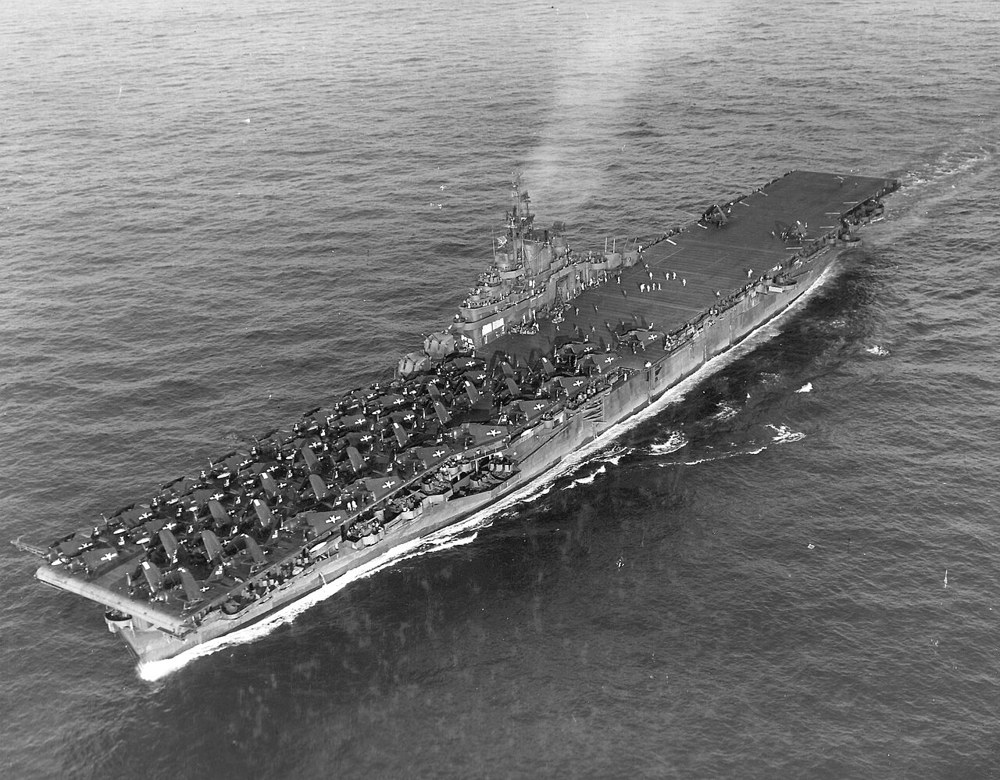
USS Wasp (CV-18) is an Essex-class carrier. She was laid down at Quincy on 18 March 1942 as Oriskany and renamed Wasp on 13 November 1942, after the carrier Wasp (CV-7) had been sunk by I-19 two months earlier. She was launched on 17 August 1943 and commissioned on 24 November 1943 with Captain Clifton A. F. Sprague in command. She is CV-18, not CV-7.
She reached Pearl Harbor on 4 April 1944 and joined Task Force 58 at Majuro. On 19 and 20 May her aircraft struck Marcus Island and on 24 May Wake. In June she supported the Saipan landings. During the Battle of the Philippine Sea on 19 June her fighters met the Japanese raids, and on 20 June her aircraft joined the long-range strike on Ozawa's fleet that sank the carrier Hiyo and two oilers. In September and October she struck the Palaus, the southern Philippines, Okinawa and Formosa. On 25 October, with Task Group 38.1, she turned back toward Samar and launched strikes at Kurita's ships at about 1030, when they were still some 330 miles away.
On 19 March 1945, off Japan, a 500-pound armor-piercing bomb went through her flight deck and hangar deck and exploded in the crew's galley, where men were at breakfast after a night at general quarters. About 100 of her crew were killed. Her air group was flying again 27 minutes later. She returned to Puget Sound for repairs on 13 April, was back with the fast carriers in July and flew her last strikes on Japan in August. A typhoon hit the force on 25 August. She earned eight battle stars.
Her wartime commanding officers, from NavSource: Captain Clifton Albert Frederick Sprague, 24 November 1943 to 22 July 1944; Captain Oscar Arthur Weller, 22 July 1944 to 7 June 1945; Captain Wendell Gray Switzer, 7 June 1945 to 4 March 1946.
Sources: Dictionary of American Naval Fighting Ships (DANFS), Wikipedia, NavSource Online (commanding officers) and Wikimedia Commons (photograph records).