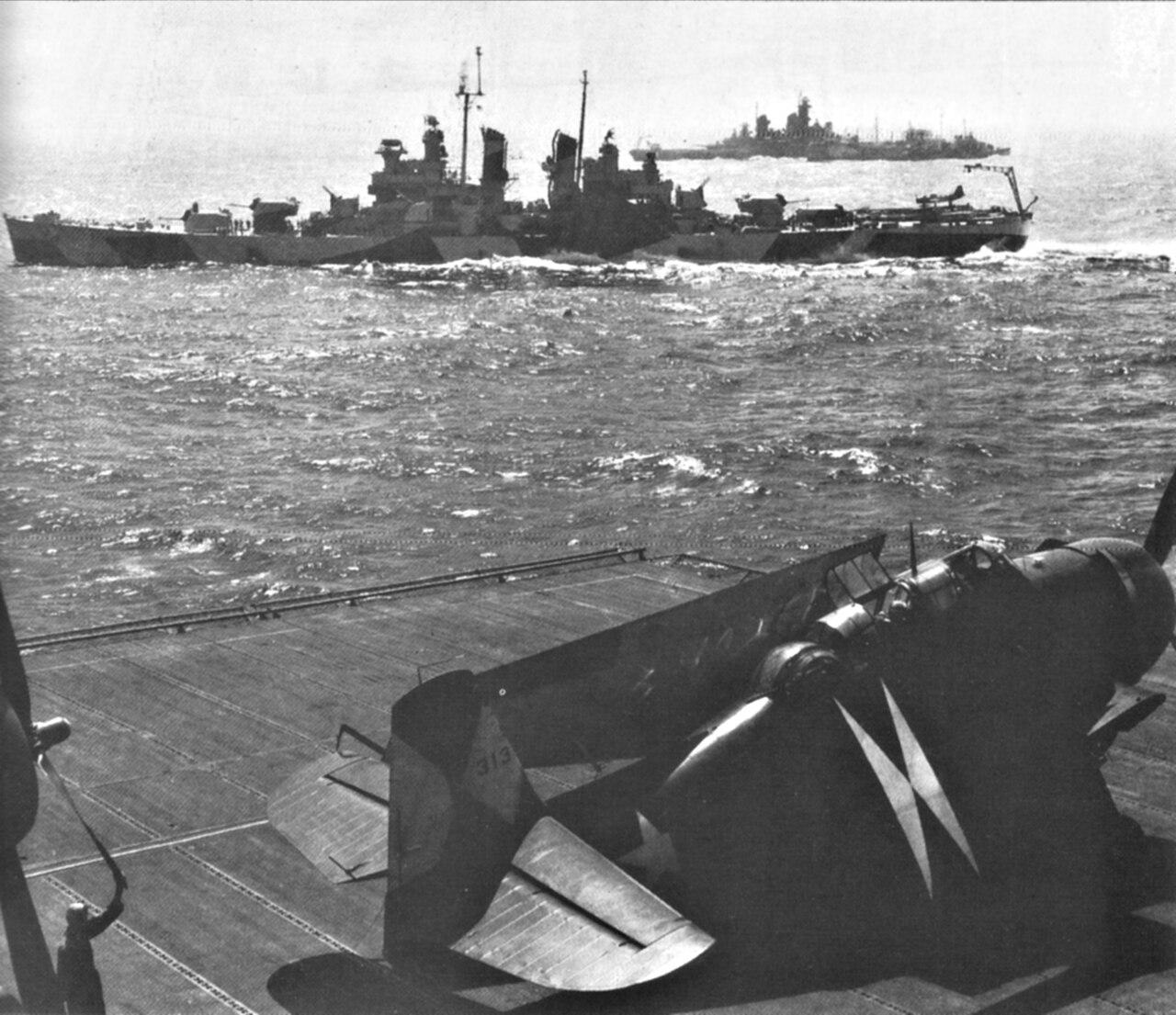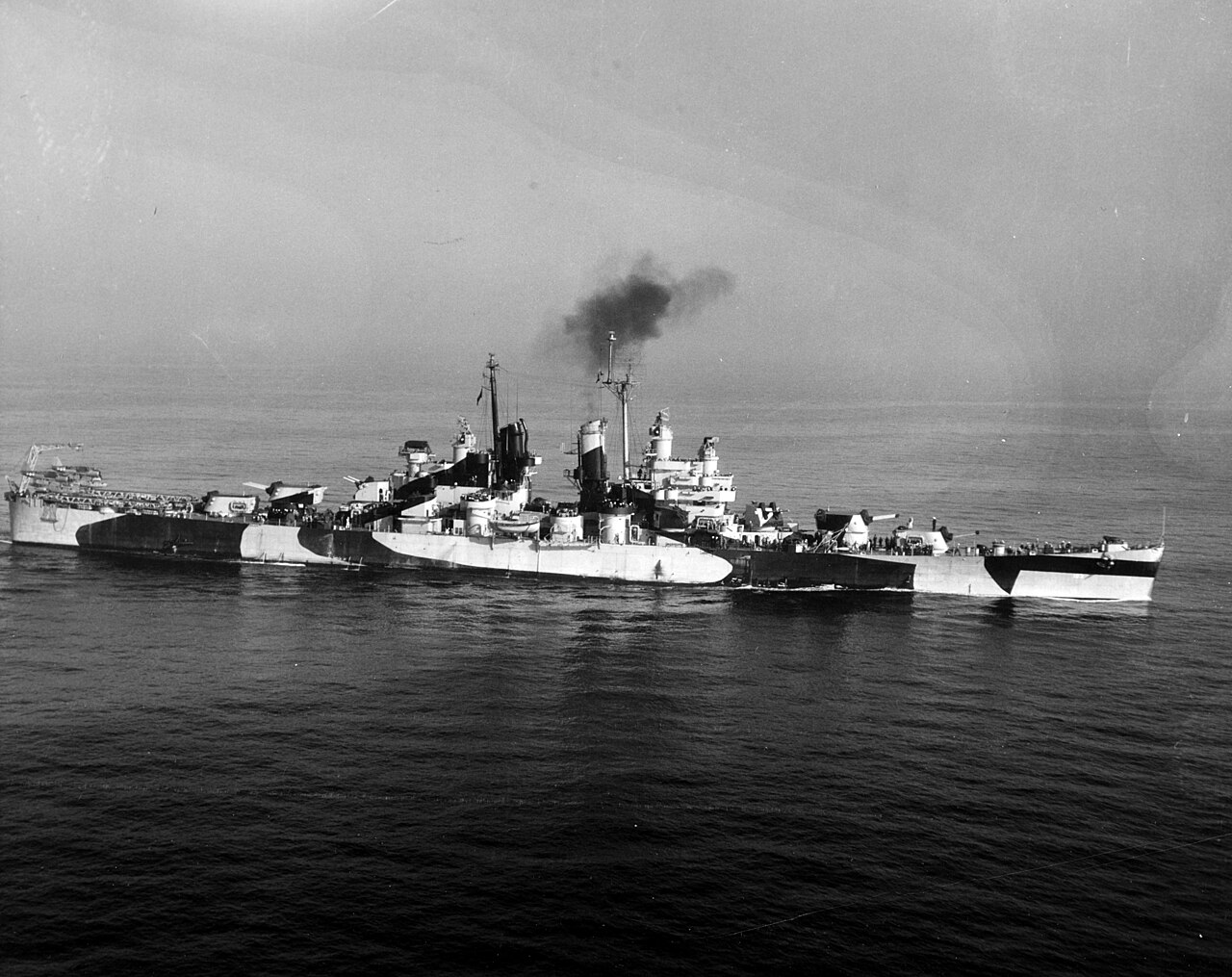
The name had been used once already in this building program. Wilkes-Barre (CL-90), a Cleveland-class light cruiser, was laid down on 6 September 1941 at Philadelphia by the William Cramp Shipbuilding Company, and on 16 October 1942 she was renamed Astoria. The Pennsylvania city then went to a second hull, CL-103. New York Shipbuilding Corporation laid her down at Camden, New Jersey, on 14 December 1942. She was launched on 24 December 1943, sponsored by Mrs. Grace Shoemaker Miner, the wife of a Wilkes-Barre doctor, and commissioned at the Philadelphia Navy Yard on 1 July 1944 with Captain Robert L. Porter, Jr., in command. The DANFS line gives 10,000 tons, a length of 610 feet 1 inch, a beam of 66 feet 6 inches, a mean draft of 20 feet, 33 knots, a complement of 992, twelve 6-inch guns, twelve 5-inch guns, twenty 40 mm guns, and ten 20 mm guns. NavSource dates Porter from 1 July 1944.
After fitting out she shook down in Chesapeake Bay and in the Gulf of Paria, off Trinidad, and returned to Philadelphia. She sailed on 23 October 1944, trained on the way to the Panama Canal, transited on 27 October, loaded at San Diego, fired off San Clemente Island, and left for Hawaii on 10 November. She reached Pearl Harbor on 17 November, exercised there, and on 14 December sailed for the Carolines. At Ulithi she joined Cruiser Division 17 and sortied on 30 December with the support unit for Vice Admiral John S. McCain's Task Force 38.
The carriers hit Formosa, the southern Ryukyus, and then Luzon in support of the landings there. A second Formosa strike followed on 9 January 1945. On the night of 9 and 10 January the force passed the Bashi Channel into the South China Sea. On 12 January, the day Navy aircraft sank 127,000 tons of shipping in the Indochina area, Wilkes-Barre and the rest of Cruiser Division 17 were detached from Task Group 38.2 as Task Group 34.5, sent after warships reported off Camranh Bay. The cruisers' search planes found nothing, and the division rejoined Task Force 38. On 13 and 14 January a tropical disturbance put her over as much as 38 degrees to a side. When the weather opened, the carriers struck Takao, Amoy, and Swatow on 15 January and Hainan, Indochina, and Hong Kong on the 16th. Fueling finished on the 19th. Strikes on Formosa on 21 January cost the force Langley (CVL-27) and Ticonderoga (CV-14) damaged. The next day the planes hit Okinawa. Task Force 38 reached Ulithi on 26 January. There it became Task Force 58 under Vice Admiral Marc A. Mitscher.
She sailed again with Cruiser Division 17 in Rear Admiral Frederick C. Sherman's Task Group 58.3, flag in Essex (CV-9). Off Honshu on 16 February 1945 she screened the carriers while their planes bombed Tokyo, a raid meant to draw attention from the landings then being made on Iwo Jima, and the first carrier bombing of the capital since the Doolittle raid from Hornet (CV-8) in April 1942. After two days the group turned south, striking Chichi Jima and Haha Jima on the way. On 21 February she was called in to bombard Iwo Jima. Spotters in her Kingfishers directed the fire onto gun positions, pillboxes, fortified caves, and ammunition dumps, and one call-fire mission turned back a Japanese counterattack. She rejoined Task Group 58.3 on 23 February, screened strikes on Tokyo on 25 February and on Okinawa on 1 March, and was back in Ulithi from 5 to 14 March.
East of Okinawa on 18 March the carriers struck airfields on Kyushu, and they struck again the next day. The combat air patrol and the screen met the reply. On the 19th she shot down her first aircraft, a Judy dive bomber. The same day two bombs turned Franklin (CV-13) into a burning wreck, and the group retired slowly to cover the damaged ships while Japanese aircraft kept after them. Planes from the group hit Okinawa on 23 and 24 March. On the 24th one of her Kingfishers picked up two pilots from Bataan (CVL-29) off Minami Daito Shima. Three days later she shelled the airfield there with a destroyer group and the rest of the cruiser division. After a high-speed night run toward Kyushu, the carriers struck the coasts of Kyushu and the Inland Sea on 29 March, and one of her planes picked up two fliers from Bunker Hill (CV-17) off Yaku Shima.
On 1 April 1945 the troops went ashore on Okinawa, and Task Force 58, Wilkes-Barre with it, began the supporting strikes and the raids on airfields in Kyushu, Shikoku, and southern Honshu. On 11 April Japanese planes attacked Task Group 58.3 from noon until dark. She knocked down three Zeke fighters and a Val, and assisted on two more Zekes. When the force went north against the southern Kyushu fields on 16 April she shot down a bomber at 1854, and a Zeke at 0939 the next morning. On 26 April her Kingfishers picked up two Navy fliers about 30 miles east of Okinawa. For the first ten days of May the carriers worked about 60 miles east of the island. On 10 May Cruiser Division 17 and its destroyers were sent for another night shelling of Minami Daito Shima.
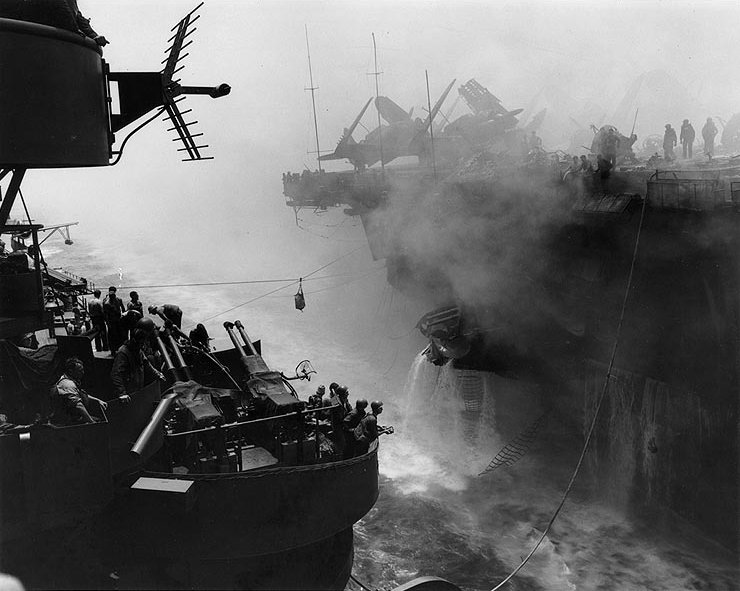
The next morning two kamikazes hit Bunker Hill and set the after deck on fire. At 1059 Wilkes-Barre was ordered to stand by. Captain Porter put her bow against the carrier's starboard quarter at 1115. She played ten streams of water on the fires while forty men trapped aft on Bunker Hill came across. Stembel (DD-644), Charles S. Sperry (DD-697), and English (DD-696) put their hoses in as well. She sent fire-fighting gear across and took off the injured and the dying. At 1534, with the flames under control, she cleared the carrier. The captain of Bunker Hill later said the cruiser and the three destroyers had come alongside without knowing whether the carrier would explode, and that Wilkes-Barre had taken off the seriously wounded. On 12 May she buried at sea thirteen men from the carrier who had died of their wounds and transferred the survivors to Bountiful (AH-9). Strikes on the Kyushu fields followed on the 13th. At dawn on the 14th the group's turn came. Falling shell fragments, possibly from friendly guns, hit the after signal bridge and wounded nine men. At 0816 she claimed an assist on a Zero.
On 28 May the force numbers changed again when McCain relieved Mitscher. She left Task Group 38.3 on 29 May for the Philippines and lay in San Pedro Bay from 1 to 20 June for repairs, upkeep, and replenishment, then exercised off Samar from 20 to 23 June. Task Force 38 left Leyte Gulf on 1 July. In Task Group 38.3 she spent the first week of July on aircraft patrol and firing practice. Carrier planes struck Hokkaido and Honshu on 10 July. Four days later she left the group for antishipping sweeps off northern Honshu and across Kii Suido. On the night of 24 and 25 July the bombardment ships left the group and at 1210 opened fire on the Kushimoto seaplane base and the Shionomisaki landing field. Planes struck Kure and Kobe from 24 to 27 July, and on the 30th they hit the manufacturing centers of Tokyo and Nagoya. Typhoons kept the aircraft down for most of the first week of August. The ships turned north on 7 August. Weather blocked the 8th. Strikes went on for the next two days, and on the 15th the order came to cease offensive operations. Porter was relieved on 17 August 1945 by Captain William Williams Juvenal.
Cruiser Division 17 left Task Group 38.3 on 23 August and on the 27th, after 59 days at sea, entered Sagami Wan with the Third Fleet. Her 6-inch guns covered the occupation of the Yokosuka Naval Base. On 3 September, the day after the surrender, she moved into Tokyo Bay, more than 103,000 miles out from her commissioning. As flagship of Task Unit 35.7.2 she left on 9 September for Tateyama Wan and on the 10th covered the seizure of the midget-submarine and suicide-boat base there. She covered demilitarization at Koajiro Ko from 12 to 14 September, refueled in Tokyo Bay, shifted to Onagawa Wan from the 15th to the 17th, and covered the occupation at Katsuura Wan before returning to Tokyo on 24 September. She anchored in sight of Mount Fuji until 4 October and exercised from 24 to 28 October. Detached from the Fifth Fleet on 5 November, she sailed on the 9th for Korea and reached Jinsen, now Inchon, on the 13th. On the 16th, with Hart (DD-594) and Bell (DD-587), she shifted to Tsingtao. Occupation duty kept her on the China coast, twice to Taku and Chinwangtao, and she spent the rest of 1945 at Tsingtao. She sailed for home on 13 January 1946, called at Pearl Harbor, and reached San Pedro on 31 January.
She left for the east coast on 4 March, transited the Panama Canal from 12 to 14 March, and reached Philadelphia on the 18th. Juvenal was relieved on 13 June 1946 by Captain Rutledge Barker Tompkins. She stayed at Philadelphia through the spring and summer, sailed for the Gulf on 20 October, and was at New Orleans for Navy Day on 27 October. From there she went to Guantanamo Bay for refresher training with Dayton (CL-105) and Providence (CL-82), returned to Norfolk on 13 December, and on 17 February 1947 sailed on a goodwill cruise. She reached Plymouth on 27 February, operated in British waters through March and April, and made one trip to Bergen before coming home for the reserve fleet. Captain Edward Randolph Gardner relieved Tompkins on 28 May 1947. Lieutenant Commander Charles Henry Johnson, Jr., relieved Gardner on 1 October. Lieutenant Commander Lewis Edwin Davis, Jr., relieved Johnson on 8 October and was still listed the next day. She was decommissioned on 9 October 1947 and placed in reserve at Philadelphia the same day.
She stayed in reserve at Philadelphia until her name was struck on 15 January 1971, the last light cruiser on the Navy list. She was then used for underwater explosive tests. On 12 May 1972 the hulk broke in two. The after section sank that day. The forward section sank on the 13th from a scuttling charge. DANFS leaves her off the Florida Keys, still in use as an artificial reef. She received four battle stars for World War II service. She was not sunk in the war.
A note on sources. The narrative follows the Naval History and Heritage Command Dictionary of American Naval Fighting Ships entry for Wilkes-Barre (CL-103) for dates, places, the Camranh Bay sweep, the rolls of 38 degrees, the aircraft claims, the nine wounded, the thirteen dead from Bunker Hill, the 103,000 miles, and the 1972 sinking. That page prints Nagoya as "Na-goya." The ordinary spelling is used here. The commanding officers and their dates are NavSource's list for CL-103. DANFS names only Porter, as Robert L. Porter, Jr. A short HyperWar page for CL-103 is a digest, not the full entry. It gives the hull as 608 feet 4 inches by 63 feet, draft 24 feet 7 inches, speed 33 knots, and complement 1,200 or more. DANFS gives 610 feet 1 inch, beam 66 feet 6 inches, mean draft 20 feet, 33 knots, and 992 men, and that line is followed. HyperWar dates the Bunker Hill kamikazes to 10 May 1945. DANFS places the night shelling of Minami Daito on 10 May and the attack on Bunker Hill early the following day, and the times 1059 and 1115 are told in that next-day paragraph, so the story uses 11 May. HyperWar also omits the 21 February bombardment of Iwo Jima, which DANFS describes. HyperWar says she was sunk in the tests in May 1972 and adds, outside the history, that she lies in 240 feet of water. The depth is not in DANFS and is not used. A NavSource photograph caption says the ex-cruiser was being sunk for a reef off Key West in April 1972. DANFS is followed on 12 and 13 May, off the Florida Keys. NavSource's own data line gives a beam of 66 feet 4 inches, a maximum draft of 25 feet, 32.5 knots, a crew of 1,255, and twenty-eight 40 mm guns, against twenty 40 mm in DANFS. The order date 7 August 1942 is only on NavSource. No slug on the battle list covers the January 1945 South China Sea sweep, the February Tokyo strikes except as they led to the Iwo Jima bombardment, the shelling of Minami Daito, or the July and August strikes on Japan. Operation Ten-Go is not named.