Ships
- USS South Dakota (BB-57) Captain from 9 December 1944 · Relieved on 30 July 1945
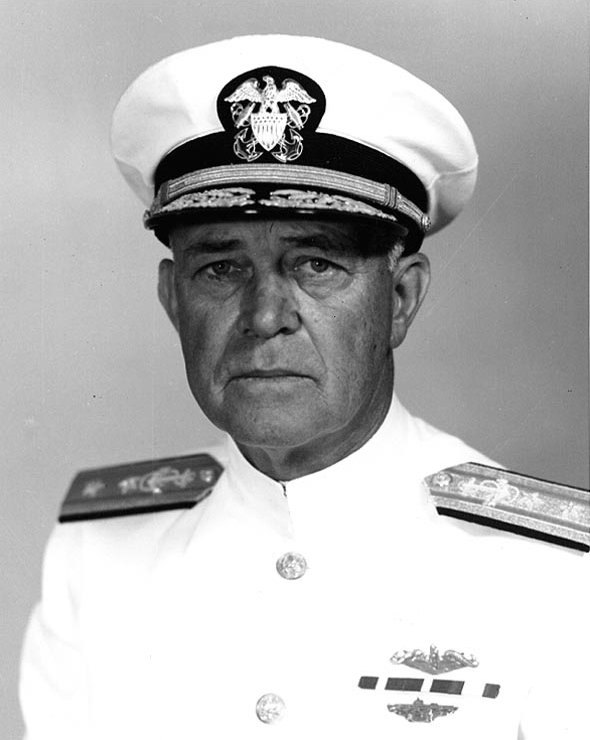
Charles Bowers Momsen was born in Flushing, Long Island, on 21 June 1896. The fleet called him Swede. He entered the Naval Academy from Minnesota with the class of 1920 and graduated in June 1919 on the shortened wartime course. After duty in battleships he qualified in submarines and, between 1923 and 1927, commanded three of them.
Two peacetime losses set the work that made his name. S-51 went down in 1925, and S-4 was rammed and sunk off Provincetown in December 1927, with men still alive inside and no reliable way to get them out. At the Bureau of Construction and Repair, Momsen designed a breathing bag a trapped sailor could use to rise to the surface, then tested it on his own body at depth. The Navy adopted it as the Momsen lung and in 1929 awarded him the Distinguished Service Medal. He also pressed helium-oxygen diving for deeper work and directed development of a rescue chamber that could be lowered onto a submarine hatch. Escape trials were run from the submarine S-1. The chamber later became widely known under another officer's name.
On 23 May 1939 the submarine Squalus flooded on a test dive and settled in about 240 feet of water off the Isles of Shoals. Thirty-three men were alive in the unflooded forward rooms. Momsen, then a commander, ran the rescue at the scene. The chamber made four trips and brought every one of those thirty-three up. Twenty-six men aft had already drowned. The boat was later raised. In October 1944 the lung was used in combat for the first time, when eight men escaped from Tang after she sank in the East China Sea.
In February 1943 he became commander of Submarine Squadron Two in the Pacific. That November he shifted to Submarine Squadron Four and, until April 1944, also served as chief of staff to the submarine training command. Boats were coming home with torpedoes that struck and failed to explode. Momsen drove the investigation and an improved exploder. On one trial a live war shot fired into a cliff did not detonate, and he went into the water to help recover it. The Legion of Merit followed. He also worked out how to send submarines into enemy waters together as a coordinated attack group, still able to hit hard. The Navy Cross for his squadron duty from 1943 into 1944 credited the boats under him with five Japanese ships sunk and eight damaged.
He served in the Office of the Chief of Naval Operations from June to December 1944. On 9 December 1944 he took command of the battleship South Dakota as a captain. Through the winter and spring the ship operated with the fast carrier force against Japan, striking the Tokyo area, fighting off air attack, and bombarding shore defenses, including the first naval bombardment of the main island of Honshu. From 14 March to 14 May 1945 she supported the assault on Okinawa. Momsen was relieved on 30 July 1945. A further Legion of Merit, with the combat device, covered that command, and the Fifth Fleet commended his conduct of the ship off Okinawa.
His time in South Dakota came long after the night battle off Guadalcanal. On the night of 14–15 November 1942 the ship was under Thomas L. Gatch. Momsen was not in command. In that action Washington sank the Japanese battleship Kirishima. South Dakota did not.
After he left the battleship he joined the headquarters of the Commander in Chief, United States Fleet, to prepare for an invasion of Japan then planned for 1946. When Japan surrendered on 2 September 1945 he became administrator of the Naval Shipping Control Authority for the Japanese Merchant Marine and took up the repatriation of Japanese service personnel and civilians. Over the next several years he was commandant of the Naval Operating Base at Guam, served on the General Board, and was Assistant Chief of Naval Operations for Undersea Warfare. From May 1951 to June 1953 he commanded the Submarine Force, Pacific Fleet, and afterward the First Naval District. From April 1954 to September 1955 he commanded Joint Task Force Seven during nuclear tests in the Pacific. He retired that September as a vice admiral and died on 25 May 1967.