Ships
- HMAS Shropshire (73) Captain from 28 December 1942
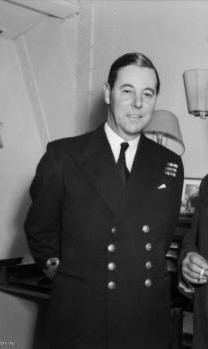
David Hugh Harries was born on 27 June 1903 at Kew, Melbourne, the son of David Henry Harries, a stockbroker from Wales, and Vera Lyon Harries, née Cross. He attended Melbourne Church of England Grammar School and entered the Royal Australian Naval College at Jervis Bay on 1 January 1917. He graduated in 1920 with a strong record in both the classroom and sport, then went to England for sea training and courses with the Royal Navy. He was promoted lieutenant in 1924.
For the next ten years he served by turns in Australian and British ships, with the RAN in 1925–27 and 1930–33 and with the RN in 1927–30 and 1933–35. In 1927 he finished first on the long navigation course at HMS Dryad. He was promoted lieutenant commander in 1932 and attended the Royal Naval Staff College in 1934. On 23 December 1933 he married Margaret Emily Street at St Peter’s, Cranley Gardens, in London. In 1935 he was posted to Navy Office in Melbourne. He joined HMAS Australia as navigating officer in 1937, helped commission HMAS Hobart the following year, and was promoted commander in December 1938.
The war put him in British minesweepers. He commanded HMS Seagull from July 1939 until September 1940, then moved to HMS Niger as senior officer of the 4th Minesweeping Flotilla for the closing months of that year. From April 1941 to October 1942 he served as Australian naval attaché in Washington, where Sir Owen Dixon valued his assistance.
By December 1942 he was in England to take over the heavy cruiser Shropshire, which Britain had offered to Australia after the loss of HMAS Canberra at Savo Island. On 28 December 1942 he assumed command at Chatham, still a commander, and supervised the refit for transfer to the Royal Australian Navy. During that refit the ship’s aircraft and catapult were landed, and she served the RAN without them. On 7 April 1943 John Augustine Collins assumed command. Harries remained as executive officer when Shropshire commissioned, and he left the ship in the middle of 1944.
In August 1944 he was appointed Deputy Chief of Naval Staff and acting captain. The rank of captain became substantive on 30 June 1945. He commanded HMAS Australia in 1945–46 and HMAS Hobart in 1946–47, then completed the 1948 course at the Imperial Defence College in London. In 1949–50 he was captain of the Sydney shore establishment HMAS Penguin.
On 22 April 1950 Harries took command of the light fleet carrier HMAS Sydney. The ship deployed to Japan in August 1951 for service with United Nations forces in the Korean War. On her first operational patrol in October the air group flew eighty-nine sorties in one day, equalling the daily record then held for a light fleet carrier, and the ship rode out Typhoon Ruth. Six more patrols followed. Her aircraft supported allied troops, spotted for naval bombardments, and struck enemy positions and supply points, work that impressed senior British and American officers. Sydney sailed for Australia in January 1952. For the campaign Harries was appointed CBE in 1952 and, in 1954, an officer of the American Legion of Merit.
In April 1952 he became commodore superintendent of training at Flinders Naval Depot, and that November he joined the Naval Board as Second Naval Member. He was promoted acting rear admiral, with the substantive rank dated 7 July 1954. He headed the Australian Joint Services Staff in Washington in 1953–55, was Flag Officer Commanding the Australian Fleet in 1956–57, and was Flag Officer-in-Charge, East Australia Area, in 1958–60. Passed over for Chief of Naval Staff in 1959, he transferred to the emergency list on 27 June 1960 and was appointed CB in 1961. He settled in Sydney and qualified as a chartered accountant.
Known in the service as Darbo, he outgrew a youthful shyness while keeping a reserved manner. Officers found him quick, physically fit, and firm in his own judgment, and in senior shore posts he sometimes clashed with public servants. He kept strict discipline and expected full effort from those under him, and he stood by men who were in trouble. For recreation he played tennis and golf and studied German and Russian. He belonged to the Australian and Union clubs in Sydney and the Naval and Military Club in Melbourne. After a stroke he spent his last eight years in a nursing home. He died at Bellevue Hill on 6 July 1980 and was buried in Waverley Cemetery. His wife and two sons survived him.