Ships
- USS Alden (DD-211) Captain, 15 April 1942 to 7 July 1943
- USS Johnston (DD-557) Captain, 27 October 1943 – 25 October 1944
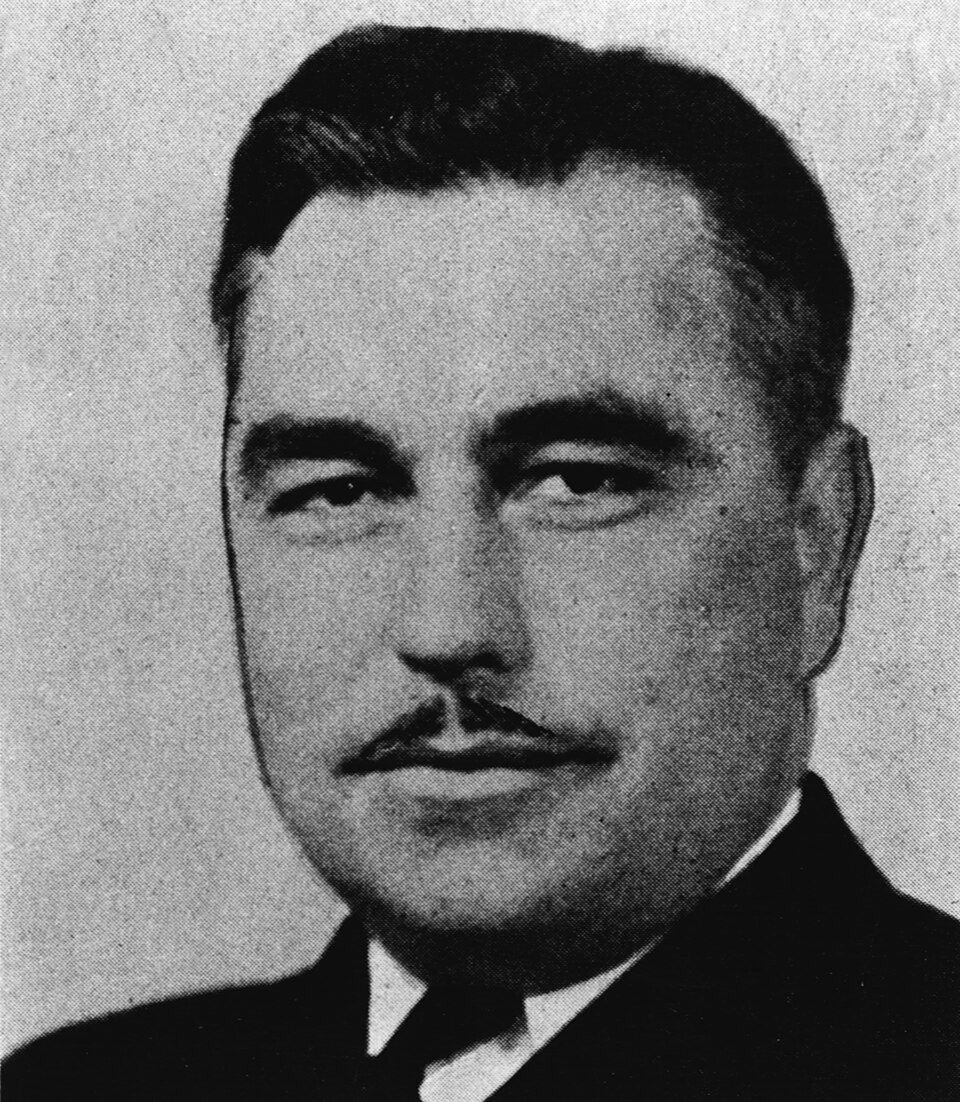
Ernest Edwin Evans left no memoir. What follows is his life from the Navy record, the commissioning words his crew remembered, and the action off Samar.
He was born on August 13, 1908, in Pawnee, Oklahoma, and grew up in Muskogee. The official Navy biography calls him half Cherokee and one-quarter Creek; the Cherokee Phoenix later described him as a citizen of both the Cherokee Nation and the Muscogee (Creek) Nation. At the Naval Academy his classmates nicknamed him Chief, Big Chief, and Cherokee. His gunnery officer, Ensign Robert C. Hagen, later said the crew called him the Chief, not to his face, and that he was proud of the Indian blood in him.
That Oklahoma is the same state, and roughly the same years, as Killers of the Flower Moon, but it is not the same story and not the same nation. The film is about the Osage Reign of Terror in Osage County, centered on Gray Horse, Fairfax, and Pawhuska, from about 1918 into the mid-1920s. Oil headrights had made the Osage the richest people per capita in the world, and white men, William K. Hale chief among them, murdered Osage allottees to inherit the rights. Pawnee, where Evans was born, sits in the county just south of Osage County. He was a boy and a teenager while those murders were happening an hour or so north of his birthplace. He was not Osage, and nothing in the record ties him or his family to those killings. His people were Cherokee and Creek, from Pawnee and then Muskogee, in the old Indian Territory nations farther east. What the two stories share is the Oklahoma he came out of: allotment, oil, guardians appointed over Native wealth, and a hard ceiling on what an Indian boy was expected to become. In 1926, the year Hale and his nephew Ernest Burkhart were arrested for the Osage murders, Evans enlisted in the Navy.
He had wanted to be a Marine officer and was not selected for the Academy. He enlisted on May 29, 1926, served a year as an enlisted man, won a fleet appointment, and entered Annapolis on June 29, 1927. The 1931 Lucky Bag called him big-hearted, good company, and, without explanation, radical from birth. The yearbook’s endpapers carried John Paul Jones’s line, “Give me a fast ship, for I intend to go in harm’s way.” He graduated on June 4, 1931. He tried flight school, washed out on hand-eye coordination, and went to the surface fleet, first to the battleship Colorado, then through a string of ships. His father, Charles William Evans, had been a streetcar motorman; his mother was Anna. He married Margaret Bell. By 1945 they had two sons, Ernest E. Jr. and Jerry David.
On August 9, 1941, he reported to the old four-piper destroyer Alden in the Asiatic Fleet. After Pearl Harbor he was in the Dutch East Indies campaign and the Battle of the Java Sea in February 1942, when an outgunned Allied force was beaten. Lewis Coley still had her. Jacob Cooper had her for the next month. Evans took command on April 15, 1942, and kept her until July 7, 1943. He was promoted to commander dating from November 1, 1942. In mid-1943 he was sent to Seattle to fit out a new Fletcher-class destroyer, USS Johnston (DD-557).
He assumed command at her commissioning on October 27, 1943, and told the crew assembled on deck: “This is going to be a fighting ship. I intend to go in harm’s way, and anyone who doesn’t want to go along had better get off right now.” He later added that now that he had a fighting ship, he would never retreat from an enemy force. Johnston went west. On May 16, 1944, off Bougainville, she depth-charged and sank the Japanese submarine I-176. Evans received the Bronze Star.
On the morning of October 25, 1944, Johnston was screening Taffy 3, a small escort-carrier group under Rear Admiral Clifton Sprague, off Samar in the Philippines. The unit was six jeep carriers, three destroyers (Johnston, Hoel, and Heermann), and four destroyer escorts, there to cover the Leyte landings. Out of a rain squall came Vice Admiral Takeo Kurita’s Center Force: four battleships including Yamato, eight cruisers, and eleven destroyers, which had slipped through San Bernardino Strait in the night. They were about fifteen miles away and coming fast.
Evans did not wait for orders. He was the first to lay smoke to hide the carriers and the first to open fire. He turned Johnston out of the screen, rang up flank speed, and charged alone at a force that outgunned him in every category that mattered. A Fletcher carried five 5-inch guns and ten torpedoes. She was closing battleships whose main batteries were 14-inch, 16-inch, and 18.1-inch. As he closed he poured 5-inch into the heavy cruiser Kumano, then fired his whole torpedo battery. At least one torpedo, and probably more, blew Kumano’s bow off and forced her out of the action; the heavy cruiser Suzuya stopped to assist and was effectively removed as well.
The celebration did not last. Johnston was hit by three heavy shells and three 6-inch shells. A shell burst on the bridge blew two fingers off Evans’s left hand and tore the shirt off his back. When the medical officer reached him, Evans sent the doctor to the men hurt worse, wrapped a handkerchief around the stumps, and stayed in command. Steering and one engine room were gone. He shifted conn to the fantail, shouted rudder orders down an open hatch to men turning the wheel by hand, and kept fighting. With no torpedoes left he made a second attack, firing into a Japanese battleship, then turned his remaining guns on the cruiser that was killing the escort carrier Gambier Bay, deliberately drawing that fire onto Johnston.
When a Japanese destroyer column closed the carriers, he charged that line too, still without torpedoes, and helped break up the attack. After about two and a half hours a hit in the forward fireroom killed the last engine. Johnston was dead in the water, guns out except one 5-inch still firing in local control, and Japanese ships circled her at a few thousand yards pouring shells in. At about 9:45 a.m. Evans ordered abandon ship. She rolled over and sank at about 10:10. A Japanese destroyer, Yukikaze, closed and her captain later said the crew saluted. Of 327 men, 141 were saved. About 50 were killed by gunfire, about 45 died of wounds on the rafts, and 92, Evans among them, were alive in the water after she went down and were never found. He was last seen on the sinking ship, helping get men off.
A line often put in his mouth that morning, “survival cannot be expected, we will do what damage we can,” belongs to Lieutenant Commander Robert Copeland of the destroyer escort Samuel B. Roberts, who made his own attack later. Evans’s words that the record actually holds are the commissioning promise and the order to attack.
The Medal of Honor citation says he was the first to lay smoke and open fire, launched the first torpedo attack under straddling shellfire, and, seriously wounded, kept Johnston between the Japanese fleet and the carriers until she was dead in the water after three hours. It credits his courage and shiphandling with helping turn Kurita back at the critical moment. The medal was presented to his wife Margaret on September 28, 1945, in San Pedro, with his mother, a sister, and both sons present. He was the first Native American in the Navy to receive it. Johnston earned the Presidential Unit Citation. His name is on the Walls of the Missing at Manila American Cemetery. In 2021 the wreck was found more than 20,000 feet down off Samar, still upright on the bottom.
The Navy's biography gives his birth as 13 August 1908 in Pawnee. An Oklahoma birth record, read by Larry Floyd for The Chronicles of Oklahoma in 2010, is for a boy named Ernest Evans born on 13 August 1909 in Shawnee, to William Charles Evans, a cook, and Anna Belle Maloney. The 13th of August 1908 was a Thursday. The 13th of August 1909 was a Friday. The 1931 Lucky Bag opens its sketch of him with one Friday the thirteenth. If that record is his, he was sixteen when he enlisted on 29 May 1926, and thirty-five when he died. The official biography keeps 1908 and Pawnee. The birth record and the yearbook are the other account.
Floyd's account of the household is the fuller one. The family moved often and had little money. His grandfather, George Washington Evans, had been mayor of Okmulgee. A brother, George Lee, and two sisters are named in the Academy memorial research: Mary, later Mrs. Hugh Hendrickson of Tulsa, and Janie, later Mrs. Crosbie. His father died in 1933. His mother lived until 1964. The Navy biography calls his wife Margaret Bell. A later biography calls her Margaret Wilfong of Kentucky. Those two names have not been reconciled from a record read here.
How he came to be called Cherokee is less settled than the official phrase. One Navy biography, the text kept by the Academy's memorial hall, calls him half Cherokee and one quarter Creek. The Naval History and Heritage Command text of the biography leaves that sentence out. Floyd read the birth certificate as listing the parents and the child as White, and he did not find the parents on the Dawes Rolls. The classmates still nicknamed him Chief, Big Chief, and Cherokee, and Hagen wrote that he was proud of the Indian blood in him. He described himself that way, and the men who served with him described him that way. The rolls do not confirm it.
He entered the Academy from the fleet on 29 June 1927, with the highest mark among sixty-two enlisted candidates, and he graduated 321st in a class of 443. The directories place him in Colorado, then the destroyers Roper and Rathburne, then under instruction at Pensacola from October 1933 to April 1934. He did not become a pilot. On Pensacola he rode as aviation gunnery observer in Scouting Squadron 9 until 15 April 1937. He served in the transport Chaumont, including the landing of the Sixth Marines at Shanghai on 19 September 1937. His first command was the yard tug Cahokia at Mare Island, from July 1938 to October 1939. From November 1940 he was in the tender Black Hawk.
On 9 August 1941 he joined Alden as executive officer under Lieutenant Commander Lewis E. Coley. He was not yet her captain. At the Java Sea on 27 February 1942 she fired both torpedo batteries at very long range. None is known to have hit. On the night of 28 February the four American destroyers ran the Bali Strait with no torpedoes left, and all four came through. A ship's history dates his assumption of command as 14 March 1942. The dates kept here give the ship to Jacob Elliott Cooper until 15 April 1942, and to Evans from that day until 7 July 1943.
On the night of 16 May 1944, northeast of Buka, Johnston hunted the submarine I-176 with Haggard and Franks. After Haggard was damaged she coached Johnston in, and Johnston made three runs. Four minutes after the last, the men saw and felt a large underwater explosion, then oil and debris. I-176 went down with all 103 men, and the three destroyers shared the credit. The Bronze Star citation credits his tactics and his work with the other ships.
At Guam, from 21 to 29 July 1944, he took her in ahead of the landing waves. He wrote afterward that the Japanese fired at the ship rather than the boats, and that this cut the casualties on the beach. In eight days she fired 3,546 rounds of 5-inch antiaircraft common. He called the 40 mm guns a Jap killer against troops in the open, and he named his executive officer, Lieutenant Elton B. Stirling, and Hagen, for the fire he said saved men ashore.
The accounts do not agree on whether the first torpedo attack off Samar was his own order. Hagen's action report, his article of 26 May 1945, and the ship's later history say Evans made smoke and attacked before any order from Sprague. Morison writes that Evans was passing on an order already received, to attack with Hoel and Heermann. The orders recorded in the other ships' histories fall after Johnston had fired her torpedoes. Hagen says the decision to close was the captain's, so the torpedoes could still be fired if the ship were hit. One torpedo hit Kumano and took her out of the battle. Japanese records are the source of that hit.
Where he was last seen is not one story. The action report of 14 November 1944, written by Hagen, says the captain was missing and that the missing were seen alive in the water after the ship was abandoned. Hagen's article the next May says he was last seen with other officers and men in a small boat. The only boat recorded, the gig, had been holed and sank. The 2021 ship's history says he was last seen wounded, in a life jacket, on the night of 25 October, with Lieutenant Joseph L. Worling and Lieutenant Walter P. Deutsch, on timbers that had drifted off the ship, and that none of the three was seen again. Later interviews, as Floyd reports them, found no survivor who saw him leave the ship. The earliest official record is that he was missing, and that he was believed to have been alive in the water.
A bronze plaque with the citation was put on the door of his Academy room in October 1950. The destroyer escort Evans was launched on 14 September 1955, sponsored by his sister Mrs. Hugh Hendrickson, and served until 1973. On 15 November 2023 the Navy announced that a destroyer, DDG-141, would be named Ernest E. Evans. The wreck was first found in 2019. In March 2021 she was filmed at 21,180 feet, upright, with the hull number 557 still on the bow.