Ships
- USS Washington (BB-56) Captain, 5 June 1945 – July 1946
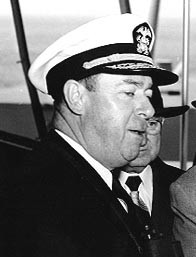
Francis Xavier McInerney was born in Cheyenne, Wyoming, on 28 March 1899, the son of Thomas and Phyllis McInerney. He finished high school in Cheyenne, spent a year at the University of Colorado, and entered the Naval Academy. In June 1921 he was commissioned an ensign in the United States Navy.
His early sea duty was in the battleship New Mexico, the destroyers Burns and Williamson, and the destroyer tender Dobbin. In 1935 he earned a law degree from George Washington University and was admitted to the bar in the District of Columbia. He later served in the light cruiser Concord and taught at the Naval Postgraduate School in Annapolis.
He took command of the destroyer Smith in 1940 and was still her captain when the United States entered the war. The ship was working with destroyers out of San Francisco, then shifted to escort runs between the West Coast and Pearl Harbor. On 1 February 1942 he became the senior destroyer officer in the ANZAC Squadron, a force of Australian, New Zealand, and American ships in the South Pacific. He led Destroyer Squadron 9 from late March into early August 1942, and Destroyer Squadron 2 from August to November, and he took part in the early strikes in the Solomons and in the Battle of the Coral Sea. After a winter with the Twelfth Naval District in San Francisco, he returned to sea on 10 March 1943 in command of Destroyer Squadron 21, with his pennant in the destroyer Nicholas.
That July the squadron was in the hardest of the Solomons fighting. At Kula Gulf on 5 and 6 July, during a landing operation, he handled the destroyers in action and stayed with survivors of the sunken cruiser Helena while Japanese aircraft attacked on three separate occasions. He received the Navy Cross for his conduct there. In the early hours of 13 July, off Kolombangara, he held tactical command of the destroyers at the head of the American column, again from Nicholas. The fire those ships delivered under his lead helped defeat the Japanese force, and he was awarded the Silver Star. On 15 and 16 July he commanded the destroyers covering the removal of about 165 Helena survivors from the enemy-held shore of Vella Lavella, service recognized with the Legion of Merit with Combat V. A Bronze Star with Combat V marked his part in mining waters the Japanese were using heavily.
In August 1943 he became the senior representative of the Pacific destroyer command in the South Pacific. In March 1944 he was named chief of staff to the Commander, Operational Training Command, Pacific Fleet, and he remained in that post into 1945.
Command of the battleship Washington (BB-56) came to him after Roscoe Fletcher Good. Her famous night battle off Guadalcanal, fought under Willis Augustus Lee, was already past. His tour as captain runs from 5 June 1945 to July 1946. Another account opens the same tour on 3 June 1945. Both accounts close it in July 1946, without a day, and Henry Effingham Eccles took her that month. The two accounts differ on the day in June. He joined Washington at Leyte. The battleship had just come off a long run of operations. On 6 June he sailed her toward the West Coast, with calls at Guam and Pearl Harbor, and on 23 June he brought her into the Puget Sound Navy Yard at Bremerton. The last wartime overhaul was still underway when Japan surrendered, and he kept the ship through the first year of peace.
In October 1946 he became commanding officer of the Naval Receiving Station at San Francisco, on Treasure Island, and he stayed until January 1948. He was promoted to rear admiral in 1947. He then commanded a light cruiser division in the Pacific into January 1950, when he took command of the Amphibious Training Command, Pacific Fleet. From October 1951 to March 1953 he commanded Amphibious Group Three. In the Korean War he led the joint amphibious task forces numbered Seven, Seventy-Six, and Ninety-Two. He next served as senior member of the Board of Inspection and Survey, and from October 1954 he presided over general courts-martial in the Eleventh Naval District. He retired on 30 June 1955 as a vice admiral. McInerney died in San Diego on 24 June 1956. The guided-missile frigate McInerney (FFG-8), which entered service in 1979, was named for him.