Ships
- USS John D. Edwards (DD-216) Captain by 7 December 1941 · In command at the Java Sea · Left her in March 1942
- USS Washington (BB-56) Captain, July 1946 – 2 April 1947
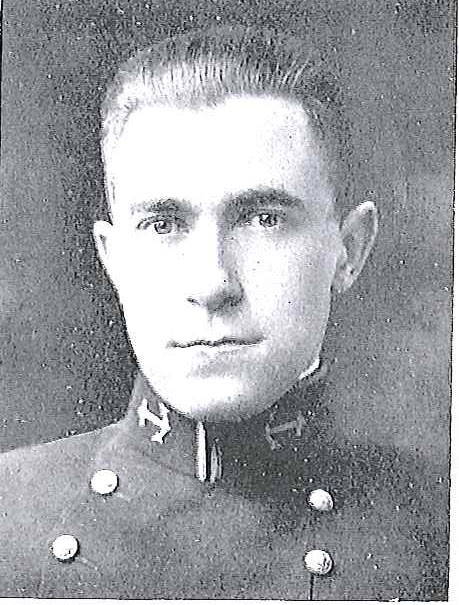
Henry Effingham Eccles was born in Bayside, New York, on 31 December 1898. His father, George Eccles, was an Episcopal priest, and George and Lydia Eccles taught him at home until he was twelve, when he entered Trinity School in New York City. After a year at Columbia University he went to the United States Naval Academy and graduated with the class of 1922. Engineering and submarines marked his first years as an officer. In 1930 he took a master of science degree in mechanical engineering from Columbia, then returned to sea in command of the submarines O-1 and R-13.
By the middle of the 1930s he was back on surface ships. He commanded the destroyer John D. Edwards with the Asiatic Fleet when the United States entered the Second World War, and he kept her through the Netherlands East Indies campaign, about thirteen engagements in all. On the night of 19–20 February 1942, in Badoeng Strait off Bali, he fought a stronger Japanese force and received the Navy Cross. On 27 February, in the Battle of the Java Sea, he took John D. Edwards in with Destroyer Division 58 and carried a torpedo attack in against Japanese cruisers, an action for which he received the Silver Star. The Netherlands awarded him the Bronze Lion. He was wounded during the campaign and left the destroyer in March 1942.
After he recovered he joined the Office of the Chief of Naval Operations. In the Base Maintenance Division through 1942 and 1943 he helped plan logistic support for advanced bases. From June to December 1943 he attended the command course at the Naval War College in Newport, Rhode Island. Promoted to captain, he spent the last two years of the war in Hawaii as head of the Advance Base Section on the staff of Commander, Service Force, Pacific Fleet. From December 1943 to December 1945 he directed the planning, construction, and supply of advanced bases across the Central Pacific, the anchorages, airfields, and depots on which the drive toward Japan depended. He received the Legion of Merit for that duty.
When the fighting ended he served on the Joint Operations Review Board, which studied how the services had operated together. In July 1946 he took command of the battleship Washington. She had already made her name in the Pacific war. In the night battle off Guadalcanal in November 1942, Glenn Benson Davis, Sr. had command of her while Rear Admiral Willis Augustus Lee, embarked in the ship, directed the American force, and her heavy guns wrecked the Japanese battleship Kirishima. Eccles’s own tour was a quiet one. He was captain of Washington from July 1946 until 2 April 1947, while the battleship was being prepared to leave active service.
In 1947 Admiral Raymond A. Spruance, president of the Naval War College, chose him to start a logistics department, a subject the college had long left thin. Eccles was its first chairman from 1947 into 1951 and conducted the Navy’s first formal courses in logistics. In 1950 he published Operational Naval Logistics, a manual that treated fuel, ammunition, repair, and the movement of men as part of how a campaign is fought. During those years he also lectured at the National War College, the Industrial College, the Command and General Staff College, and the Air University. In February 1951 he became acting chief of staff of the Naval War College and held that post until April.
He then went to London as assistant chief of staff for logistics to the Commander in Chief, U.S. Naval Forces, Eastern Atlantic and Mediterranean. At the same time he was assistant chief of staff for logistics to NATO’s Commander in Chief, Allied Forces Southern Europe, with headquarters in Naples. He was still in that assignment when he retired on 30 June 1952 and was advanced to rear admiral.
He kept writing, teaching, and advising the Naval War College for the rest of his life. His 1959 book Logistics in the National Defense described logistics as the bridge between a nation’s economy and its combat forces, and as the practical limit on how far a commander can reach. He also pictured a logistics tail that grows so large it begins to feed on itself, which he called the logistics snowball. Further books and dozens of articles followed, and officers at Newport continued to come to him for counsel. The college named its library for him. He died in Needham, Massachusetts, on 14 May 1986.