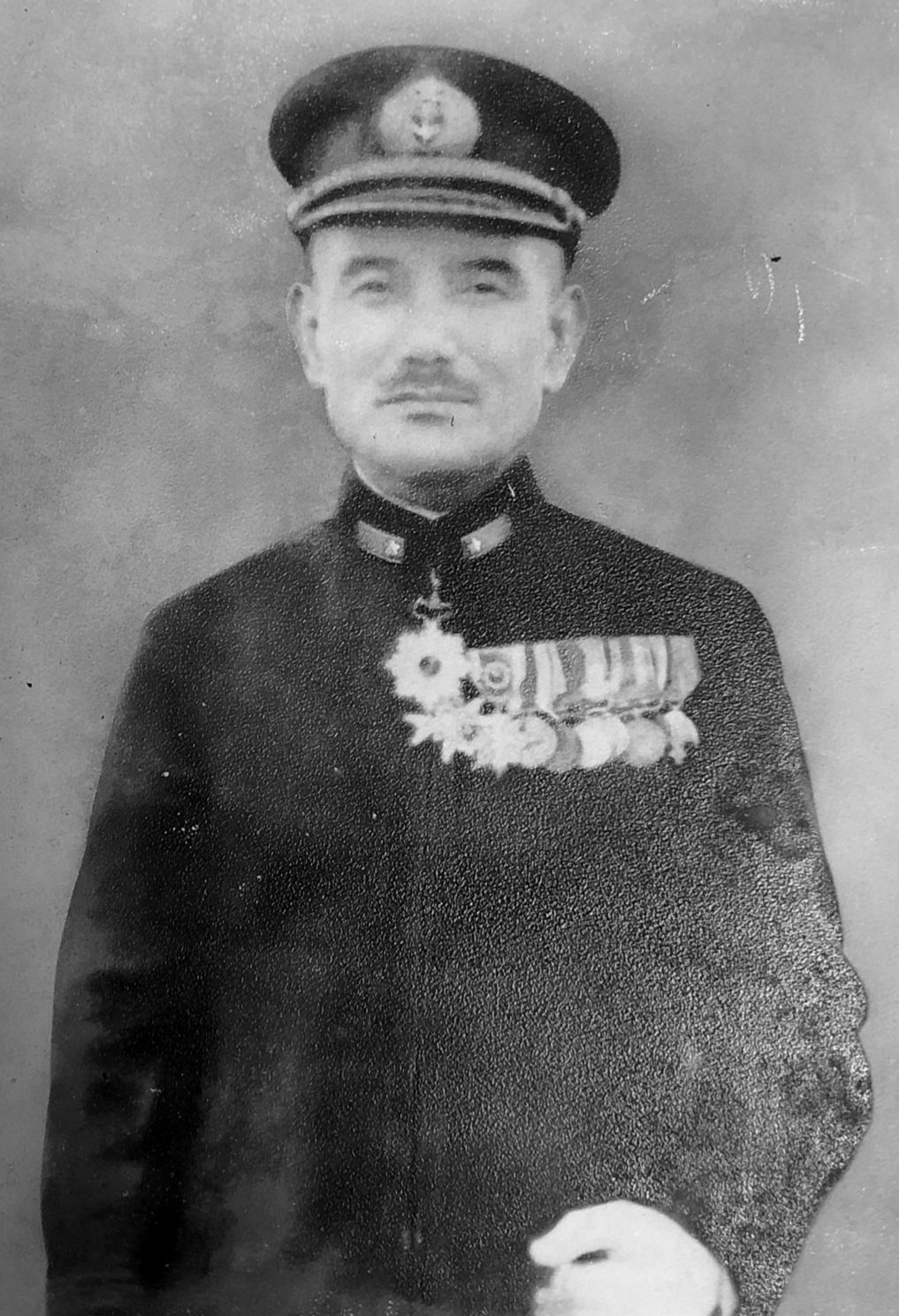
Ships
- IJN Yubari Captain from 1 November 1940 · Relieved on 15 August 1942
- IJN Ashigara Captain from 25 September 1942 · Relieved on 30 January 1944
- IJN Fuso Captain from 23 February 1944 · In command when she was lost, 25 October 1944
That ship and those dates identify him. He is not George Gill Ball and not Frank Haywood Ball. He is not a man named 伴. Hiroshi Nishida’s class list of Naval Academy graduates, which prints both kanji and readings, gives him as 阪 匡身, furigana ばん まさみ, and the English form Ban, Masami. The same reading of the family name is printed for his father on the Japanese Wikipedia article for the poet 阪正臣: ばん まさおみ. Nishida is a compiled register, not the appointment gazette itself. It is the source that actually prints the son’s furigana. Nothing consulted here prints a reading さか for this officer.
It is wrong, or at least incomplete, about the rank he died in. He was a captain (海軍大佐) when he took Fusō. On 15 October 1944, ten days before the battle, he was promoted rear admiral (海軍少将) and left in command. On 25 October, the day he was killed, he was advanced to vice admiral (海軍中将). Japanese class lists that show only a “final rank” therefore call him chūjō. Lists that style him rear admiral for the whole of the Fusō command, including the Japanese Wikipedia history of the ship, are reading the later rank backward over the eight months he was still a captain.
Origins
He was born on 18 October 1893 (Meiji 26). Nishida and the compiled Naval Academy graduate table both give his registered place of origin as Aichi. That fits the family, so far as the family can be documented. His father, 阪正臣 (Ban Masaomi, 1855–1931), was a waka poet, calligrapher, and scholar of old calligraphy, a contributor to the Imperial Poetry Bureau, holder of the 正四位勲三等. The father’s own name is sometimes written 坂. He was the eldest son of a wealthy merchant house, 瀧本屋 (the reading of that shop name is not printed in the sources used), in Yokosuka town, Chita district, Owari — present-day Aichi — and he made a life in the capital’s literary and court circles: studies in national learning, service at shrines including Ise, a professorship at the Peersses’ School, fair copies of the Meiji Emperor’s collected poems. His grave is in Aoyama. None of that is a biography of the son. It is the house the son came out of, and it is better documented than the son’s childhood, which these sources do not describe at all. No school before the Naval Academy is securely attached to Masami here. A private alumni table places “学習院” beside his name; the column was not verified against a register, and it is not used below.
The father’s Japanese Wikipedia article, citing a 2013 essay by 八木意知男 in Ritsumeikan Bungaku (立命館文学), says that the eldest son, 阪匡身, put his father’s papers in order and compiled 『樅屋全集』, issued in August 1932 and not for sale. A bookseller’s record of a five-volume set names 阪匡身 as editor, with a kanji variant 匤 in the listing. The same Wikipedia paragraph then says, without a footnote, that Masami’s wife was 文子, from the 黒坂 family, Tokyo Prefecture samurai stock; that the father’s second son was 丈緒; and that the address was 赤坂区榎町5番地. Those three statements are not treated here as established. 丈緒, on the grammar of a family section about the father, is the father’s second son — Masami’s brother — not a son of Masami. Neither 文子 nor 丈緒 is given a reading in that article, and none is supplied here. No child of Masami appears in any source read for this essay. If 文子 existed, what he left her is not in the record.
What is in the record is a lieutenant commander, not yet forty, taking on a dead poet’s lifework while he was still a destroyer captain. Masaomi died on 26 August 1931. That summer Masami was in command of the destroyer Sawakaze. The collected poems came out the next August, by which time he had moved to Kisaragi. The navy did not give him a sabbatical to become an editor. Whatever hours the book cost, they came out of a sea appointment. It is the one piece of evidence that he spent himself on something other than the next ship, and it survives only as a title page and a scholar’s note. No preface in his voice was found.
Formation
He entered the world the navy actually kept books on when he graduated from the Naval Academy on 19 December 1914, class 42, number 58 in a class of 117. Midshipman, assigned to the old cruiser Sōya. Fifty-eighth of 117 is the middle of the class, not the failure and not the man the staff college would pick out. The compiled graduate table leaves his Naval War College column blank, and Nishida’s header for him, unlike those of the classmates who went through the A course, carries no 海大 line. He was a deck officer who stayed a deck officer.
The first year was the usual cruise of a new officer through big ships that were already old or, in one case, brand new. On 27 August 1915 he went to the battlecruiser Ibuki. On 13 December 1915 he was commissioned ensign and sent to Fusō. She had been completed at Kure on 8 November, five weeks earlier: Japan’s first superdreadnought, twelve 14-inch guns, already, though nobody in 1915 could know it, the ship that would be second-line by the time he was trusted with her. He was a junior officer of the watch and of a division, not her captain. He left her a year later, on 1 December 1916, for the battlecruiser Tsukuba, then in February 1917 for the old cruiser Chiyoda.
From December 1917 the navy put him through the schools that marked a gunnery and torpedo officer rather than a navigator or an engineer: torpedo school, basic course, then gunnery school, basic course, from May 1918. He was lieutenant junior grade. In December 1918 he joined the destroyer Harukaze. A year later he was acting division officer in the light cruiser Tatsuta. On 1 December 1920 he was lieutenant and back in gunnery school for the advanced course. Then the small ships that would be his real education: the destroyer Kuwa (December 1921); gunnery officer and division officer of Amatsukaze (December 1922) and of Umikaze (24 March 1923); division officer of the light cruiser Kitakami (5 February 1924). On 1 December 1924 he received his first command, the old destroyer Hatsushimo, by then rated a minesweeper. On 1 December 1926 he was captain of the destroyer Kusunoki. He made lieutenant commander on 1 December 1927.
What followed was a decade of the same work, one hull after another, which is how the navy trained a man it did not send to the War College. Destroyer Tsubaki, 10 December 1928. On 30 November 1929 he was captain of Sawakaze and, for a year, of Minekaze at the same time; from 20 November 1930, Sawakaze alone. A specialist site that transcribes appointment orders for Sawakaze names 海軍少佐 阪匡身 as her captain from that November 1929 date until 14 November 1931, when Lieutenant Commander 河西虎三 relieved him. That day Nishida has him taking Hatakaze. From 1 December 1931 he held Hatakaze and Asakaze together. On 21 February 1932 he took Kisaragi. He became commander on 15 November 1933, still in that world: Shirakumo from 15 November 1934, Hibiki from 21 November 1935.
On 1 December 1936 the appointments step up from a single ship to a unit: commander of Torpedo Boat Division 21. On 1 December 1937, commander of Minesweeper Division 11, which is a China-war job in the year the war in China became general, though the register does not say where the division swept or what it cost. On 3 October 1938 he was ashore, attached to Yokosuka Naval District. On 15 November 1939, at forty-six, he was promoted captain. The first sea job in the new rank was command of Destroyer Division 6, from 2 March 1940. On 1 November 1940 he was given the light cruiser Yūbari.
That is twenty-six years from midshipman to a cruiser, almost all of it in destroyers, torpedo craft, and minesweepers, with one early look at the battleship he would die in. The registers do not record a reprimand, a brilliant action, or a quotation. They record a man the navy kept at sea.
The war, as the appointments and the last night allow it to be told
He was Yūbari’s captain when the Pacific war opened, and he remained her captain until 15 August 1942. This essay does not retell Yūbari’s wartime cruises as if they were his biography. The tabular records of where she went under him were not worked up from her logs here. What can be said is that his war began in a small cruiser, not in a flagship, and that when the navy took him off her it did not send him to a staff.
The next five weeks are a paper trail only: attached to Yokosuka on 15 August 1942, attached to the Southwest Area Fleet on 10 September, and on 25 September captain of the heavy cruiser Ashigara. He kept Ashigara until 30 January 1944. Again the ship’s reputation in the Dutch East Indies is not his story unless an order of his is on paper. None was found beyond the fact of command. On 30 January 1944 he was attached to the First Fleet. Twenty-four days later the fleet gave him a battleship.
On 23 February 1944, at Lingga Roads near Singapore, Captain Ban Masami, former captain of Ashigara, Naval Academy class 42, was appointed commanding officer of Fusō. It gives no source and no other facts about him. The 23rd is the date to keep.) Two days after he joined, Battleship Division 2 was disbanded and Fusō and Yamashiro were placed directly under Combined Fleet. The Combined Fleet tabular record, a compilation by Bob Hackett and Sander Kingsepp and not an official history, has him inheriting a ship already in the southern anchorage: gunnery practice with Nagato in March, a docking at Seletar in April, damage-control drills back at Lingga in May, and the long summer of a slow battleship that the navy had not been willing to spend earlier in the war. The point for him is the shape of those months, not the ship’s machinery. He was fifty. He had been a captain for more than four years. He had been given the oldest battleship Japan still kept in commission, and he was told, by the simple fact of the order, to make her ready for a fleet action she had been spared.
He was still a captain on 15 October 1944, when the appointment list promoted him rear admiral and did not relieve him. In the late-war navy a rear admiral in command of a single battleship was no longer rare; Nishimura Shōji’s southern force sailed with rear admirals on both of its battleships. Ban’s promotion fell in the week the fleet was committing itself to Shō-Gō, the operation that became Leyte Gulf. He had ten days of flag rank.
The night of 24–25 October 1944 is the only passage of his life for which witnesses and, much later, the wreck itself can be put beside the register. Even there, almost nothing is known of him as a person. No order in his handwriting, no signal signed by him, and no survivor who describes his face or his words has turned up in the sources read for this essay. What follows is the ship under his command, and the limits of what that ship’s end can say about the man.
Fusō sortied from Brunei on 22 October in Vice Admiral Nishimura’s Force C, the southern prong aimed at Surigao Strait: Yamashiro flying Nishimura’s flag, Fusō, the heavy cruiser Mogami, and four destroyers. On the morning of 24 October the force was bombed. Anthony Tully’s 2009 book, as cited in a 2024 paper he wrote with Robert Lundgren, treats Fusō as having taken two bombs that day — one said to have gone deep beside No. 2 turret, one said to have blown a hole in the fantail and started a fire that did not last — and as still fit to fight. An earlier essay of Tully’s said Ban had the fire out in forty-five minutes. That sentence belongs to a reconstruction Tully later abandoned on other points, and it is not repeated here as fact. The 2024 paper’s own footnote calls the bomb damage “alleged.” She was still in formation that night.
American accounts for a generation said she was torpedoed around 0309, fell out, blew up, and broke in two, and that the two burning halves drifted until morning. The Naval War College’s 1958 analysis of Leyte Gulf, written without survivors it trusted for Fusō, had already warned that no direct information of any consequence was available on her. Tully’s 2009 book argued from survivor statements and action reports that she foundered and rolled over in one piece, inside an oil fire that looked, from a distance, like a ship torn in half. In November 2017 a survey of the strait found the wreck upside down, bent into a boomerang, the pagoda mast off the hull to the north, the hull still essentially one piece. The 2024 Tully–Lundgren paper, posted online on 3 October 2024, takes that wreck as confirmation of the outline of the 2009 argument and as a correction of the track: she did not retire south after the first torpedoes. She kept going north, was hit again on the port side, lost power, and sank by the bow shortly after 0400.
The two Japanese accounts the paper relies on are those of Yasuo Katō, at a gunner’s station inside No. 1 turret, and Petty Officer Hideo Ogawa, in the powder room of No. 2 turret. Tully says both were published in a 1984 amalgam article and are quoted in his 2009 book; the 2024 paper reprints them and is frank that they are snapshots. They describe the first hits and then the last minutes. They skip the middle. Katō’s watch had stopped at 0325, so his clock is not a log. Both men remembered two or three shocks on the starboard side a little after 0300, darkness in the turrets, emergency lighting, a steep list that then eased. Ogawa said water entered the magazine slowly; on the turret captain’s order he and ten other men climbed into the shell room and shut the door. Katō heard, through the speaking tube, that the rooms below No. 1 were flooding. The wreck, as the 2024 paper reads it, shows more than those first hits: damage forward under No. 1, weakening under the pagoda, a hit aft on the starboard side that would have taken at least the outer shaft, and later port-side hits consistent with a destroyer attack around 0344, which the paper assigns to USS Daly. The paper is explicit that parts of this track are reconstruction. Radar plots, Mogami’s action report, and the steel are the evidence. Ban’s intentions are not. Tully writes that a captain in his position “doubtless” did not think of leaving the battle while the ship still answered the helm. That “doubtless” is an inference from how Japanese captains usually behaved, and from the track. It is not a document.
Nishimura’s 0330 signal to the fleet reported destroyers hit and Yamashiro torpedoed but still able to fight. It did not mention Fusō. For years that silence was read as proof he had already lost her. The 2024 paper reads it the other way: she was still coming, and there was nothing to report. At 0352 the flag asked Fusō for her maximum speed. By then, on this reconstruction, she was already dying and did not answer. Whether Ban had told Yamashiro anything earlier, by a dimmed signal lamp that no other ship logged, is something the paper says cannot be known. Yamashiro’s message logs did not survive.
The abandon-ship order is in Ogawa’s account, not in a ship’s log. He remembered the neighborhood of the bridge suddenly noisy, the order given, men going over the starboard side amidships, most of the hundred or so men of the 1st and 2nd divisions gathering to port. He straddled a rail on the starboard side of No. 2 turret and watched the sea come up. Tully’s narrative names the order as Ban’s. The quoted memory says the order was issued. It does not say Ogawa heard Ban’s voice or saw him. What Ogawa does say, and it is the last human question anyone in these sources asks about this captain, is: how were the commanding officer and the other officers on the bridge now? Then the bridge went into the water. The stern, some sixty meters of it abaft No. 6 turret, hung at about fifty degrees. The screws were still turning in the air. Ogawa got clear of the oil before it burned. He heard men in the fire. Katō, who had mustered his own ten men by touch in the dark because he could not see faces, watched the rudder against the sky and cried. He had been in her, he said, since 1938. That sentence is about the ship, from a turret crewman. It is not about her captain. Neither survivor says he saw Ban leave the bridge. The reasonable reading, and it is only a reading, is that the officers Ogawa was asking after went with it.
The older Combined Fleet tabular record still tells the abandoned version: a turn away to the south, an order by Rear Admiral Ban to abandon, a sinking by the bow near Kanihaan Island around 0340–0350, about ten survivors out of 1,630, and a posthumous vice admiralcy. Its footnote on the survivors is itself tangled. It calls Paymaster Lieutenant Ezaki Hisato Fusō’s senior survivor. Tully’s work, and the Japanese Wikipedia history of the ship, place 江崎寿人 (the same officer; Tully also spells him Izaki) on Yamashiro, on or near her bridge. Wikipedia notes that some postwar testimony mixed the two ships’ survivors, and that a handful of Fusō ratings were carried on the books as transferred to ground units at Manila, without it being clear whether they had left the ship before the sortie or lived through the strait. Ogawa’s account, in the 2024 paper, continues past the sinking far enough to recognize Mogami still moving beyond the burning oil. So at least two men from the forward turrets lived long enough to be interviewed decades later. “All hands” is not true. “The captain lived” is not claimed by anyone.
Nishida’s ship list gives the loss as combat, Surigao Strait, 25 October 1944, at about 10°25′ N, 125°23′ E, and removal from the navy list on 31 August 1945. The Combined Fleet tabular record gives a different position, about 10°24′ N, 125°21′ E, tied to the older story of the sinking. The 2024 paper does not treat those older coordinates as the place she finally went down. The wreck is there to be visited by a camera. It has not produced a body, a sword, or a paper with his name.
He was fifty-one. The promotion to vice admiral is on the same line of Nishida’s table as the death: 25 October 1944, 海軍中将, 戦死. That is the ordinary wartime arithmetic, a rank conferred because he had been killed in command, not a rank he exercised. A Gendai article by 神立尚紀, on aristocratic and near-aristocratic war dead, lists him the same way: Rear Admiral Ban Masami, captain of Fusō, killed 25 October 1944, vice admiral after death. That article is not an official gazette. It matches the register.
The cost, and what remained
The cost that can be named is his own life, the lives of most of the men in his ship, and a posthumous rank that did his family no recorded good because no family papers were found. Fusō’s complement that night is not agreed. The Combined Fleet table says about 1,630 and about ten left alive by morning. Tully, comparing her with Hyūga and Kongō, has argued for something on the order of 1,400 to 1,600. The 2024 paper does not settle a head count. It does settle that the old picture — a clean break, two burning islands of steel, a morning of gunnery against the halves — was an impression made by fire on the water and by the dark. The men in that fire were his crew. How many of them he ordered into the water, and how many were still below when the bow went under, is not in a report he signed.
What he had chosen, so far as choices are visible, was the ordinary costly choice of his service: stay in the advance. The reconstruction that the wreck now supports is that Fusō, holed on the starboard side, shortened of speed, flooding forward, came back up to something like sixteen knots and stayed in Yamashiro’s wake until a second set of torpedoes finished the machinery. If that track is right, the decision not to turn out of the strait was made while he still had steerage way, and it was made under a vice admiral who had already been told, by a scout plane, roughly what was waiting at the north end. Nishimura’s decision to keep going is well attested. Ban’s concurrence is inferred from the fact that his ship was still there. Inference is not the same as a spoken order, and this essay will not supply the words.
Before the war, the one choice that cost him something other than rank was the book. A destroyer captain in 1931–32 sat down with a poet’s remains and produced a private collected edition. That is small beside Surigao. It is also the only evidence that anyone outside the navy had a claim on his time, and that he honored it. The claim was his father’s, already dead. Whether a wife in Akasaka, or anywhere, had a similar claim is exactly the sort of fact the uncited Wikipedia sentence pretends to settle and does not.
Nothing in his voice survives in the sources used here. No letter, no diary, no reprimand, no citation text. Nishida’s table carries, in the miscellaneous-status column and with no date, the mark 功二級. On these tables that abbreviation usually means the Order of the Golden Kite, second class, often posthumous for a man killed in command. He was not found on the second-class Golden Kite lists that could be checked in this pass, and the mark is undated. It is recorded here as a mark on a compiled table, not as a confirmed decoration.
After the war there was no after, for him. Classmates of the 42nd class who lived went on the retired list in the autumn of 1945 and died, some of them, in the 1970s and 1980s. His line on the same table ends on 25 October 1944. The ship was struck off on 31 August 1945. The hull was photographed on the bottom in 2017, keel up, bent where the pagoda tore away. His name remains on the academy lists as a vice admiral who died in Surigao Strait as captain of Fusō, which is the truth of the registers if one remembers that the vice admiralcy was conferred the day he died and that he had been a rear admiral for ten days and a captain for the command that led to them.
He was a middle-of-the-class sea officer who spent a quarter of a century in small ships, edited his father’s poems once, and was given, at the end, an old battleship and one night. The night is now known in more detail than his life. That is the shape of the record, and it should not be papered over with the fame of the battle.