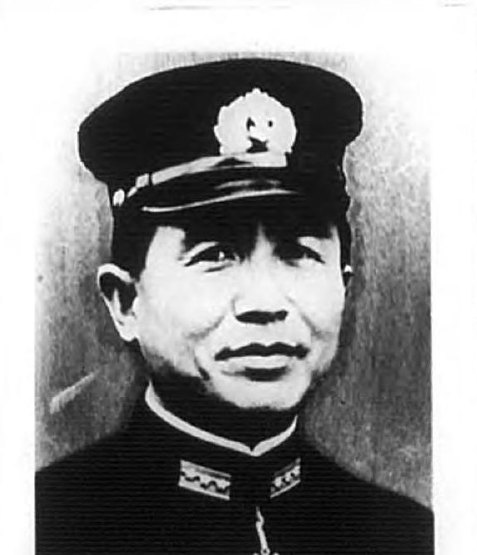
Sadamichi Kajioka was born on 18 May 1891 in Ehime Prefecture, the second son of Tamesaburo Kajioka, and he spent his whole career in the Imperial Japanese Navy. He finished the Naval Academy with the 39th class in July 1911 and went to sea as a midshipman in the cruisers Aso and Tokiwa. After he was commissioned he served in Akitsushima. Navigation became his trade. As a lieutenant, and later as a lieutenant commander, he was navigator of ships that included Kiso, Chikuma, and Kasuga, then the armored cruiser Asama, the heavy cruiser Nachi, and the battleship Mutsu, with intervals ashore in the Hydrographic Department and as an instructor, including duty at the Navigation School.
He was promoted to captain in November 1934. In that rank he commanded the fleet oiler Naruto, took the light cruiser Nagara in November 1935, and afterward commanded Kasuga and Kiso, before a shore post managing the harbor at Yokosuka. On 15 November 1940 he became a rear admiral. He then led the Sasebo Defense Squadron and, from April 1941, the Yokosuka Defense Squadron. In July 1941 the Fourth Fleet gave him Destroyer Squadron 6. That was flag duty. On 11 December 1941 his flag was in Yubari. He went against Wake as a rear admiral in command of the invasion force, while each ship kept its own captain.
The force he took in for the first landing comprised the light cruisers Tenryu and Tatsuta and the destroyers Oite, Hayate, Mutsuki, Kisaragi, Yayoi, and Mochizuki, together with two converted destroyers, Jingei, Kongo Maru, and Kinryu Maru. A naval landing party was embarked to put troops on the beach. Air attacks over the previous days had been reported as having destroyed the aircraft on the island and silenced the coastal batteries, and the squadron closed the atoll on the strength of that report. The Marine guns were still in action when the ships arrived.
In the dark before dawn on 11 December the column stood in to lower its boats, and the shore batteries opened fire. Those guns sank Hayate. The cruiser records credit a bomb from Captain Henry T. Elrod with the hit on Kisaragi. Yubari was struck repeatedly by the same shore fire, other ships in the line were damaged, and the landing party never got a foothold it could hold. With two destroyers lost and the flagship hurt, Kajioka broke off the assault and took the force back to Kwajalein.
He kept the command and was sent to try again. He brought the force back from Kwajalein reinforced, with a heavier escort and with carrier aircraft overhead that the first attempt had lacked. The second landing got troops ashore against the same garrison, already worn down by the first fight and by continued bombing. Wake surrendered on 23 December 1941. The island that had driven an invasion force away on the 11th was in Japanese hands before the month ended, and Kajioka's squadron had carried both the failed attempt and the return.
He remained commander of Destroyer Squadron 6 into the South Pacific campaigns of 1942. His ships covered the landings at Lae and Salamaua on the north coast of New Guinea. In May he escorted the convoy bound for Port Moresby, and that convoy turned back during the Battle of the Coral Sea after the air cover it depended on was gone. In July 1942 he shifted to command of Cruiser Division 18. That September he was ordered to the special naval base force at Rashin, on the northeast coast of Korea, harbor and local-sea duty far from the carrier battles. In October 1943 he left active service and was placed on the retired list.
The navy recalled him in January 1944. In April he was given the 6th Escort Convoy headquarters, responsible for merchant and troop movements on routes where American submarines were taking a heavy toll of Japanese shipping. He directed sailings that included the Take Ichi convoy and convoy HI-71, moving men and supplies between the home islands and the southern theaters. On 12 September 1944 he was at sea in command of convoy HI-72 when the escort Hirado, the ship he was aboard, was sunk. He was killed. The navy promoted him to vice admiral after his death.