Ships
- IJN Kirishima Captain from 20 April 1942 · In command when she was lost, 15 November 1942
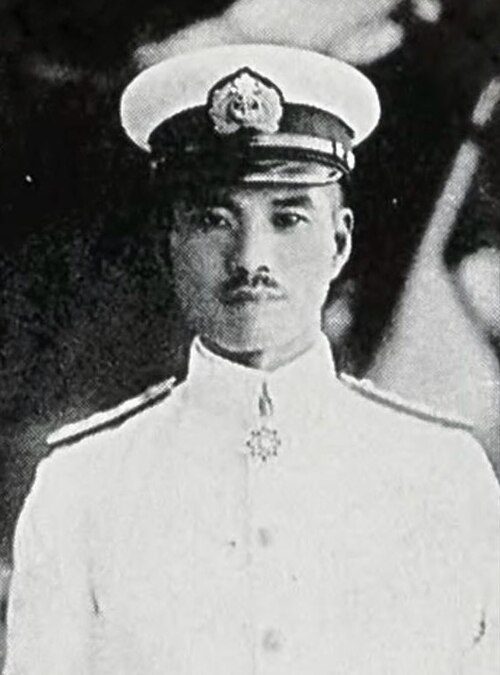
Sanji Iwabuchi was born on 2 March 1895 in what is now Sanjo, in Niigata Prefecture. He entered the Imperial Japanese Naval Academy with its 43rd class and graduated in December 1915, thirteenth of ninety-six. His first sea duty was as a midshipman in the armored cruiser Iwate. He later served in the armored cruiser Nisshin and the destroyer Umikaze, and he passed through the basic courses at the gunnery and torpedo schools. A tour with the Yokosuka Air Group in the early 1920s placed him for a time among naval aviators. He then made his career in gunnery.
On 22 March 1938 he took command of the seaplane carrier Kamoi. That August he moved to the Naval General Staff. He was a captain by 1 April 1941, when he was given the training cruiser Kashii. At the opening of the Pacific War he was ashore as chief equipment officer of the seaplane tender Akitsushima, still under construction, a duty he had held since 1 November 1941. On 25 March 1942 he joined the staff of the Combined Fleet.
That staff duty lasted only a few weeks. Iwabuchi became captain of Kirishima on 20 April 1942. She was a Kongo-class battleship, rebuilt between the wars as a fast ship meant to run with the carriers. In June she screened the carrier force at Midway. Through the late summer and autumn she worked from Truk in the struggle for Guadalcanal, and under his command she was present for the carrier battles off the Eastern Solomons in August and at Santa Cruz in October.
His command of the battleship ended in the second night action off Guadalcanal. On the night of 14–15 November 1942 Kirishima went in with Vice Admiral Nobutake Kondo’s force, sent to shell Henderson Field. American battleships stood in the way. Kirishima and the Japanese escorts struck South Dakota hard, and Washington replied with 16-inch fire at close range. The hits ruined Kirishima’s steering, wrecked her upper works, and opened heavy flooding. Iwabuchi remained in command. He ordered a forward magazine flooded and tried to have her towed toward a beach, with destroyers or the light cruiser Nagara to help. The ship was beyond saving. Before dawn on 15 November the crew scuttled her, and Iwabuchi left with the survivors.
On 22 November 1942 he joined the staff of the 11th Air Fleet, occupied with air operations over Guadalcanal and Rabaul. In February 1943 he returned to Japan for duty in the First Naval District. Promotion to rear admiral came in May 1943, together with command of the 31st Special Base Force at Manila. In November 1944 he also took charge of the Manila Naval Defense Force, sailors and attached soldiers holding the Philippine capital. Their positions included hundreds of antiaircraft and dual-purpose guns, some of them taken from ships wrecked in the harbor.
American troops landed on Luzon in January 1945. General Tomoyuki Yamashita, commanding Japanese army forces in the Philippines, ordered the naval garrison out of Manila so the campaign could be fought from the mountains, and he meant the capital to be left an open city. Iwabuchi kept his men there and defended it street by street. Naval troops under his command killed civilians on a vast scale while the fighting consumed the neighborhoods and the old walled district of Intramuros. The civilian dead are commonly reckoned at about a hundred thousand, along with most of the Japanese garrison and about a thousand Americans. On 26 February 1945, as the defense collapsed, Iwabuchi took his own life at his headquarters in Intramuros. The navy promoted him to vice admiral after his death.