Ships
- IJN Akagi Captain from 25 April 1942 · In command when she was lost, 5 June 1942
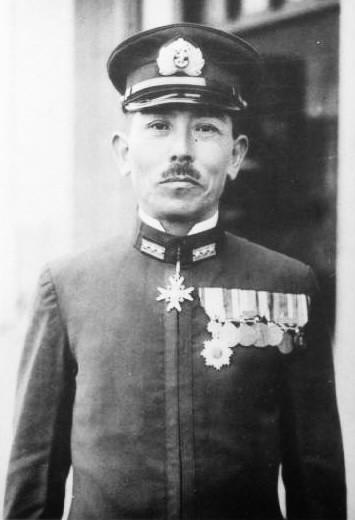
He was the officer the Japanese personnel compilations call 青木泰二郎, read Taijirō, and written in English Taijiro. The English Wikipedia lead also prints "Takijirō." That is a bad romanization. 泰二郎 is Taijirō, not Takijirō. The Naval Data Base, the Etajima class lists, and the Japanese captain lists all use 青木泰二郎. No second writing of the characters turned up. This essay did not get a clean optical reading of his name in an appointment gazette, so the kanji rest on those lists agreeing with one another, and on the American interrogation that names "Captain AOKI, Taijiro" as Akagi's commanding officer at Midway.
Not Kyuji Aoki
Kyuji Aoki is 青木久治, Etajima class 50, a destroyer captain from Mie, killed on 7 July 1944 when the destroyer Tamanami was sunk in the South China Sea. He was fifteen classes and a generation behind. Nothing in Taijiro's record puts him on Tamanami, in a destroyer division, or among the dead of 1944. Nothing in Kyuji's record puts him on Akagi.
青木 is a common naval surname. The same personnel file that carries Taijiro carries other Aokis of other classes and specialties. The class-41 lists consulted here contain one 青木泰二郎. He is the one who had the carrier for six weeks in 1942, lost her, and was still alive in Tokyo in October 1945 to be questioned about it.
Origins
No birth date has turned up. The Japanese Wikipedia infobox says the birth year is unknown, and the Naval Data Base, which is usually willing to print a year when it has one, prints none. The class lists give his registered domicile as Tokyo. In the way those lists are built, that is the Navy's 本籍, the legal home inherited from the rolls, not a proved birthplace and not a proved house. No middle school is attached to his name in the class-41 roster that prints schools for many of his classmates. No parents, no wife, and no siblings have been found in anything read for this essay.
He graduated with the 41st class of the Naval Academy at Etajima on 19 December 1913. On that, the Naval Data Base, a compiled class roster, and Niehorster's class table agree, and they agree that he finished a captain, not a flag officer. They do not agree on the size of the class or on his place in it. The Naval Data Base says the class graduated 118 strong and that he stood 90th. The compiled roster and Niehorster's table both say 113 graduates, and neither prints a class standing. The English Wikipedia repeats 90 out of 118, which is the database figure, not an independent count. The original order-of-merit list was not opened. If 90th of 118 is right, he left Etajima in the bottom quarter of a large class. The Navy did not treat that as the end of a career. It did shape the ceiling. Classmates on the same lists include Ryūnosuke Kusaka, Masatomi Kimura, and Raizō Tanaka, all of whom reached vice admiral. Aoki stopped at captain. Nishida's postwar rank roll of the class, which keeps only men who made commander or above in a shortened table, files him under 海軍大佐 with two other captains and does not pretend he was among the admirals.
A son is a separate and weaker claim. The Japanese Wikipedia article on the journalist and Tsukuba professor Aoki Akira (青木彰), born in Tokyo on 4 July 1926 and dead on 16 December 2003, names 青木泰二郎 as his father in the infobox. The line is widely copied. It is not footnoted in the article as retrieved, and no family register was read. It is recorded here as that article's identification, not as a proved household.
Formation
The rank dates and the early billets that follow are the Naval Data Base chronology unless a gazette is named. The English Wikipedia "known assignments" list tracks the same promotions to the day, which is a sign that both drew on the same compiled file, not that two archives were read. Most of these dates were not re-read in the Kanpō or the appointment gazette for this essay.
He was warranted midshipman on 19 December 1913, the graduation day. Ensign on 1 December 1914. Lieutenant (junior grade) on 1 December 1916, with the ordinary course at the Torpedo School and then, from 1 June 1917, the ordinary course at the Gunnery School. Lieutenant on 1 December 1920. The database then puts him in the crew of the destroyer Nashi, then of Tachibana from 20 November 1921, then as an instructor at the Tokyo Higher Merchant Marine School, then in the crew of the 18th Destroyer, and from 1 December 1923 to 1 December 1924 as gunnery officer of the destroyer Tanikaze. Lieutenant commander on 1 December 1926, and an instructor at the Gunnery School, then gunnery officer of the heavy cruiser Aoba. From 1 November 1930 he was on the fitting-out detail of the heavy cruiser Takao. The English list has that billet running to 15 October 1931 and then makes him gunnery officer of the carrier Kaga until 20 October 1933. The database's dates for Kaga are not spelled the same way; it says gunnery officer of Kaga after the commander promotion of 1 December 1932. The two lists are describing one gunnery career, and they are not identical in the joins.
What is consistent, and what matters, is the turn out of gunnery. On 20 October 1933 he became executive officer of the seaplane carrier Notoro. On 1 November 1934 he was an instructor at the Kasumigaura Air Group. He was not, on his own later word, a pilot. The United States Strategic Bombing Survey's interrogators wrote it down as the first thing they recorded about him: commanding officer of Akagi at Midway, and not a pilot. The aviation in his record before the war is administration and training, not a cockpit.
Commander on 1 December 1932, if the database's promotion date is the one to follow, while he was still in the gunnery line. Executive officer of the Kisarazu Air Group from 1 April 1936. Executive officer of Kaga again from 1 December 1936. Captain on 1 December 1937. On 15 November 1937, two weeks before that promotion in the database's order, he was given command of Kinugasa Maru. The English assignment list has him leave her on 28 April 1938. On 16 May 1938 he was chief equipping officer of the new seaplane tender Mizuho, and on 25 February 1939 her first captain. He left her on 15 November 1939. Mizuho's later life, including her loss in 1942, belongs to other captains. He had her for the commissioning year, not for the war.
From 15 November 1939 the database has him as head of the preparatory-training department at the Yokosuka Air Group, the yokaren pipeline, and then attached to Kasumigaura as an instructor. On 15 November 1940 he became commanding officer of the Tsuchiura Air Group. The Tsuchiura article in the Japanese Wikipedia cites the appointment gazette, internal extra, No. 555, 15 November 1940, JACAR C13072079500, for the start of that command. The metadata of that file was opened. The transcribed extract at the head of it is a run of captains' orders and does not reach his name; the images were not read. The citation is the article's, not a line verified here. The same article, without a gazette footnote, has Captain Hasegawa Kiichi relieving him at Tsuchiura on 25 April 1942.
That date is the hinge. Hasegawa is the captain the Akagi lists show in the ship from 25 March 1941 through the Pearl Harbor operation, the southern raids, and the Indian Ocean, and out on 25 April 1942. The same lists put Aoki in on that day. If both lists are right, the Navy swapped them: the man who had fought the ship went to a training group, and the training-group commander went to the ship. Aoki had come up through guns, a seaplane tender, and the air schools. He had not taken a fleet carrier to war. He told the American interrogators in 1945 that Pearl Harbor was Akagi's first operation, that she had attacked Ceylon and Trincomalee, and that Midway was the only action in which he himself was aboard.
He was at Tsuchiura when the Pacific War opened. The sources read here do not say what he did with that air group in the sixteen months he had it, beyond the fact of the command. A surviving class album from the 1942 preparatory course has been offered for sale with his name, and Hasegawa's, printed as successive commanding officers. The album was not in hand. It is a pointer that he was the commander the trainees were told they had, not evidence of how he ran the field.
The weeks he actually had her
Twenty-five April 1942 is the date in the Naval Data Base, in the English assignment list, in Jeff Donahoo's carrier table, and in the Japanese Wikipedia captain list for Akagi. That last list attaches the date to Toyama Misao's Kanchō-tachi no kankanshi and to the officer biographies in Nihon kaigun shi, not to a numbered gazette. The appointment gazette for 20–30 April 1942, JACAR C13072085200, was downloaded and is fifty-four image pages. It is full of Akagi orders in those days: division officers, aircrew ordered into the ship, a maintenance officer, men "ordered to Akagi while she is in commission." A line reading that Captain Aoki was appointed her captain was not successfully read out of it. The date is the date every serious list uses. It is not, in this essay, a date copied off the order itself.
He joined a ship that had just come home. The Mobile Force's own detailed battle report, First Air Fleet Secret No. 38 of 15 June 1942, in the Office of Naval Intelligence translation, says the ships returned to home ports on 22 and 23 April and went straight into repair. From late April the carrier planes trained at Kagoshima for Akagi, Kanoya for Kaga, Tomitaka for Hiryū, Kasanohara for Sōryū. Because Akagi was under repair, the flag moved to Kaga early in May and came back to Akagi in the middle of the month, at Hashirajima. Aircraft were taken aboard on 24 May. Operation plans were agreed on the 26th. At 0600 on 27 May the force sailed. Aoki had been her captain, on the lists, for thirty-two days when she left the anchorage, and for a large part of that month the flag had not even been in her.
The same report is blunt about the air group he inherited and did not train. There had been a heavy turnover. Almost nobody got past basic work. Inexperienced fliers were barely able to make daytime carrier landings. Some of the veterans had lost skill. There was no joint training of search, illumination, and attack, and the report says a night attack was therefore almost pointless. Mock torpedo attacks in mid-May, judged by the Yokosuka Air Group, were so poor that someone remarked it was a mystery how such men had done so well in the Coral Sea. On 18 May, against Cruiser Division 8 at thirty knots, about a third of the torpedoes were lost in forty to fifty meters of water. Dive-bombing practice was starved by maintenance and by the time lost flying to and from the target ship Settsu. The carriers themselves were in dock until a few days before sailing. The report's "I" is Vice Admiral Nagumo, not the new captain. Aoki was not a pilot, and he had been aboard for days, not for the months in which that air group was made. The failure described is a fleet failure sitting on his flight deck. It is not a verdict the report delivers on him by name. The report does not name him at all.
He told the interrogators what the passage felt like from the ship. Radio silence. Training flights for about two days, and then the weather went bad. Antisubmarine patrol every day, four Type 97 attack planes searching out to about 40,000 meters. No combat air patrol on the way. At night the same ring formation as by day. He had expected the first air attack about 500 miles out. It came, he said, about 200 miles out, about two hours after sunrise. Because the Navy had lost so little at Pearl Harbor, he said, they thought they would get away with the same thing at Midway.
The day
The times in the Mobile Force report are the report's times. Later scholarship reads them as Japan Standard Time, which puts the bombing on 5 June by the Japanese calendar and on 4 June by the American one. The interrogators and Aoki, in Tokyo in October 1945, used the American dates: hit on 4 June, scuttled the next morning. 5 June 1942 matches the American date of the scuttling, and the Japanese date of the hits. It does not match the Japanese date of the sinking, which the report puts at 0200 on 6 June. Both calendars are in the sources. They are not a disagreement about what happened.
What happened, in the report's own Akagi section, is this. Through the morning the ship had been maneuvering against torpedo planes and had not been hit. At 0726 three dive bombers came out of the clouds on the port side, from about 2,000 meters, in a dive of about fifty degrees, and released at about 500. The first bomb was a near miss, about ten meters abeam of the bridge. The second hit near the midships elevator. The report calls that the fatal hit. The third hit the flight deck to port, aft: holes in the after deck, one emergency-duty man killed. She was spotted to launch a second strike. The fire went through the hangar. At 0729 torpedoes stowed there began to cook off. The magazines were ordered flooded. The forward groups flooded at once. Aft, damaged valves stopped the automatic flooding of everything but one ammunition room; the rest were flooded two and a half hours later.
At 0736 the starboard after engine was damaged and she could still make cruising speed. At 0742 the steering failed, the engines stopped, and all hands were ordered to fire-fighting stations. The only guns still able to fire were two machine-gun groups and one antiaircraft gun. At 0743 a fighter parked to starboard of the bridge caught fire and the fire spread to the bridge. The pumps were ordered on, and the engine room was ordered to make full speed. At 0745 the destroyer Nowaki came alongside to take the staff. At 0746 the commander in chief and the other headquarters officers left the bridge.
The captain did not go with them. At 0820 the report says the commander and the others who were still on the bridge moved to the forward flight deck. At 0830 the air personnel and the wounded were ordered to the destroyers. At 0835 the torpedo and bomb stowage blew, and the flight deck was on fire in earnest. At 0840 the commander and the staff officers still aboard moved down to the forward anchor deck. At 0850 the chief engineer came to that deck and reported the state of the engines. At 0903 the ship, which had been stopped, started to move on her own and to turn to starboard. At 0913 an engineer ensign named Akiyama, sent to find out why, reported that the engine-room command had been wiped out. At 0930 Nowaki signaled, and the report quotes the signal as from the commander of Akagi: all safe except on the flight deck, every effort being made to fight the fires. At 1038 the Emperor's portrait was taken across to Nowaki. At 1050 Akagi stopped.
Aoki's own account, three years later, is shorter and not the same in the details. He said two bombs, not a near miss and two hits, one of them starting the fire at the after elevator. He said about half the planes were already off attacking Midway, about forty still aboard being serviced, and a high cover of six Zeros. There was no second flight from Akagi. The planes in the hangar, bombs on them, caught fire. The ship did not sink from the bombs. The engines were helpless, the fire had done its work, she could not be navigated, and the ship was given up. Many of the engineers were killed. On the morning of the 5th, in the American dating, a Japanese destroyer torpedoed her. He said 200 dead and 100 wounded out of 1,400 aboard, and six pilots lost. The others, he said, had landed and been picked up by destroyers.
The report's later reckoning of the dead, as the Japanese Wikipedia cites it from part 4, page 47, of the same document, is 221 killed: eight warrant officers and above, 213 enlisted. The article also says the number actually on board is not known, because men were embarked to occupy the Midway base, and it gives a paper complement of 1,630 plus 64 men of the First Air Fleet staff. That page of the report was not opened for this essay. Aoki's 200 out of 1,400 and the report's 221 are the same order of loss. They are not the same number, and they do not describe the same counted population. He was remembering in 1945. The report was written in June 1942, under the difficulties the American editors noted: many of the ships' diaries and charts had gone down with them.
By 1620, the report says, the situation was deemed hopeless, and the captain of Akagi decided to order all hands to abandon ship. He reported that to the Mobile Force commander. The order went out at 1625. At 1700 men began transferring to the destroyers Arashi and Nowaki. At 1925 Admiral Yamamoto, from Yamato, ordered the scuttling delayed. At 0150 on the 6th he ordered it carried out. At 0200 she was scuttled in position 30 degrees 30 minutes north, 178 degrees 40 minutes west. The report does not say, in the translation, that the captain asked for the torpedoes, and it does not say that he refused to leave. It says he decided the ship was finished, reported it, and gave the order.
The story that he meant to die on her, and was talked or dragged onto Arashi, is not in that report and not in his interrogation. It is in later Japanese accounts. The Akagi article on the Japanese Wikipedia, citing memoirs and secondary books rather than the battle report for this particular moment, puts him on Arashi at 1930, persuaded by Captain Ariga Kōsaku of Destroyer Division 4, by Commander Miura, Akagi's navigator, and by Commander Masuda Shōgo, her air officer. Those books were not read for this essay. Hisako Sawachi, in Sōkai yo nemure, is the source the current Japanese Wikipedia article cites when it discusses his survival, and Yōji Watanabe's Sen'un no hate de is the source it cites for a harsh judgment of his last command. Neither book was opened. What can be said from the documents that were read is narrower. He stayed after the admiral left. He was still sending a fighting-the-fires signal at 0930. He gave the abandon-ship order at 1625. He was alive in 1945.
The same report, in the same pages, writes the other three captains differently, and the difference is in the document, not in a later moral. Kaga's captain was on the bridge when a bomb killed everyone there. Sōryū's captain, Ryūsaku Yanagimoto, went to the signal tower, would let no one approach, and was shouting banzai when the fire took him. Hiryū's captain, Tomeo Kaku, and Rear Admiral Tamon Yamaguchi stayed after their crew had left, waved their caps, and went down with the ship; she was then scuttled by one torpedo from Makigumo. Akagi's captain is not given that paragraph. The report records his decision and his order. It does not praise him and it does not accuse him.
He told the interrogators the occupation was abandoned because the carriers were too badly damaged and the force had lost control of the air. He said no battleship in his group was seriously hit, and that he saw no American planes on the 5th or later, during the retirement. He said Akagi had no radar, and that no carrier at Midway had it. When he went to the arsenal at Kure in August 1942, he saw the antenna grids on Ise and Hyūga, and he supposed the sets were then going onto the better ships. That sentence is the last thing the interrogation gives of his own movements. It puts him in Japan, at Kure, in August 1942. It is his date, not a gazette's.
After the ship
The lists do not agree about the months after Midway, and his August at Kure is the fact that sorts them.
One Japanese summary, repeated on several carrier-captain pages of no great authority, says he was transferred to the reserve on 14 July 1942, then recalled and attached to the Hainan Guard District. The Naval Data Base says the reserve date was 16 October 1942, and that he was recalled on 1 November 1942 and attached to the Hainan Guard District. The English Wikipedia assignment list, which is silent on any reserve status, has him as a staff officer at Yokosuka from 25 July to 25 August 1942, at Kure from 25 August to 5 October, at Yokosuka again from 5 October to 1 November, and then on the staff of the Hainan Guard District from 1 November 1942. The Kure dates are the only ones that sit under his own words. A man placed in the reserve on 14 July and sent to Hainan does not, without some further order, walk the Kure arsenal in August and look at battleship radar. The 14 July story is the weak one. Between "reserve on 16 October, recalled 1 November" and "staff officer at Kure through 5 October, then Yokosuka, then Hainan on 1 November," this essay cannot choose by reading the gazette. Both are compilations. Only the August visit is his.
From there the same two compilations walk him through air-group commands and do not use the same names or the same days. The database has him, from 1 October 1943 to 1 May 1944, as commanding officer and executive officer of the Haikou Air Group, then commanding officer of the 951st Air Group, which it glosses as Sasebo, and from 15 December 1944 as commanding officer of the Genzan Air Group. The English list has him commanding the Hainan Air Group from 1 October 1943 to 26 May 1944, with additional duty as commanding officer of the Haikou Air Group and of the Oryū Air Group until 1 May 1944, then the Sasebo Air Group from 15 May to 15 December 1944, then commanding officer and executive officer of the Genzan Air Group from 15 December 1944 to 15 August 1945. Haikou is on both lists. "Hainan Air Group" and "Oryū" are not on the database line. The May 1944 handoff is the 1st on one list and the 15th, or the 26th, on the other. None of these orders was read in the gazette.
Genzan, at Wonsan in Korea, is where both lists leave him at the end of the war, and where the postwar argument starts. The English Wikipedia, and the Japanese encyclopedia copies that still carry a biographical sketch, say that when the surrender was announced he flew back to Japan, and that the men left at Wonsan were taken by the Soviet Union and sent to camps in Siberia, where many died. The current Japanese Wikipedia article does not tell that story in its own voice. It says that researchers disagree, cites Sawachi on his conduct at Midway, and cites Watanabe for a severe judgment of the Genzan withdrawal as an abandonment of a commander's duty. Those judgments are the authors'. They were not re-argued here, because the books were not read, and no order, flight log, or nominal roll of the Genzan Air Group was opened. What is documented without them is that on 9 October 1945 he was in Tokyo, not in Korea. Captain C. Shands, USN, questioned him for the Strategic Bombing Survey. Brigadier General G. Gardner, Commander T. H. Moorer, and Lieutenant Commander J. A. Field, Jr., were present. The transcript is the interrogation of the Midway captain, and he answered as that man: not a pilot, aboard Akagi for Midway and for no earlier operation, and recently enough at Kure to remember the radar on Ise and Hyūga.
The Japanese Wikipedia says he was listed for the postwar purge from public office, and points at page 1 of the 1949 roster of persons falling under the relevant memorandum, compiled by the Prime Minister's Office. That page was not retrieved. A kindergarten in Saitama, which some encyclopedia copies give him as a postwar job, is not in the current Japanese article's text as fetched, and no school record was found. It is not used here.
The Naval Data Base and the Japanese Wikipedia infobox give his death as 23 November 1962. No obituary was found. No grave, no will, and no last address were found. If the date is right, he lived twenty years after the ship, and seventeen after the afternoon in Tokyo when he told an American captain how she burned. The rank he died with, on every list, was captain. The Navy had not made him an admiral after Midway, and it had not kept him out of work. It had sent him to training fields and to air stations in occupied China and in Korea, and it had left him a captain.