Ships
- IJN Kongo Captain from 15 August 1941
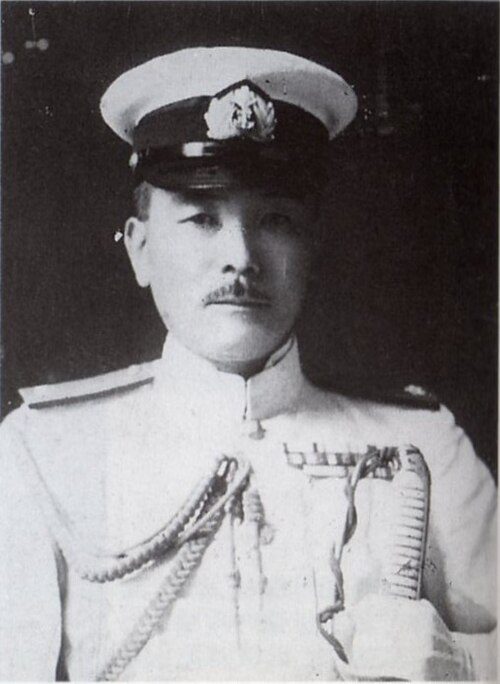
Tomiji Koyanagi was born in Niigata Prefecture on 16 July 1893. He graduated from the Imperial Japanese Naval Academy in December 1914, 72nd in a class of 117, and started as a midshipman in the cruiser Aso and then the battleship Kawachi. After the Naval Staff College in 1926 he was promoted to lieutenant commander and given his first command, the destroyer Wakatake. Through the 1930s he taught destroyer handling and torpedo tactics, at the torpedo school and on the Navy's education staff, and that specialty stayed with him for the rest of his service.
He became a captain in December 1936. In July 1938 he took the cruiser Iwate, and in January 1939 the 8th Destroyer Division, before returning to the torpedo school as chief instructor. On 15 October 1940 he assumed command of the heavy cruiser Atago. On 15 August 1941 he became captain of the battleship Kongo at Hashirajima. Kongo was flagship of Vice Admiral Takeo Kurita's Battleship Division 3, and Koyanagi spent the first year of the Pacific War on her bridge.
In December 1941 Kongo sailed with Haruna in the Southern Force, covering the landings in Malaya from Cam Ranh Bay and the South China Sea and, later that month, the landings in Lingayen Gulf. In April 1942 she went into the Indian Ocean with the carrier force that struck Ceylon. At Midway in June she screened the Second Fleet's invasion force and came home without a surface engagement. Her heaviest action under his command was the night of 13 October 1942, when Kongo and Haruna closed Guadalcanal and bombarded Henderson Field, setting aircraft and fuel on the field ablaze while Kurita directed the division from the flagship.
Koyanagi was promoted to rear admiral on 1 November 1942 and left Kongo in December. Toshio Shimazaki took the battleship after him. Late that month Koyanagi was given the 2nd Destroyer Squadron, the formation Raizo Tanaka had led on the supply runs into Guadalcanal. The tour was short. From January to June 1943 he commanded the 10th Destroyer Squadron and helped bring Japanese troops out of the Solomons as the fight for Guadalcanal ended. Matsuji Ijuin commanded another destroyer squadron in those same waters.
In July 1943 he joined Kurita again, this time as chief of staff of the Second Fleet, the Navy's heavy surface force of battleships and cruisers. The two men already knew each other from Battleship Division 3, when Kongo had been the flagship. Koyanagi kept the staff post through the fleet operations of 1944. In the Battle of the Philippine Sea that June, Kurita led the van ahead of the carriers, and Koyanagi was with him. He still held to the idea of one decisive battle with the American fleet, and he objected when the orders for the Philippines aimed the Second Fleet at the transports off the Leyte beaches.
He sailed for that operation in Atago, once more Kurita's flagship. Early on 23 October 1944, in the Palawan Passage, the American submarine Darter hit Atago with four torpedoes and the cruiser capsized. Koyanagi survived and moved with Kurita to the battleship Yamato. Nearly half the flag communications crew was lost with Atago, and the staff felt that shortage for the rest of the battle. On 25 October the Center Force met American escort carriers and their destroyers off Samar, fought a running action, and then turned north. Koyanagi later gave one of the fullest accounts of why Kurita made that turn and left Leyte Gulf astern. On 26 October, during the retirement, fragments from a near miss wounded him badly.
The wounds kept him in hospital until August 1945. He then served at Yokosuka and, for a short time, as principal of the naval torpedo school, the work he had taught before the war. On 24 October 1945, in Tokyo, he answered questions about Samar and about the turn to the north. He retired as a vice admiral. In 1953 he wrote his own account of the operation under Kurita. He died on 6 August 1978.