Ships
- USS Craven (DD-382) Captain, 2 September 1937 – 15 June 1939
- USS George F. Elliott (AP-13) In command, 7 August 1942
Compiled lists give him USS Craven (DD-382) from 2 September 1937 to 15 June 1939.
That is a peacetime commissioning command, not a war cruise, and the word “Captain” on the command line is the Navy’s old name for the officer in command, not the rank. The Dictionary of American Naval Fighting Ships, in the text reprinted for Craven (DD-382), confirms the start: the ship was commissioned at Bethlehem, Quincy, on 2 September 1937, Lieutenant Commander W. O. Bailey in command. The Navy Directory of 1 January 1938 still lists him that way — lieutenant commander, commanding USS Craven. The 1 July 1938 Register then lists him as a commander. In that volume’s lineal list an explicit date of rank, 23 June 1938, stands at the entry just before the dittos, and Bailey’s own line, signal number 868, is marked “do,” with no later date breaking the chain. If he was still in Craven on 23 June 1938, the promotion fell in the middle of the command listed as a lieutenant commander’s tour from beginning to end.
The end date is weaker than the start. The NavSource command list closes the tour on 15 June 1939. No register or directory read for this essay prints that day. What the directories do print is the bracket around it: commanding officer on 1 January 1938, and by the directory of 1 October 1939 a commander serving as inspector of naval material at Chicago. The June 1939 relief is consistent with that bracket. It is not, on the sources in hand, independently proved.
He is not David Worth Bagley, the admiral born in 1883 who had Pensacola in the early 1930s and flew a flag in the war. The Registers carry other Baileys in the same decades — Vaughn, Carlos A., William B., a Marine named Kenneth D. — and the Atlantic Fleet’s organization chart for the third quarter of 1942 names a Captain C. A. Bailey in Transport Division One and in Neville. Watson Osgood Bailey’s signal number, birth date, and date of entry run in one continuous line from the 1 January 1918 Register to the 1 July 1945 Register. The Craven commanding officer and the amphibious captain of 1943–44 are that man. His war, once it is traced, was not fought in Craven at all.
Origins
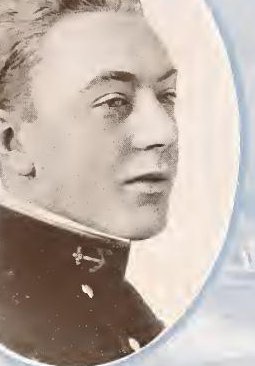
The 1 July 1945 Register gives his date of birth as 2 October 1897 and his date of entry as 16 June 1914. It does not give a birthplace. A compilation used by uboat.net says Boston; that place is not in the register line, and it is not used here as fact. What the Naval Academy’s own book says is hometown, not birthplace. The 1918 Lucky Bag heads his sketch “Watson Osgood Bailey, Lynn, Massachusetts,” and the nicknames “Bill Bailey” and “W.O.” Hall of Valor’s awards page later lists a home of East Lynn, Massachusetts, which is a section of the same city. Lynn is the place his classmates put under his name. East Lynn is an awards-index field, not a sentence he wrote.
He entered the Academy in the summer of 1914 with the class that the Lucky Bag calls 1918. The war cut the course to three years. The Register of 1 January 1918 lists him as a lieutenant (junior grade), signal number 2403, inside a block of that rank whose first line is dated 15 October 1917 for temporary rank under the act of 22 May 1917, with permanent rank ensign from 29 June 1917. His own line carries the ditto. That 29 June 1917 ensign date is the wartime commissioning of the class. He was nineteen.
The yearbook is not a service record. It is what his classmates chose to print, in the voice they used on everyone, and it should be read as that. They called him genial and open-hearted, “the pride of his fellow-statesmen,” and then immediately undercut the pride: he was one of the boys who “increases the activities of the Academic Departments,” and who, just as another failure seemed certain, “crowns the exam with fervor and gleefully takes a new lease on life.” His advice on re-examinations, they said, was “Don’t let a little thing like that worry you.” They credited him with track numerals, not a varsity letter, and with a label, “Buzzard,” that the sketch does not translate. They put him on the stage, on a bicycle, in the mile, in chemistry, and in German, and claimed his German was “positively immodest.” The later Registers, which are careful about languages, do not list him as an interpreter or translator. The fluency is a classmate’s joke until some other source confirms it.
They also gave him a girl and a superstition, neither of them documented outside the joke. When a record started the song “Bill Bailey, won’t you please come home?,” they wrote, he thought it was the Marine Corps calling. He liked the Navy, “coming as he does from the coast of Massachusetts,” but there was “a valid and potent reason” for the other thought: “It is said she possesses all the virtues of two pilgrims, six fairies, and the queen of England.” No name, no marriage. He told them, they said, that he had left home on Friday the thirteenth, ridden in car 13, arrived in Baltimore on track 13, taken train 13 to Annapolis, and walked into military life with thirteen wrinkles. And he was one of “the owls on board the Wisconsin” who sat up until three in the morning “in a thorough and exhaustive research to determine who had the luck.” Games of chance were “his specialty,” pinochle the one they thought had become too dangerous to keep playing. USS Wisconsin was the Academy practice ship. The sketch places him in her for a card game. It does not date the cruise, and it does not make the Friday-the-thirteenth itinerary anything but a story he told.
That is the only portrait of temperament that survives from before the war: a Lynn boy who scraped the academics, ran track for his class, liked a game, and got through. The Registers show that he did get through, with his class, on 29 June 1917. What ship took the new ensign in the last year of the World War is not in the 1918 Register and has not turned up in a directory. The first year and a half of his commissioned life is a blank.
Formation
By the Register of 1 January 1920 he is a lieutenant. The page is the temporary-rank list under the act of 22 May 1917, so the rank on that date is the wartime temporary grade, not yet a clean permanent date of rank. The OCR of his line will not support a day. A secondary rank table gives temporary lieutenant on 1 July 1918 and permanent lieutenant on 1 July 1920. The January 1920 Register is compatible with the first of those and too early to test the second. Neither day was read off a register line clean enough to quote.
The Navy Directory then begins to place him. In November 1923, on 1 March 1924, on 1 January 1925, and on 1 May 1925, Lieutenant Watson O. Bailey is in USS Chewink. The directory does not describe the ship. It does show a long tour in one ship, the kind of duty that teaches a lieutenant how a ship actually runs when nobody is writing a citation about it. Between May 1925 and January 1927 the directories consulted here go silent on him.
On 1 January 1927 he is a lieutenant again, this time “instrn, Columbia University, New York.” Instructor, not student. The directory does not say whether the billet was naval science, engineering, or something else, and it would be a guess to call it NROTC. On 1 April 1928 he is in USS Beaver. On 1 January 1930 he is division engineer officer of Submarine Division 16. On 1 April 1931 he is still a lieutenant, ordered to the navy yard at Portsmouth, New Hampshire. A directory of 1 January 1929 that was searched did not yield his name in readable form; that year sits in the gap between Beaver and the submarine division, unexplained.
The qualifications on his later register line belong to these years even though the registers do not date them one by one. By 1 July 1938, and again in 1941 and 1945, his special-course codes are 1, 18, 22-a, and 30. The 1 July 1941 Register defines them in a key that is clean where the 1945 key’s columns are scrambled: 1, qualified for command of submarines; 18, completed the Naval War College correspondence course in strategy and tactics; 22-a, completed the postgraduate course in Diesel engineering; 30, completed the course in submarine instruction. He was not a passerby in the submarine force. He had the diesel course, the submarine school, and the qualification for command. The directories show the jobs that match: engineer in a submarine division, a stretch at the Portsmouth navy yard, and USS Beaver before that. The directory lines do not themselves say what Beaver was employed as, and this essay does not add a hull type. No source read for this essay shows him in command of a submarine. The qualification and the command are not the same fact.
By 1 July 1932 the directory has changed his rank. He is a lieutenant commander, engineer officer of USS Raleigh, and he is still that on 1 January 1933, 1 April 1934, and 1 January 1935. The promotion falls between the Portsmouth directory of 1 April 1931 and the Raleigh directory of 1 July 1932. Uboat.net prints 4 June 1931, which sits inside that window and was not confirmed from a register page opened here. Three years as engineer of Raleigh, after the diesel course and the submarine qualification, is a particular kind of formation. The directory does not print her type, and this essay does not add one. He knew machinery. The Navy kept giving him machinery.
On 1 April 1936 and again on 1 April 1937 he is assistant naval inspector of machinery at the Bethlehem Shipbuilding Corporation, Quincy, Massachusetts. That is the yard that had Craven on the ways. DANFS records the launch on 25 or 26 February 1937 — the reprinted DANFS text says 26 February; some later retellings say the 25th — sponsored by Mrs. F. Learned, daughter of the Commander Craven for whom the ship was named, and the commissioning on 2 September 1937 with Bailey in command. The man who had been signing off machinery at Quincy took the new destroyer to sea. The Directory of 1 January 1938 still has him there, lieutenant commander, commanding.
DANFS gives Craven’s movements while that command is at least partly his. After training in the Caribbean and along the east coast, and experimental torpedo firing at Newport, she left Norfolk on 16 August 1938 for the fleet at San Diego. From 4 January to 17 July 1939 she cruised to the Caribbean for maneuvers and fleet problems and to the east coast for visits, and otherwise operated off the west coast. The August 1938 sailing falls after the June 1938 promotion and before the October 1939 Chicago directory, so it belongs to his tour if he had not already been relieved — and nothing in the directories suggests he had. The long 1939 cruise runs past the 15 June relief date NavSource gives, so the last month of it may have been another man’s. From 1 April 1940, DANFS says, Craven was based at Pearl Harbor. That is after Bailey. When the Japanese attacked, she was at sea with Enterprise, coming back from Wake. Bailey had been in Chicago since at least 1 October 1939. The destroyer he commissioned fought the Pacific war under other captains: Mead Saltonstall Pearson from the NavSource list’s 15 June 1939, then Charles F. Quimby, then others. Those cruises are not his, and they are not told here as if they were.
What he did take from Craven was the one seagoing command of a fighting ship that the records show him holding. He brought a new destroyer through shakedown, torpedo trials, the passage to the Pacific fleet, and at least the start of her West Coast life. Then the station lists put the submarine-qualified engineer ashore as inspector of naval material in Chicago, and left him there. No order in hand says whether he asked for that or was sent. The directories of 1 October 1939, 1 November 1940, and 1 April 1941 all say the same thing: Commander Watson O. Bailey, inspector of naval material, Chicago. Europe had been at war since September 1939. He was not at sea for it.
The war as he lived it
The April 1941 directory is the last peacetime station list. After that the Registers drop the ship and the city, and the trail of billets breaks until the summer of 1943. Rank does not break. The 1 July 1941 Register still has him a commander, signal 734, the same course codes, date of rank still the June 1938 ditto. The 1 July 1945 Register, whose distinctions are those recorded through 1 May 1945, lists him among the captains. The column for temporary rank dittos back to an explicit 1 January 1942 at the head of that block. The permanent rank is captain, and the permanent date of rank dittos back to 30 June 1942. Born 2 October 1897. Entered 16 June 1914. Four marks beside the name: (D) (D) (D) (D). In that register’s key, (D) means the Legion of Merit awarded by the Navy Department. Four of them, on the books by the first of May 1945.
The citations, as Hall of Valor prints them, are the only detailed account of what he did in the war. They are official in form — “the President of the United States takes pleasure in presenting” — and they carry the service number 0-17076, which was not recovered from a register index in the copies read here. They are also boilerplate in diction. “Great energy and professional skill,” “able and aggressive leadership under fire,” “resourcefulness and outstanding ability” recur because that is how the Navy wrote a Legion of Merit, not because a witness sat down to describe one man’s face under fire. Read for facts, not for adjectives, they still place him.
The first, without a Combat “V” in the text as reproduced, is for Sicily. He was Commander, Transport Division Five, for the amphibious invasion of the island. The citation says he directed all the preparatory training, “molded Transport Division Five into an effective combat force,” and by leadership under fire landed the embarked troops “efficiently and expeditiously on enemy beaches.” It does not name the flagship or the division’s ships. The Eighth Fleet’s narrative of Husky, in the administrative history of Naval Forces, Northwest African Waters, records a movement rather than a man: at 0742 on 10 July 1943, “Trans div 5 moved in to 5000 yds. off CENT beaches.” The same narrative has CENT as the Scoglitti landing, flag in Ancon, troops of the 45th Infantry Division under General Middleton, H-hour delayed, air attacks through the day, boats held up on beaches for lack of shore parties. It never, in the passages read, says that Bailey gave the 0742 order or stood in any particular ship. The citation makes him the division commander for that invasion. The narrative shows what the division’s morning looked like from the task-force log, and no more. Claiming the log’s sentences as his personal acts would be a step past the evidence.
The second award, a Gold Star in lieu of a second Legion of Merit, with the Combat “V,” is for 1943 as “Commander of a Task Unit during the amphibious assault on Italy.” He directed training, planning, and the landing of “the embarked reinforced regimental combat team with vehicles and equipment” on “heavily defended assault beaches,” then “withdrew his Unit without serious casualty, despite repeated enemy bombing attacks.” The citation does not say Salerno, and it does not name a ship. Sicily already had its own citation, so this is a second landing. The American assault on the Italian mainland in 1943 was Salerno, in September. That is the operation the year and the wording point to. It is an identification by elimination, and it is marked as that. “Without serious casualty” is the citation’s phrase. It is not a claim that nobody was hurt, and it is not a report that has been checked against a ship’s log.
Then Normandy. The third award — second Gold Star, Combat “V,” action date 6 June 1944 — names him Commander of an Assault Group. He “was in command of a main group of the Assault Force, composed of a mixed fleet of American and British transports and American Landing Craft, which provided the lift for the 115th and 116th Regimental Combat Teams.” He brought them “to their pre-determined stations in the transport area,” got them unloaded, and “expedited the assault troops and equipment to the designated beaches.” The work was done “under darkness in an adverse sea.”
The operation order ties the surname to the group. Operation Order No. BB-44 of Assault Force “O,” signed aboard USS Ancon at Portland on 20 May 1944, lists Assault Group O-2, task designation 124.4, as “Captain Bailey, USN,” with Captain Wright as deputy. The flagship notation is CARROLL (F) — USS Charles Carroll (APA-28) — with Thomas Jefferson (APA-30) and the British Empire Javelin, six LSTs, a large LCI group, more than fifty LCTs, and the control craft. The order prints “Captain Bailey,” not the full name. The citation prints Watson Osgood Bailey, the same day, the same job, and the two regiments this group existed to lift. Assault Group O-1, under Captain Fritzsche of the Coast Guard, had Samuel Chase and the 16th Regimental Combat Team on the other half of Omaha. The match is to O-2, not to a different Bailey. He was the group commander embarked with his flag in Carroll. He was not Carroll’s commanding officer. The order does not make him one.
The Force “O” report, printed by the Commander-in-Chief in the Neptune series, is the account of what that morning became, and it is harsher than the citation. The air bombardment of Omaha did not arrive. The sea was bad enough that the duplex-drive tanks in front of one regiment foundered and the tanks in front of the 116th were taken in close before launching, which is why those reached the shore. Obstacles were thicker than intelligence had said. Demolition parties took about forty percent casualties and cleared five gaps instead of sixteen. Boat waves piled up on the obstacles, lost their shape in wind and tide, and were pulled back and reformed by the deputy assault group commanders — Wright’s function, not a sentence that names Bailey. At H-hour, “at the request of the Commanding General, V Corps, the Commander Assault Group O-2 was directed” to land the 115th Regimental Combat Team at H plus four hours, so that every infantry unit embarked in Force “O” was committed from the start. The report says the troops were pinned on the shingle for hours, that destroyers closed the beach to shoot what they could see, and that not until late morning did the exits begin to open. Bailey’s citation praises prompt unloading and sound judgment. The force report describes a landing that discarded its timetable and nearly stalled. Both can be true. Getting a mixed fleet of American and British ships to the transport area in the dark, in the adverse sea the citation names, and then feeding the 116th in and, on order, the 115th in behind them, is what the papers credit him with. Which beach sectors those regiments actually struck is a matter for the landing tables; this essay does not retell them beyond the force report’s own account that the 116th’s tanks were the ones taken in close, and that O-2 was then told to land the 115th. They do not credit him with the courage of the boat crews, which the force commander himself called one of the three things that actually won the beach. They also do not record a decision he made that the deputies then had to undo. The interesting fact is the gap between the two documents: the award is written as a successful evolution; the report is written as a morning that came apart and was put back together closer to the sand than a transport-group commander, held out in the transport area, could reach.
The fourth award, third Gold Star, Combat “V,” is Southern France in August 1944. He was “Commander of a Transport Division and Commander of a Beach Assault Group.” He led an assault convoy from the mounting ports to the assault area, landed troops, equipment, and supplies “over the designated beaches,” fast enough, the citation says, that the ground forces extended the beachhead “with extreme rapidity,” and then turned the ships around for reloading. One clause says “the ship under his command” sailed promptly back to base ports. Singular. The citation does not name her. Whether that means a flagship or is loose language for the division is not something the text settles.
Four landings in about thirteen months: Sicily in July 1943, the Italian mainland later in 1943, Omaha on 6 June 1944, the Riviera in August 1944. A submarine engineer who had commanded one new destroyer before the war, and then spent the first years of the European war inspecting material in Chicago, spent the crisis of the war as a captain of transports. The destroyer is the command the peacetime record remembers. The citations remember the boats.
Nothing in those citations, or in the force report, says he was wounded, that a named officer under him was lost, or that he asked to be relieved or fought to stay. The cost that can be documented is the cost his group delivered other men into. The 116th Regimental Combat Team, which the citation says his assault group lifted, went into that morning. The force report’s picture is troops pinned under artillery, mortar, and machine-gun fire, with the first hours of the timetable gone. This essay does not retell that morning as Bailey’s battle, and it does not invent a reaction he never wrote down. The Navy’s measured response was four Legions of Merit. That is what the institution decided the work was worth. It is not a diary.
Where he was between the Chicago directory of 1 April 1941 and Sicily in July 1943 is not stated in any source read here. Where he was between the Riviera in August 1944 and the register of 1 July 1945, still a captain on the active list with the four awards already recorded, is likewise unstated. The war’s middle, for him, is four citations and a blank on either side.
After
On 1 July 1945 he is still a captain. Hall of Valor says he retired a rear admiral. Uboat.net says the retirement date was 30 June 1949 and the retired rank rear admiral. That pattern — a captain with combat decorations advanced on the retired list — was common under the law then in force, but the statute is not cited here as his story, because no retirement order was found. The 1949 and 1951 register texts searched for this essay are punched-card OCR and did not yield a readable line for him. The rear-admiral retirement is a secondary statement, repeated in two compilations, not a register entry transcribed in this research. It may be right. It is not proved from the page.
No postwar billet, no city of residence, no business, no letter, has turned up. The Lucky Bag’s unnamed “she” never becomes a wife in any source found. No child is named. What he left a family cannot be written, because the family itself is missing from the record. That is the largest human gap in the record, and it should stay a gap.
Uboat.net, and apparently a death index behind it, says he died in October 1979 at Laguna Hills, California, aged 81. Born on 2 October 1897, he would have turned 82 during that month, so “81” depends on the day, which the same source does not give. No obituary was found. No cemetery was found. Boston as birthplace, Laguna Hills as deathplace, and the October 1979 month stand or fall with that one compilation. The registers prove the birth date. They do not prove the death.
What the sea made of him
The documents will not support a conversion narrative, and this one does not invent one. The shape that is actually there is plainer. He qualified to command submarines and then spent years as an engineer — division engineer, engineer of Raleigh, inspector of machinery at the yard that built his destroyer. The Navy gave him Craven, a new destroyer, for less than two years, and then took him off her and sat him in Chicago while she went to Pearl Harbor and to war. When the war finally took him to sea again, it did not give him back a destroyer or a submarine. It gave him other people’s ships: a transport division off Scoglitti, a task unit on an Italian beach under bombs, a mixed Allied group in the dark off Omaha, another division and a beach group on the Riviera. The skill the citations praise is the skill of the engineer turned commander of a crowd of ships — training, stations, unloading, turnaround — not the skill of a single bridge in a gunnery action. Omaha is the place where that skill met a beach that did not care. His report card says he did the job. The force commander’s report says the job, that morning, was mostly done by boat crews, infantry, and destroyers firing from the shallows, after the plan had failed. Holding both sentences is the honest account of him under pressure. There is no private sentence beside them.
He disappears, on present evidence, between a captain’s name on a July 1945 register and a death month in a California suburb thirty-four years later, rank on the retired list asserted and not here confirmed, family untraced. He is remembered because he once commanded Craven. The war had him somewhere else.