Ships
- USS Laffey (DD-459) Captain, 31 March 1942 – 13 November 1942
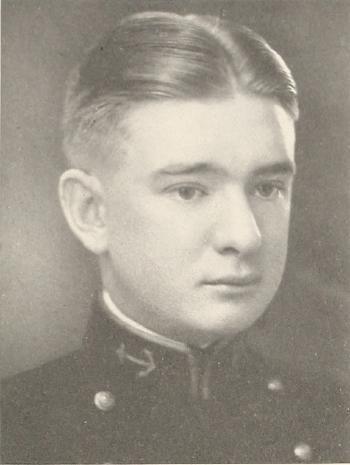
William Edwin Hank (25 September 1902 – 13 November 1942) was a United States Navy officer from Norfolk, Virginia, a graduate of the Naval Academy in the class of 1925, and the commanding officer of the destroyer Laffey (DD-459) from her commissioning until her loss. He commissioned her at San Francisco on 31 March 1942 and took her to the South Pacific, where she picked up survivors of the carrier Wasp, fought in the Battle of Cape Esperance in October, and, on the night of 12–13 November 1942, went up the line at the Naval Battle of Guadalcanal under the guns of the Japanese battleship Hiei. The ship narrowly missed colliding with the battleship, shot up her bridge at point-blank range, and was then torn open by a torpedo and a shell and blown apart by an internal explosion. Hank was last seen in the water near her bow. He was forty years old. He received two Navy Crosses, the second posthumously, and the destroyer Hank (DD-702) was named for him.
He was born in Norfolk, Virginia, on 25 September 1902. Researcher notes on the Naval Academy's Virtual Memorial Hall record that his father, W. H. Hank, was a bookkeeper at a music company, that his mother was named Marguerite, and that he had two sisters, Dorothy and Marguerite, and a brother, Leonard Gaines Hank, who was himself a naval lieutenant. The 1925 Lucky Bag gives his home as Norfolk. The sources examined here do not name his schools, describe his boyhood, or say what drew him to the Naval Academy.
The 1925 Lucky Bag, page 70, gives him three names: "Hank," "William E." and "Bill." The sketch is a classmate's affectionate portrait of a cheerful, sleepy, popular young man. It opens: "ENDOWED by nature with a sunny disposition, Hank was a popular target for the brutal upper-classmen." It credits him with prudence in one department: "Wise beyond his years, he never dragged blind—but once—and since then he has confined himself to soulfull and heartrending communications 'a la U. S. Mail' with numerous of the sub-debs of No'folk." The writers recall a Baltic port call on the Second Class summer cruise: "Great was the wailing and gnashing of teeth when Hank set sail from Copenhagen on Second Class Cruise, and we fear that several fair hearts were shattered beyond repair." And they give him the sentence that every tired midshipman of the period might have owned: "For four years his athletic aspirations have fought a game but losing fight with his ever-present and growing desire to lie enfolded in the arms of Morpheus. His noble efforts on the track, however, will be long remembered by several of his admirers." Two quotations close the sketch: "Lawd, how I love that girl!" and "Somebody wake me up in time for formation. I swear I didn't get enough sleep last night." The activities line under his name records a Black N.
He graduated in June 1925 at the age of twenty-two and was commissioned an ensign. The Navy Directories, which list every officer by ship and station, trace the next fifteen years in outline. In July and October 1925 he was an ensign in the battleship Texas; in January 1926, in the battleship New York. In October 1926 he was an ensign under instruction at the Naval Torpedo Station at Newport, Rhode Island. From January 1927 the directories place him in the destroyer Bruce, through his promotion to lieutenant (junior grade) in October 1928 and until January 1930, when he is listed as gunnery officer and first lieutenant of the ship. By April 1930 he was aboard the cruiser Chester, and the directories show him there through April 1932.
In October 1932 he appears as a lieutenant (junior grade) at the Naval Academy, among a large body of young instructors that included several of his own classmates. By July 1934 he was at the Naval Gun Factory in the Washington Navy Yard. In October 1934 he joined the destroyer Hull, and he stayed in her through January 1938: lieutenant from July 1936, gunnery officer from January 1937, and, from September 1937, first lieutenant and gunnery officer together. After that came a shore tour at the Bureau of Navigation in Washington, from July 1938 through at least October 1939. He went back to sea in 1940 as gunnery officer of the carrier Saratoga, where the directories list him from June 1940, as a lieutenant commander from November. He was still there in April 1941.
The Naval Academy's researcher notes add two things to the formal record: that he attended the Chemical Warfare School at Edgewood Arsenal, Maryland, in December 1925, and that his wife was Claribel, born in Ohio in 1908. They had a daughter, Cary. The notes do not give a marriage date or place. The Dictionary of American Naval Fighting Ships sketch for the destroyer named in his honor summarizes his prewar career in a single line: that he served at various shore stations and in New York, Hull and Saratoga.
What the record shows, then, is a gunnery officer: gunnery officer and first lieutenant of the Bruce and the Hull, and gunnery officer of the Saratoga, who became a lieutenant commander in 1940.
The Laffey was a Benson-class destroyer built by Bethlehem at San Francisco, launched on 30 October 1941 and commissioned on 31 March 1942 with Lieutenant Commander William E. Hank in command. The Navy's biographical sketch gives 1 April 1942 as the date he took her. He was thirty-nine. After shakedown on the West Coast she sailed for the war zone by way of Pearl Harbor and reached Efate in the New Hebrides on 28 August. She screened in the antisubmarine patrol until 6 September, when she joined Task Force 18 built around the carrier Wasp. On 15 September the Wasp was torpedoed and sunk, and the Laffey picked up survivors and returned them to Espiritu Santo.
One detail of how he handled the ship comes from the Laffey's own crew. James Hornfischer, in Neptune's Inferno, writes that Hank's ship-handling had been "a source of consternation and embarrassment to the crew" when he showed a willingness to use emergency engine orders during routine docking. The same book reports that in the first minutes of the November battle that willingness mattered.
Her first fleet action was the Battle of Cape Esperance, 11–12 October 1942. The Laffey operated with Rear Admiral Norman Scott's cruiser group, and when Scott formed single column on the 11th she joined two other destroyers in the van. Hank was forty, sixteen days past his birthday. According to the Dictionary of American Naval Fighting Ships, when the engagement began the Laffey raked the cruiser Aoba with three of her 5-inch guns. His first Navy Cross citation says more. "Boldly engaging a Japanese force of two destroyers and a cruiser, Lieutenant Commander Hank, despite his extremely hazardous position in a leading group and the terrific fire of the enemy, fought his ship with devastating effect upon the opposing vessels. Directing the fire of his guns with cool and daring accuracy, he enabled the LAFFEY to sink one hostile destroyer, to damage another, and to assist in the sinking of a cruiser." At dawn, the ship's official history says, the destroyer Duncan was sinking and the Farenholt badly damaged.
After the battle she rendezvoused on 11 November with a group escorting transports from Nouméa and reached Lunga Point off Guadalcanal on the 12th. The unloading was interrupted by a heavy air attack. That night Rear Admiral Daniel J. Callaghan took five cruisers and eight destroyers into the sound to stop a Japanese bombardment force. The Laffey was in the van.
At about 2:15 in the morning of 13 November, by the account Hank's executive officer wrote the next day, the Laffey "in company with TASK UNIT 67.4 and second ship in formation, column of ships, made contact with a Japanese force of approximately fifteen units located about six miles to the eastward of Savo Island." The enemy was Vice Admiral Hiroaki Abe's force of two battleships, a light cruiser and fourteen destroyers. In the confusion at close range the van of destroyers lost its order, and the Laffey found herself, in Hornfischer's words, leading the American van. Her torpedo officer, Tom Evins, later recalled the sight that matters here: "There, bearing down on us on a collision course from the port side, was what seemed to be the biggest manmade object ever created."
It was the Hiei. Hornfischer, drawing on survivors, says that Hank rang emergency full astern, cross-connected his engine and fire rooms with the burners full open, and then signaled emergency full ahead. The destroyer leaped forward and the battleship swept past her fantail so close, Lieutenant Julian Becton of the Aaron Ward wrote, that Hank could have hit her "with a slingshot." The executive officer's report is plainer: "A short time after firing commenced a large enemy unit bore down on the LAFFEY from port and only by speeding up was a collision prevented. Torpedoes were fired at this ship and they were seen to run to the target but did not explode due to the short run and the torpedoes not arming. This large enemy crossed astern of the LAFFEY and fire was opened on its bridge superstructure by all guns which would bear." Hornfischer writes that as fire from the Laffey and three other destroyers raked the Hiei's bridge, Admiral Abe took shrapnel to the face and his chief of staff, Commander Masakane Suzuki, was killed. Whether Hank saw any of that is not recorded.
The ship was not to survive her moment of luck. Making for Savo Island, looking to use its silhouette, she was crossed ahead by three Japanese destroyers and taken under fire; a large-caliber salvo hit her bridge structure and her number two gun turret, "followed very shortly by a torpedo hit at the fantail," in the words of the report. Hornfischer attributes the salvo to the battleship Kirishima and says the torpedo blew away some fifty feet of her stern. The report lists the damage in six numbered lines: guns two, three and four out of commission, engine spaces untenable from escaping steam, the stern blown off up to number four turret with no propulsion or steering, an oil fire at the extreme stern, no pressure on the firemains, no electrical power.
Hornfischer, quoting survivors, records a last exchange on the bridge. Her hull "nearly broken in two" and her propellers gone, Hank and his engineering officer, Lieutenant Eugene Barham, argued briefly about whether the ship could be saved. "Chief, just get me going and I'll get you out of this," Hank said. The engineer recommended abandoning ship; Barham asked leave to let the boats go over the side, which the captain approved; and when Barham left to see to it, Hank passed the order to abandon ship. The report's account is flatter. A determined effort was made to put out the fire aft with a portable gasoline pump and with water poured by hand from empty powder cans; when "it was definitely established that the ship could not be gotten underway," the commanding officer "gave orders to abandon ship." Abandonment, the report says, was "conducted in an orderly fashion." Both motor whaleboats and all but three of the liferafts were in the water when "a terrific explosion occurred aft." The report believes that the explosion caused the greater part of the casualties, "due to large and small parts of the vessel descending on personnel in the water." Then the ship sank at once.
Paragraph six of the report is the only first-hand sentence about Hank's end that the sources examined here preserve: "The Captain, Lieutenant Commander William E. Hank, U.S.N., was last seen in the water near the bow of the vessel but has not been seen since the final explosion of the vessel." The report was signed by W. T. Doyle Jr., given in the heading as "The Commanding Officer (Acting)"; its first paragraph calls him "the Executive Officer, now Commanding Officer." Survivors had landed on Guadalcanal; the report asked that the officers and crew be kept together "to place a new vessel in commission," on the ground that the crew was "of exceptionally high caliber in spirit and morale." Fifty-nine of the 247 men aboard were killed and 116 wounded. Hank was reported missing and presumed dead on 14 November.
His second Navy Cross, a Gold Star in lieu of a second award, was presented posthumously. The citation reads: "On this occasion the force to which Lieutenant Commander Hank was attached engaged at close quarters and defeated a superior enemy force, inflicting heavy damage upon them and preventing the accomplishment of their intended mission. This daring and intrepid attack, brilliantly executed, led to a great victory for his country's forces." It was published in Bureau of Naval Personnel Information Bulletin No. 320 in November 1943. The Laffey received the Presidential Unit Citation. The citation says nothing of what he said on the bridge. He was forty years and forty-nine days old.
There was no after. He was reported missing on 14 November 1942, and his wife, Claribel, was listed as next of kin. The Naval Academy's researcher notes record that he has a memorial marker at Arlington National Cemetery; a memorial at the Manila American Cemetery is also reported in the compilations. The sources examined here do not say where, if anywhere, he is buried.
The Navy named a destroyer, USS Hank (DD-702), for him. The name Laffey went to a new destroyer, DD-724, which on 16 April 1945, off Okinawa, took four bombs and five kamikaze hits, lost thirty-two dead and seventy-one wounded, and stayed afloat; she is a museum ship at Patriots Point, South Carolina. Of his own family the sources name his wife Claribel, his daughter Cary, and his brother Leonard, a naval lieutenant; they say nothing more of them.
He left no memoir and, in the sources examined here, no letter. What remains is a yearbook sketch of a sleepy, popular Norfolk midshipman who loved a girl and found formation hard to make, fifteen years of gunnery duty in destroyers and a carrier, a captain whose emergency engine orders had embarrassed his crew in harbor, and a night at the head of an American column when an enormous ship came out of the dark at the Laffey and she was not struck by it.