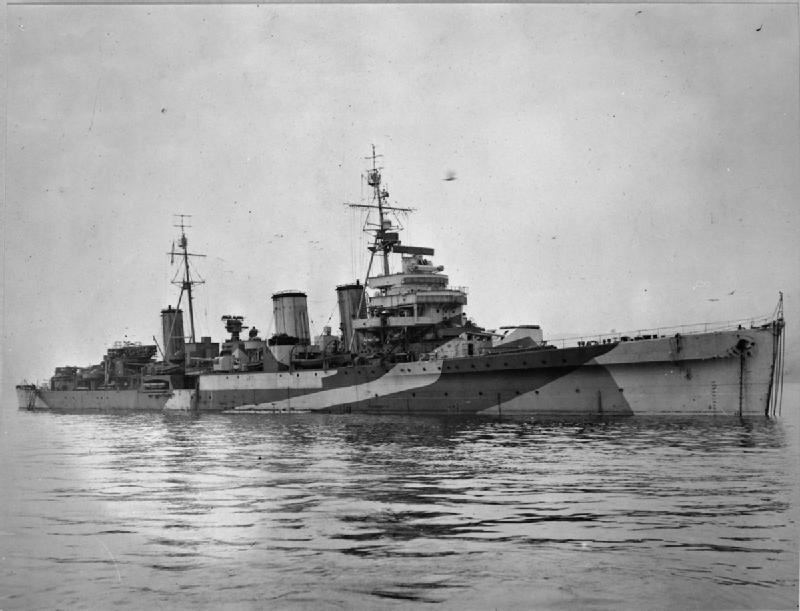
HMS Enterprise (D52) was an Emerald-class light cruiser ordered from John Brown at Clydebank and launched on 23 December 1919. After launch she was towed to Devonport, where Mason's chronology says the work was completed on 31 March 1926. Uboat.net gives the commissioning date as 7 April 1926 and prints the pennant as D 52. She was the fourteenth Royal Navy ship of the name.
Captain John Campbell Annesley had HMS Enterprise (D52) from 2 March 1940. In December 1941, after the outbreak of war with Japan, she was escorting military convoys in the Bay of Bengal to Rangoon and Singapore. In January 1942 she was part of the escort of military convoy EM10 on passage toward Singapore, and she returned to Colombo. In February she embarked a Royal Marine party, Viper Force, at Colombo for the defence of Burma and arrived at Rangoon on 11 February. On 7 March she relieved the United States cruiser Phoenix as escort for convoy MS5 in the Celebes Sea.
On 31 March 1942 HMS Enterprise (D52) was allocated to Force A of the Eastern Fleet with Warspite, the carriers Indomitable and Formidable, and the cruisers Cornwall, Dorsetshire and Emerald. She took part in an unsuccessful search for Japanese warships reported to be heading toward Ceylon. On 5 April she carried out a further search. The Japanese ships were not intercepted. On 6 April, with the destroyers Paladin and Panther, she rescued 1,122 survivors from Dorsetshire and landed them at Bombay after refuelling at Addu Atoll. Through the summer she stayed on Indian Ocean escort. On 11 September she joined military convoy WS21B in relief of Hawkins, and she was detached when the remaining ships reached Bombay on 19 September.
Annesley left HMS Enterprise (D52) on 15 July 1942. Captain George Eric Maxia O'Donnell had her from that day until 17 November, and again from 28 December 1942 until 1 July 1943. Between those two periods Commander John Noel Sparks had her. On 27 September 1942 she was nominated for return to Britain by the Cape. On 21 October, during that passage, she joined a search by Mauritius and Hawkins for a Japanese merchant ship suspected of supplying submarines. Mason calls it Operation Demcat and says it was terminated on 30 October. She reached the Clyde in December 1942, paid off, and was under refit in a Clyde shipyard from January through October 1943. The refit added Oerlikon guns and radar.
Captain Harold Taylor Wood Grant, Royal Canadian Navy, had HMS Enterprise (D52) from July 1943 until 28 June 1944. On 27 December 1943 she sailed with Glasgow to join Gambia in the interception of the blockade runner Alsterufer, Operation Stonewall. On 28 December she was in action in the Bay of Biscay with Glasgow against ten destroyers and torpedo boats, engaged at 18,000 yards, with a defect in the training of the forward turret. Mason's chronology says a torpedo boat, T26, was sunk by torpedo, and that the destroyers Z27 and T25 were also sunk in the engagement. It does not say which ship fired the torpedo. In May 1944 she joined Bombardment Force A with Hawkins, Black Prince, the monitor Erebus, the United States ships Nevada, Tuscaloosa and Quincy, and the Dutch gunboat Soemba. On 3 June she sailed from Plymouth with assault convoy U1A. On 6 June she bombarded the Saint-Martin-de-Varreville batteries during the assault on Utah Beach.
Grant left HMS Enterprise (D52) on 28 June 1944. Captain Allan Thomas George Cumberland Peachey had her until 2 October. On 16 October she joined the Reserve Fleet at Rosyth. Captain Sydney Keith Smyth, retired, had her from 2 October to 24 October 1944. Lieutenant-Commander William Desmond Revell Bravington, retired, had her from 24 October 1944 until 10 April 1945, while a refit at Chatham took out three 6-inch mountings and fitted her for trooping. Acting Captain Stephen Barry, retired, had her from 10 April 1945 into the middle of 1945, and Commander George Alan Kenneth McCombe, RNVR, from the middle of 1945 into early 1946. Mason's trooping list sends her to Bombay in June and July 1945, to Colombo in August and September and again in October and November, and to South Africa in December. She returned to Portsmouth from Simonstown in January 1946, paid off, and was sold to BISCO on 11 April 1946 for demolition by JH Cashmore at Newport. She arrived in tow on 21 April 1946. She was not sunk.
A note on sources. Movements, Force A, the 1,122 survivors, Demcat, the Bay of Biscay action, Utah Beach and the sale follow Geoffrey Mason's naval-history.net chronology for HMS Enterprise (D52), saved as a digitized copy. Uboat.net agrees the sale on 11 April 1946 and the commissioning on 7 April 1926, against Mason's completion date of 31 March 1926. The 7 April date is the one used for commissioning. Command dates follow the uboat.net list. Unithistories.com ends Grant's command on 2 October 1944, which would overlap Peachey, so the command line keeps 28 June 1944. The same site lists the Hon. Robert Arthur William Joseph Southwell as executive officer from 17 November 1942 into August 1943, not as commanding officer. Uboat.net gives him a command with a blank end that overlaps O'Donnell. He is not entered as a commanding officer.