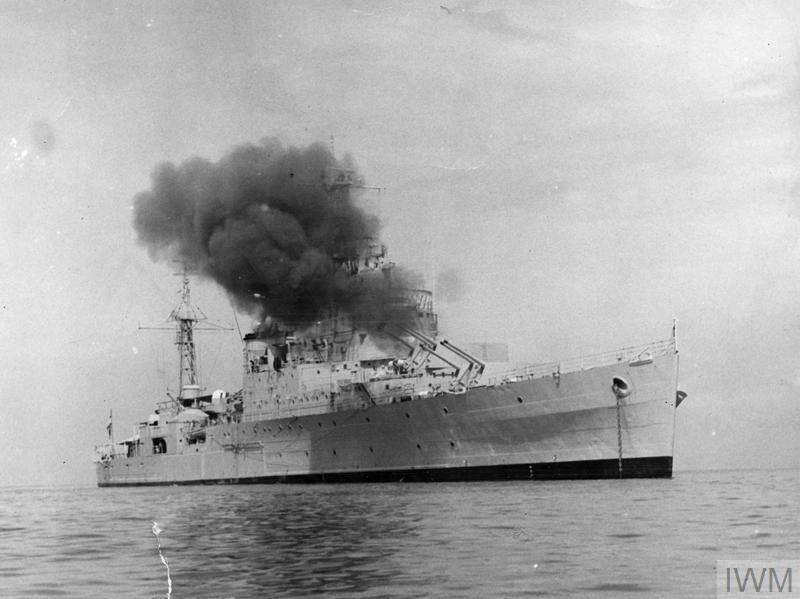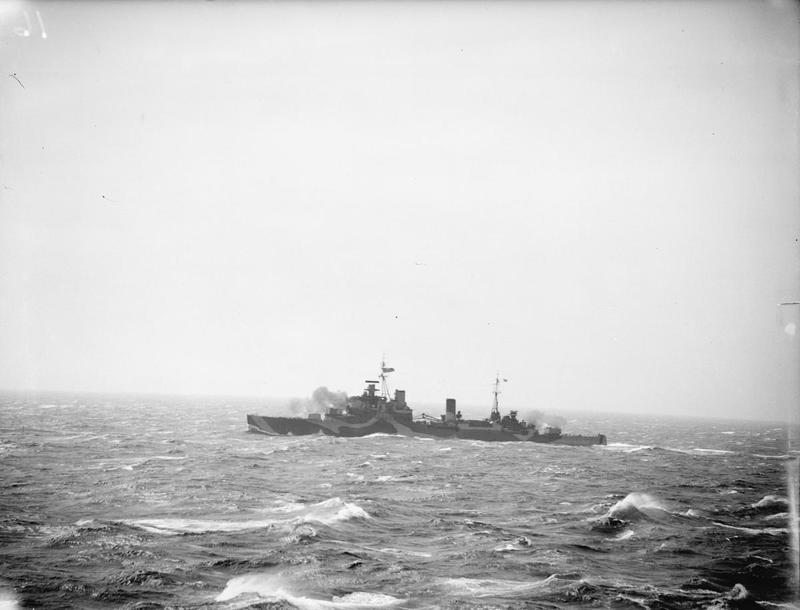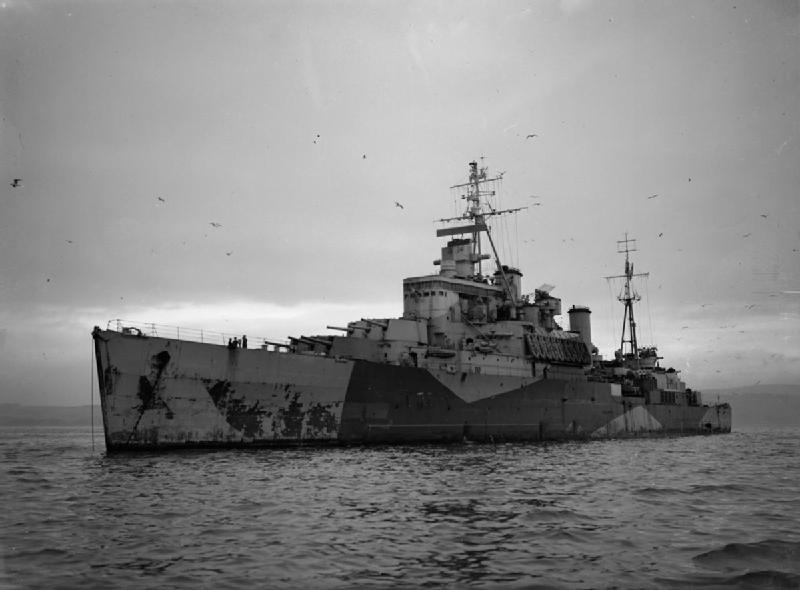
Newfoundland was a Fiji-class light cruiser, pennant 59, the first Royal Navy ship to carry the name. Swan Hunter and Wigham Richardson laid her down at Wallsend-on-Tyne on 9 November 1939, under the 1939 Estimates. Mrs Ernest Bevin, wife of the Minister of Labour, launched her on 19 December 1941. The colony whose name she bore had raised £100,000 by public subscription toward the cost. Build was completed on 31 December 1942, and Wolverhampton adopted her in place of the cruiser Curacoa, lost that October in a collision with the liner Queen Mary. Captain William Rudolph Slayter had her from 13 October 1942. On completion of trials she went to Scapa Flow on 20 January 1943 to work up with the 10th Cruiser Squadron. Her main battery was 6-inch. A later refit took her full-load displacement from 10,840 tons on build to 11,058 tons.
She was nominated for the Mediterranean and, after a spell in the Bay of Biscay against blockade runners, joined the 12th Cruiser Squadron at Algiers on 18 April 1943. In May she became flagship of the 15th Cruiser Squadron. On 22 May she embarked Admiral A. B. Cunningham for a passage to Malta. In June she was in Operation Corkscrew against Pantelleria. She bombarded the island on the 5th and again on the 8th, and on the 11th covered the landing of the 1st British Division with Aurora, Penelope, Orion and Euryalus. On the 13th she was at Linosa with the destroyer Nubian and accepted the island's surrender. General Montgomery visited her at Malta on 5 July, and Admiral Ramsay came on board the next day.
On 11 July 1943, for the Sicilian landings, she was in Support Force East with Uganda, Orion, Mauritius, Carlisle, Colombo and Delhi, and she fired at Pozzallo with the destroyers Brissenden and Blankney. The chronology prints the place as Pozallo. She bombarded Syracuse and Augusta on the 12th, the harbour defences at Augusta through the 22nd, gun positions at Catania on the 19th, and Lentini and Carlentini on the 20th. On 23 July she left Augusta for Malta with Mauritius, screened by Laforey, Lookout and Loyal. The naval-history chronology says an attack by U-407 failed and that the Italian submarine Ascianghi then torpedoed her. The damage was aft, to the steering gear. One rating was blown overboard and killed, and six men were injured. Ascianghi was sunk in the hunt that followed, by Laforey and Eclipse. Temporary repair at Malta left her with two shafts and with steering only by the main engines. She sailed for the United States on 12 August and was taken in hand at the Boston Navy Yard on the 22nd.
Slayter left her on 28 September 1943, while she was still under repair. Commander Guy Robert Pilcher had her until 4 February 1944. Uboat.net records her docked at Boston on 6 December 1943 under Pilcher. Commander Aylmer Maurice Rundle had her from 4 February until 19 February 1944. Captain Richard William Ravenhill joined on 14 February 1944 to take command, and the ship was commissioned for trials. The refit at Boston finished on 20 February. She called at St John's, Newfoundland, in late April, returned to the Clyde for British radar that had not been fitted in the United States, and was recommissioned for service after that work. The refit ran into early November. She was nominated as flagship of the 4th Cruiser Squadron in the British Pacific Fleet, worked up at Scapa Flow, and sailed for the Mediterranean on 21 December 1944.
On 2 February 1945, at Alexandria, a port torpedo tube exploded. Uboat.net, which times it at 2310, says one of the crew was killed and five were wounded, and that the damage was severe. The naval-history chronology says only that there were some casualties. Repair included more 40 mm close-range guns and delayed her passage east. She left on 26 March, by Colombo, the Cocos Islands and Fremantle, and reached Sydney on 20 April. Admiral Sir Bruce Fraser addressed the ship's company on the 27th.
On 4 May she sailed to support the Australian operations in New Guinea, with the cruiser Hobart and the destroyers Arunta and Warramunga. On the 10th she bombarded Cape Hoem with Arunta. On the 11th she bombarded Dove Bay before the landings, Operation Deluge. On the 12th she gave gunfire support at Wewak with Hobart for the landing of the 6th Australian Division. Uboat.net's day account, which does not use those place names, puts a bombardment off Wewak on the afternoon of the 10th, fire on Red Beach from 0730 to 0840 on the 11th, a further bombardment by Hobart and Newfoundland about 1700 that day, and arrival at Hollandia on the morning of the 12th. She went on to Manus, then to Auckland for rest and minor repair, and was back at Manus in June.
She was nominated for Task Group 111.2 and Operation Inmate, the attack on Truk. On 12 June she sailed with the carrier Implacable, the escort carrier Ruler, the cruisers Swiftsure, Achilles and Uganda, and destroyers. On the 14th Implacable flew against the atoll. On the 15th the chronology detaches her with the destroyer Troubridge to shell shore batteries on the island of Uman. Uboat.net's account of the same morning says she and Troubridge fired on coast-defence batteries and the airfield on Eten Island, and that the fall of shot was considered good, while Swiftsure took Moen and Uganda and Achilles took a seaplane base on Dublon. The group was back at Manus on the 17th. The February 1944 American raid on Truk is a different operation. She was not in it.
On 6 July 1945 she left Manus with Task Force 37, Rear-Admiral E. J. P. Brind's flag in her, for operations off Japan with the United States Third Fleet. The force met Task Force 38 on 16 July. On the 17th the naval-history chronology says she bombarded the Hitachi works, north of Tokyo, with the battleship King George V, the cruiser Black Prince and the Australian destroyer Quality. On 9 August she was detached with Gambia and three destroyers and bombarded Kamaishi, in northern Honshu. Uboat.net times that fire from about 1300 to 1445 and calls the target the steel works and docks. The chronology prints the place as Kamaishu. Fuel from the British fleet train ran short. On 12 August she was kept with King George V, Indefatigable, Gambia and nine destroyers when the rest of the British Pacific Fleet had to go back. On the 13th she covered Indefatigable during air attacks on Tokyo. On the 15th she joined the American Task Group 38.4. She was in Sagami Wan on the 27th and entered Tokyo Bay with Gambia on the 31st. On 2 September she was present when the Japanese delegation signed the instrument of surrender on board the American battleship Missouri. The chronology gives her war steaming as 122,490 miles.
She stayed on to help move Allied prisoners of war, and Royal Marines from her landed to take over the naval base at Yokosuka. Captain Ravenhill left her at Sydney on 7 October 1945. Captain Cecil Charles Acland Allen assumed command the same day and kept her until 6 January 1947. In March 1946, during a passage in the Malacca Strait, Commander Liddell was killed on deck in stormy weather. In May she took Admiral Fraser to Nanking and grounded on a sandbank in the Yangtse. On 28 October 1946 she scuttled the Japanese heavy cruiser Takao, which had already been damaged at Singapore. She left the squadron in November, paid off at Devonport in December 1946, and was not sunk. In October 1959 she was reduced to reserve at Portsmouth. On 30 December 1959 she was handed over to Peru and renamed Almirante Grau. When Peru gave that name to another cruiser in 1973, this ship became Capitan Quinones. She was discarded in 1979 and later broken up in Japan.
A note on sources. The narrative follows the naval-history.net service history of HMS Newfoundland by Lieutenant-Commander Geoffrey B. Mason for dates, places and the shape of the commission. Uboat.net's ship page, is followed where Mason gives no day, and it is the source for the pennant, the Wallsend yard, the 6-inch and 4-inch batteries, Brind's flag, and the clock times at Wewak, Truk and Kamaishi. Mason's page is a digitized copy. It prints Pozallo, Kamaishu, stem structure for the July 1943 damage, and Quinonis for the later Peruvian name. Uboat.net prints Kamaishi, Eten Island, and Capitan Quinones, and it does not print Pozzallo. Commissioning is 31 December 1942 on the naval-history page, which also calls that day the build-completion date, and 21 January 1943 on uboat.net. The naval-history page says an attack by U-407 on 23 July 1943 failed and that Ascianghi torpedoed her, and it notes that one source records the Italian torpedoes as having missed. Uboat.net, citing the ship's documents and German sources, says U-407 hit her in the stern at 1341B in 37°03'N, 15°24'E, blew the rudder off, and that she continued at 22 knots steering by her propellers. The same entry says the Italian torpedoes were the tracks Laforey and Eclipse sighted later, and that Ascianghi was sunk at 1623B with twenty-seven survivors picked up. The body follows the naval-history attribution. The Alexandria explosion is 'some casualties' on the naval-history page and one killed and five wounded on uboat.net. The Hitachi bombardment is taken from the naval-history page. Uboat.net's 17 July 1945 entry says King George V, escorted by Quality and Quiberon, left Task Force 37 for that night shoot and does not name Newfoundland or Black Prince in the detached unit. The island shelled at Truk on 15 June is Uman on the naval-history page and Eten on uboat.net. Ravenhill's command lines use the naval-history dates, 14 February 1944 to 7 October 1945. Uboat.net starts him on 19 February 1944 and ends him about October 1945, and it keeps Rundle until 19 February, so the two lists overlap. Allen's start is the naval-history date of 7 October 1945. His end, 6 January 1947, is uboat.net. Uboat.net's end-of-service date is 24 June 1959. The naval-history page pays her off into reserve at Portsmouth in October 1959 and hands her to Peru on 30 December 1959. Commanding officers' births, deaths and ranks are from their uboat.net pages. No Navy List or unithistories page for these five officers was fetched.