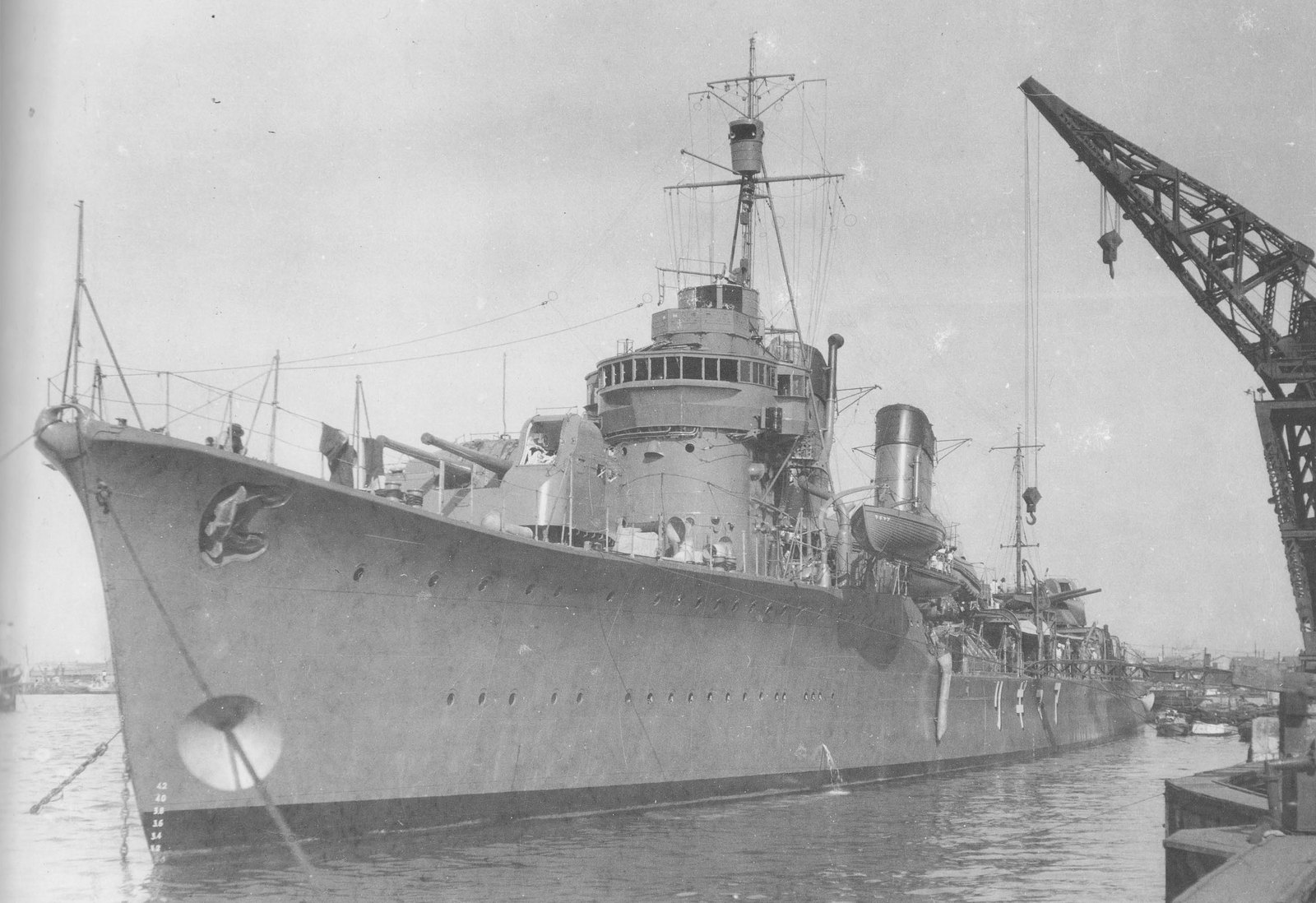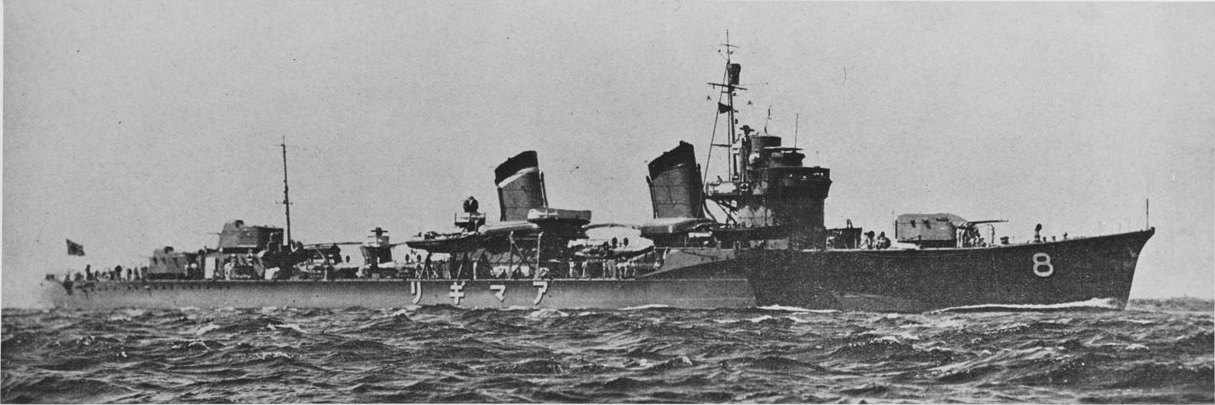
Amagiri was a Fubuki, a Special Type destroyer, built at Ishikawajima and commissioned in November 1930. The name means mist in the sky. She is known for one collision. That collision is the middle of her war, not the whole of it.
On 27 January 1942, off Endau, the British destroyers Thanet and Vampire came out against a Japanese troop convoy. A shell from the cruiser Sendai stopped Thanet in the engine room. Five-inch fire from the escort, Amagiri among the destroyers, put her under. Vampire got away.
She spent the summer on the Solomon run. On 28 August, dive bombers from Henderson Field caught Destroyer Division 20 about sixty miles north-northeast of Savo. Asagiri took a bomb in the forward torpedo mount, broke in half, and sank. Yugiri was hit on the bridge, and the division commander, Captain Yamada, was killed. Shirakumo was dead in the water. Amagiri already had about 330 troops on board. She took off 135 men from Asagiri and towed Shirakumo until the cruiser Tsugaru took the line. During the November fighting off Guadalcanal, with Mochizuki, she pulled about 1,500 men out of the water from Canberra Maru and Nagara Maru and brought the damaged Sado Maru back to the Shortlands.
On the night of 5–6 July 1943 she was on a troop run to Kolombangara and walked into the Battle of Kula Gulf. Five shells hit her. Ten men were killed. The radios were out. She stayed to look for Niizuki’s survivors and, before dawn, was in a gun and torpedo fight with Nicholas and Radford. They drove her off. She made the Shortlands.
The captain was Lieutenant Commander Kohei Hanami. On the night of 1–2 August he had her covering another run to Vila, down Blackett Strait between Kolombangara and Arundel. Earlier that night she opened fire on shapes that turned out to be rocks. She was shooting. The night’s expenditure was 48 shells, 30 rounds of 25 mm, and 56 rounds of 13 mm. Then the bow met PT-109.
The boat was an 80-foot Elco under Lieutenant (junior grade) John F. Kennedy, lying with her engines idling so aircraft would not see the wake. The boats with radar had already fired and left. Kennedy called for a turn and full power. She did not get clear. Amagiri’s stem took her amidships and broke the wooden hull in two. Gasoline burned on the water. Two of the thirteen aboard were killed in the break, Harold Marney and Andrew Kirksey. The rest were in the strait. Amagiri did not stop for them.
Her own damage was small, and it was real. A split in the stem. A little flooding in the chain locker and the woodwork store. A piece gone from a blade of the starboard propeller, so the shaft vibrated and her best speed at first was 28 knots. A signal later that morning said 30 knots were available if aircraft found her. Whether Hanami aimed the bow, or the dark boat was simply too late, is still argued. The result is not. She reported the collision and was back in Rabaul that afternoon. Two days later she sailed again.
She kept making the runs. On 6 November, the day after a carrier raid near-missed her at Rabaul, she put troops ashore by barge on western Bougainville with Fumizuki, Uzuki, and Yunagi. On 25 November, off Cape St. George, she was in the transport group with Yugiri and Uzuki, screened by Onami and Makinami, when Arleigh Burke’s destroyers hit them. Onami, Makinami, and Yugiri were sunk. Uzuki took a hit and got clear. Nothing reached Amagiri. Burke broke off short of Rabaul.
On 7 December, near Kavieng, she collided with Akikaze and damaged her bow, and went to Truk to have it repaired. By the spring of 1944 she was escorting out of Singapore. The captain was Lieutenant Commander Yoshinaga.
On 23 April 1944, about fifty-five miles south of Balikpapan in the Makassar Strait, bound for Davao with the cruisers Aoba and Oi, she struck a mine near 02°12′S, 116°45′E. The blast was up forward, by the forward tubes and the forward boiler room. Steam and burning oil came back through the ship. Men were scalded. Yoshinaga was thrown against the overhead. The chief engineer, Lieutenant Nishinosono Shigeru, was in a boiler room trying to hold her together, and he was among the thirteen who did not get off. She listed, the bow settled, and oil on the water caught fire. Abandon ship was ordered. At 1453, a little more than two hours after the mine, she went down by the bow. The stern and both screws came clear, still turning. Aoba and Oi took off the rest. No ship is credited with the mine. She was struck from the Navy List on 10 June 1944.
In 1961 Hanami went to Kennedy’s inauguration. The ship he had commanded was already gone. What was left of her was found in October 2003, on her starboard side in about 28 meters, and was later broken up where she lay.