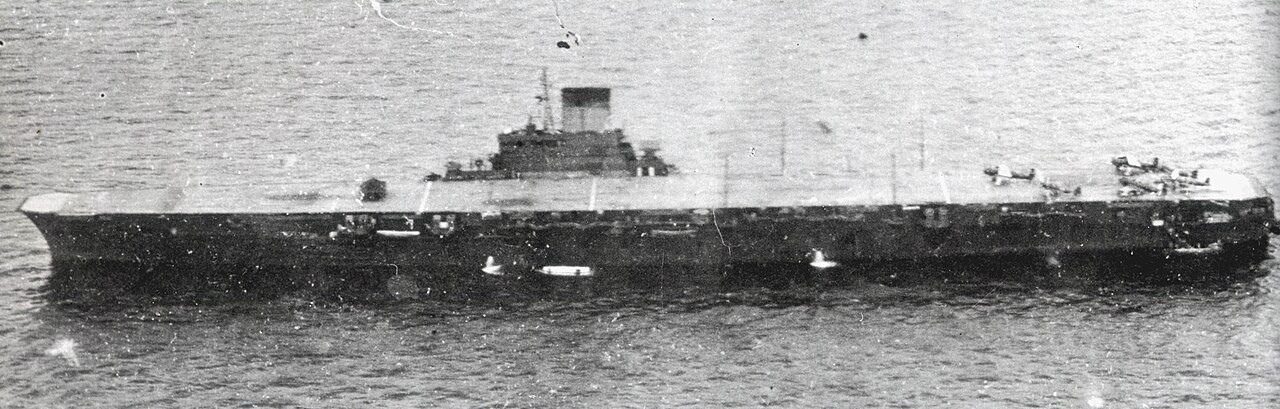
Taiho was the Imperial Japanese Navy's attempt to build a fleet carrier that could stand in the battle line and live through the kind of bomb hit that had wrecked Akagi, Kaga, Soryu, and Hiryu at Midway. The name means Great Phoenix. She was in commission for 104 days. One submarine torpedo, and the damage control that followed it, sank her on her first sortie.
She was approved in the 1939 program as an improved Shokaku. The design then changed. British armored-deck carriers, and later the Essex class, pushed the Navy toward a ship whose flight deck was part of the hull and thick enough to keep a bomb out of the hangar. The trade was fewer aircraft for that protection. Five improved sisters were ordered under a later program and never laid down. What Japan built instead were the lighter ships of the Unryu class.
Kawasaki at Kobe laid her down on 10 July 1941, launched her on 7 April 1943, and commissioned her on 7 March 1944. Captain Tomozo Kikuchi took command.
She was about 29,770 tons standard and 260 meters overall, and good for a little over 33 knots. The flight deck was armored, about 75 to 80 millimeters, and plated up to the bow. The belt over the magazines was meant to stand a heavy charge. Two enclosed hangars were split by fire curtains. Only two elevators were fitted. A third was left out to speed construction. The island was a real bridge, set a little to port to balance one large funnel angled outboard. The gun battery was twelve 10 cm high-angle guns and a large 25 mm battery, a harder anti-aircraft fit than the older mounts on Shokaku.
The air group she was drawn for was not ready. She went to sea with late-war versions of the older types. Before 13 June 1944 she had 65 aircraft: 22 Zeros, 22 Judy dive bombers, three leftover Vals, and 18 Jill torpedo bombers. Nine were gone by the day she sank. The protection had a price. The armored deck sat the hull deep. The bottoms of the elevator wells were below the waterline, and the aviation-gasoline tanks sat over those wells and were only partly armored. The hangars could be cleared of fumes only by mechanical ventilation.
Trials were in the Inland Sea. In early April she went to Singapore, arriving on 5 April, and joined Shokaku and Zuikaku in the First Carrier Division at Lingga Roads. On 15 April Vice Admiral Jisaburo Ozawa shifted his flag from Shokaku to Taiho. The three carriers worked up their air groups there. On 14 May the Mobile Fleet moved to Tawi-Tawi. Fuel was short, and the anchorage was inside submarine waters. Aircrew got little real training. By the time Ozawa sailed, Taiho had 56 aircraft left.
The invasion of Saipan brought the fleet out. Ozawa meant to launch at long range and shuttle strikes through Guam. Taiho was flagship. At 07:45 she turned into the wind and launched 16 Zeros, 17 Judys, and 9 Jills. Albacore (SS-218), under Commander James W. Blanchard, was already inside the screen and fired six bow torpedoes. Warrant Officer Sakio Komatsu, just airborne, saw the wakes, left the formation, and dove his plane into one torpedo. It detonated short and killed him. Four others missed. One hit the starboard side forward of the island.
The hit was not, by itself, fatal. It holed the hull, fractured aviation-gasoline tanks, and jammed the forward elevator between the flight deck and the upper hangar. The bow went down about a meter and a half. Kikuchi eased the speed by a knot and a half. There was no fire. By 09:20 damage-control parties had planked the open well with mess benches and tables, and Ozawa launched two more waves.
What killed her was the gasoline. Fuel, oil, and seawater mixed in the elevator pit and vaporized. The crew did not pump the well out and did not blanket the fuel with foam. Ventilation was opened to full, doors and hatches were opened, and the fumes were pulled through both hangars instead of being shut in. It was the same kind of mistake that had destroyed Lexington (CV-2) in 1942, made worse by enclosed hangars that had no other way to clear the air.
At about 14:30 a vapor explosion heaved the flight deck and blew out the sides. Taiho fell out of formation. Ozawa wanted to stay. His staff moved him, with the Emperor's portrait, to the heavy cruiser Haguro by the destroyer Wakatsuki. A second explosion followed. She sank stern-first at 16:28. Of about 2,150 aboard, 1,650 were lost. The position was roughly 180 nautical miles north-northwest of Yap. The same morning the submarine Cavalla (SS-244) sank Shokaku. The air battle the next day destroyed most of the aircraft that had gotten off. Japan did not again send a carrier force to sea with the aircraft and the fuel to strike on its own terms. She was struck from the Navy list in August 1945. No sister was begun.