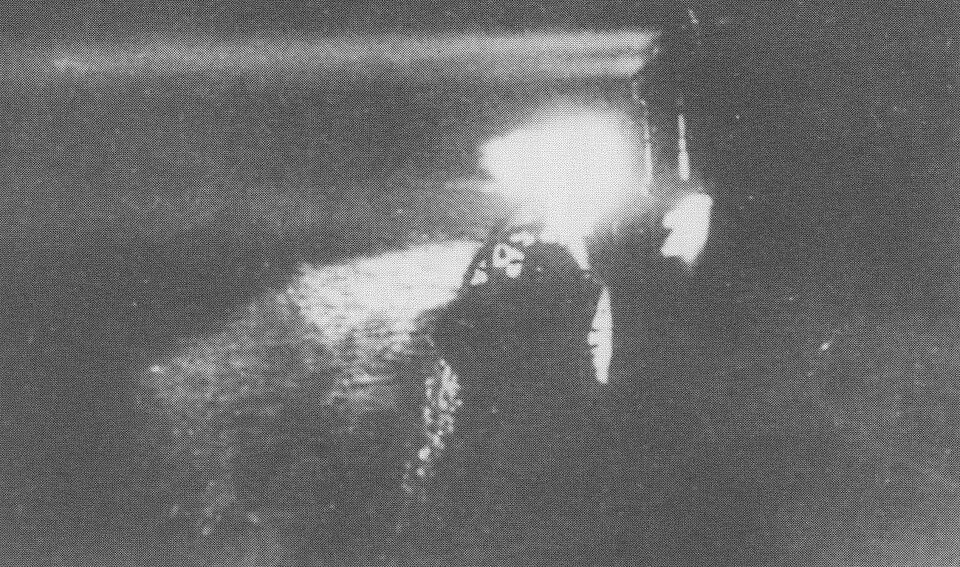
Yubari (夕張) was not a lucky ship. She was an experiment that went to war.
Named for a river on Hokkaido, she was the Imperial Japanese Navy’s attempt to put a 5,500-ton scout cruiser’s speed and punch into a hull half that size. Captain Yuzuru Hiraga and Kikuo Fujimoto designed her in 1920–21 as a test: armor used as hull structure, boilers trunked into one swept funnel, a high flared forecastle, and six 140 mm guns plus 610 mm torpedoes on a designed displacement of about 2,890 to 3,150 tons. She came out heavier than planned and made a hair under her designed 35.5 knots. No later Japanese cruiser copied her backward-sloped belt. Almost every later Japanese cruiser copied her compactness.
Laid down at Sasebo on 5 June 1922, launched on 5 March 1923, and commissioned at the end of July 1923, she spent the interwar years as a destroyer-squadron flagship: China patrols, the Shanghai Incident of 1932, work on the Yangtze, and a 1925 cruise through the western Pacific and Australia. She looked like nothing else in the fleet, short and sharp, with one stack, and she was used like a large destroyer leader for twenty years.
Opening the Pacific War
On 7 December 1941 she was flagship of Destroyer Squadron 6 in the 4th Fleet, based in the mandated islands. Rear Admiral Sadamichi Kajioka flew his flag in her for the first attempt on Wake Island, on 11 December. Marine 5-inch guns on the island straddled Yubari at 4,500 to 5,700 yards. She was not hit. Two of the accompanying destroyers were sunk. The landing failed. She came back later in the month, and Wake fell.
From January to March 1942 she covered the seizures of Rabaul, Kavieng, Lae, and Salamaua. On 10 March, while the invasion force lay off Huon Gulf, aircraft from Lexington and Yorktown hit the anchorage. Yubari was straddled and near-missed. Fragments killed machine-gun crews and damaged the hull. She reached Rabaul and spent a month under repair.
In May she was flagship of Kajioka’s Port Moresby Attack Force during the Battle of the Coral Sea. The invasion never went in. The carriers fought instead. Yubari shepherded transports and retired with the rest of the covering force.
Savo Island
After the American landings on Guadalcanal and Tulagi, Vice Admiral Gunichi Mikawa took a cruiser force south on the night of 8–9 August 1942. Yubari was with him, in the column with Chokai, Aoba, Kako, Kinugasa, Furutaka, Tenryu, and the destroyer Yunagi. In the dark off Savo Island the Japanese column tore through the Allied screening cruisers. Yubari fired four torpedoes at Vincennes. At least one hit in a boiler room. Vincennes, Quincy, Astoria, and HMAS Canberra were lost. That destruction is not credited to Yubari alone. On the way out, Furutaka, Tenryu, and Yubari hit the destroyer Ralph Talbot with gunfire. She escaped into a rain squall. Yubari was not damaged. It was the high-water mark of Japanese night surface fighting, and she was in the line that made it.
She then led the occupation of Ocean Island and Nauru at the end of August, and spent the rest of the Solomons campaign as a destroyer leader: supply runs, bombardments, escorts. On 5 July 1943, returning from a shelling of Rendova, she struck an American air-laid magnetic mine. A hole opened in the port side. The crew kept her afloat and she reached Rabaul under her own power.
Carrier strikes on Rabaul in November 1943 damaged her again. She went home for a long refit. Two of the single 140 mm guns came off. Twenty-five-millimeter antiaircraft mounts and a radar went on. Displacement climbed toward 4,450 tons. Speed fell to about 32 knots. By 1944 she was an aging prototype doing convoy and troop-lift work, because that was what Japan still had.
The last day
On 23 April 1944 she left Saipan with troops. On the 25th she was at Palau. On the 26th she sailed for Sonsorol with Samidare and Yuzuki, carrying 365 men. She landed them on the morning of the 27th.
The submarine Bluegill, on her first war patrol, was watching the islands. Yubari disappeared behind land, then came out again at 19 knots, maneuvering hard. Bluegill fired six torpedoes from about 2,400 meters. Yubari dodged four or five. At 10:04 one hit to starboard, at No. 1 boiler room. No. 2 flooded soon after. Nineteen men, mostly stokers, were already dead. All engines stopped.
After 14:00 they tried to move on the center shaft. It failed. Samidare tried a tow at 16:50. That failed too. Through the night the ship settled by the bow. At 04:15 on 28 April water reached the upper deck. The flag of Destroyer Squadron 3 shifted to Yuzuki. Survivors, including the captain and the admiral, went across at 05:44. At 10:15, almost twenty-four hours after the hit, Yubari went down by the bow at about 05°20′N, 132°16′E, some 35 miles from Sonsorol. She was struck from the navy list on 10 June 1944.
What she was
Yubari was never the luckiest ship in the Japanese navy. That name belonged to Yukikaze and, for a time, to Shigure. Yubari was the ship that proved a design idea, led destroyers from Wake to Savo, took a mine and bombs and near-misses, and still had to be left drifting for a full day before she would sink. Her silhouette, one funnel, a clipper bow, guns crowded on a short hull, is the silhouette later Japanese cruisers grew from. Her war was the work a destroyer-leader’s flagship actually did: landings, night attacks, rescues, convoys, and a last transport run that a new American submarine ended on its first patrol.