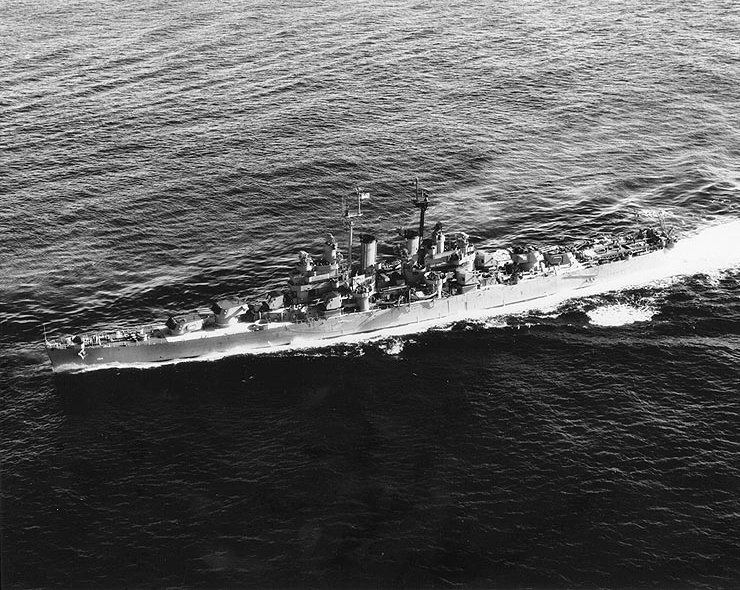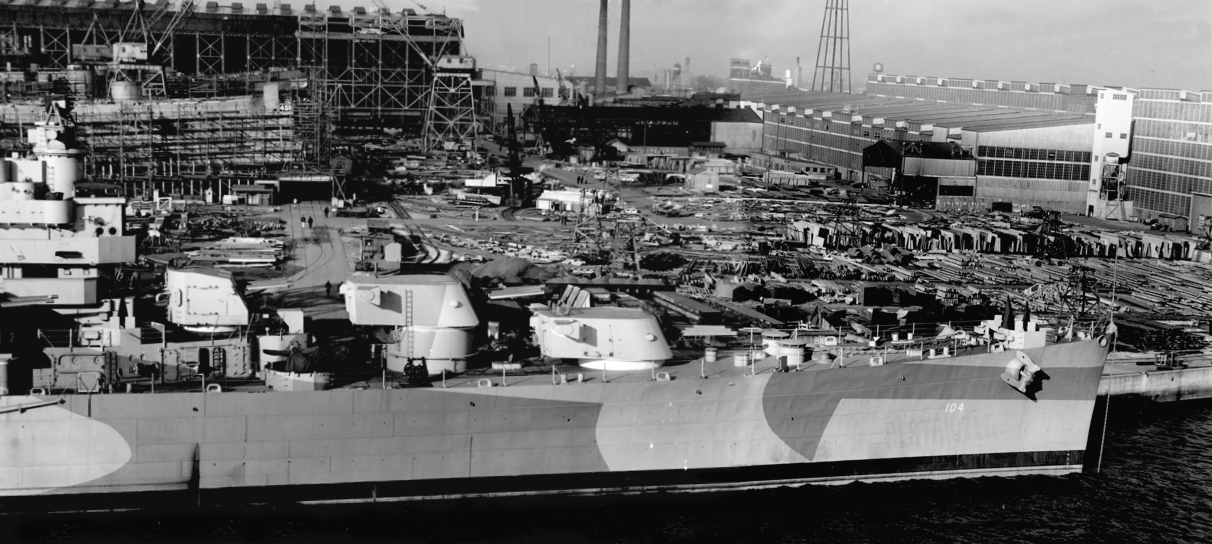
The Dictionary of American Naval Fighting Ships calls Atlanta (CL-104) the fourth ship of the name, for the city in northwestern Georgia. A screw gunboat named Atlanta, acquired in the autumn of 1858, was renamed Sumpter when the Navy bought her outright on 26 May 1859. Mrs. John R. Marsh, whose pen name was Margaret Mitchell, author of Gone With the Wind, sponsored Atlanta (CL-104) and had also sponsored the light cruiser Atlanta (CL-51). That earlier cruiser was Rear Admiral Norman Scott's flagship off Guadalcanal on the night of 13 November 1942 and was scuttled off Lunga that afternoon. Atlanta (CL-104) was laid down on 25 January 1943 at Camden, New Jersey, by the New York Shipbuilding Corporation, launched on 6 February 1944, and commissioned on 3 December 1944 with Captain B. H. Colyear in command. Her length was 610 feet 1 inch. The DANFS characteristics line gives 14,400 tons, a beam of 66 feet 4 inches, a draft of 24 feet 10 inches, 31.6 knots, a complement of 1,426, twelve 6-inch guns, twelve 5-inch guns, twenty-eight 40 mm guns, and ten 20 mm guns.
NavSource dates Captain Bayard Henry Colyear's command of Atlanta (CL-104) from 3 December 1944 to 22 September 1945. She got underway on 5 January 1945 for shakedown in Chesapeake Bay and the Caribbean, reached Norfolk on 14 February, and then went to the Philadelphia navy yard. On 27 March she sailed for the Pacific, stopped at Guantanamo Bay, transited the Panama Canal, and reached Pearl Harbor on 18 April. Training in Hawaiian waters ran from 19 April to 1 May. She then sailed to Ulithi and reported to Task Force 58 on 12 May. From 22 to 27 May Atlanta (CL-104) served with the Fast Carrier Task Force south of Japan near Okinawa while its aircraft struck the Ryukyus and Kyushu in support of the forces fighting for Okinawa. The task group broke up on 13 June. She entered San Pedro Bay in the Philippines on 14 June, spent two weeks in upkeep, and on 1 July sailed with Task Group 38.1, screening the fast carriers against the Japanese home islands and taking part in several shore bombardments of Honshu and Hokkaido. She was off Honshu when Japan surrendered on 15 August 1945. On 16 September she entered Tokyo Bay and remained through 29 September. Colyear was relieved on 22 September, during that stay.
Captain Walfrid Nyquist had Atlanta (CL-104) from 22 September 1945 to 4 August 1946. On 30 September she sailed for the United States with more than 500 passengers, paused at Guam, and arrived at Seattle on 24 October. An overhaul at Terminal Island followed. She was ready for sea on 3 January 1946 and got underway for Sasebo. Through June she operated among ports that included Manila, Tsingtao, Shanghai, Okinawa, Saipan, Nagasaki, Kagoshima, and Yokosuka, then returned via Guam to San Pedro, California, on 27 June. Two days later she entered the San Francisco Naval Shipyard. Captain Peter Michael Moncy relieved Nyquist on 4 August 1946 and had her until 22 June 1947. On 8 October 1946 she headed for San Diego for trials and remained in southern California waters until 23 February 1947, when she left for maneuvers off Hawaii. On 1 May she departed Pearl Harbor with Task Force 38 for Australia. The ships stayed in Sydney through 27 May and then sailed for San Pedro by way of the Coral Sea, Guadalcanal, Tulagi, and Guam. She anchored at San Pedro on 28 July.
Captain Frederick Leavenworth Riddle had Atlanta (CL-104) from 22 June 1947, before that arrival at San Pedro, until 12 May 1948. After maneuvers off California she returned to Pearl Harbor on 28 September 1947, went on to Yokosuka for two days, and sailed to Tsingtao. Other ports on that deployment were Hong Kong, Singapore, and Keelung. On 27 April 1948 she got underway via Kwajalein and Pearl Harbor for San Diego and arrived back in the United States on 19 May. Captain Rodger Whitten Simpson, whose final rank on the NavSource list is rear admiral, is entered for 12 May 1948 only. Commander Charles Adams Blakely, Jr., relieved him the same day and had the ship until 23 May 1949. She exercised off San Diego, visited Juneau from 29 June to 6 July 1948, began a major overhaul at Seattle on 12 July, and returned to San Diego for local maneuvers on 20 November. In early February 1949 she embarked naval reservists and operated between San Diego and San Francisco until 1 March, when she entered the Mare Island Naval Shipyard to begin deactivation. Commander Francis Thomas Williamson, Naval Academy class of 1931 on that list, and later a rear admiral, relieved Blakely on 23 May 1949. Atlanta (CL-104) was decommissioned on 1 July 1949 and placed in the Pacific Reserve Fleet. Williamson was relieved on 23 July 1949.
The name of Atlanta (CL-104) was struck from the Navy list on 1 October 1962, and she was earmarked for disposal. She was then modified at the San Francisco Naval Shipyard and reinstated on 15 May 1964 as IX-304, a target ship for studies of high-energy air explosions. The hull was cut down to the main deck. Experimental superstructures for guided-missile frigates and guided-missile destroyers were erected on it: two destroyer deckhouse types, three mast arrays, representative destroyer communications, fire control, and weapons, and an experimental reinforced fiberglass deckhouse set against the aluminum deckhouses then in use. Three tests were conducted off Kahoolawe, Hawaii, in early 1965, under the name Operation Sailor Hat in the DANFS caption. She was damaged and remained afloat. Laid up at Stockton, California, sometime late in 1965, she was struck again on 1 April 1970. On 1 October 1970 the former light cruiser Atlanta (CL-104) was sunk in an explosive test off San Clemente Island, California. She earned two battle stars for World War II service. She was not lost in combat.
A note on sources. The narrative follows the Naval History and Heritage Command Dictionary of American Naval Fighting Ships entry for Atlanta (CL-104) for dates, places, the sponsor, the 1945 cruises, the postwar deployments, the IX-304 conversion, and the sinking on 1 October 1970. The characteristics line on that page prints the length as 610T'. HyperWar and NavSource both print 610 feet 1 inch, and that is the length used above. The same line prints the displacement as 14,400 tons, the draft as 24 feet 10 inches, the speed as 31.6 knots, and the complement as 1,426. HyperWar prints 10,000 tons, a draft of 25 feet, 32.6 knots, and a complement of 992, and it omits the 40 mm and 20 mm guns. NavSource prints 10,000 tons, 610 feet 1 inch by 66 feet 4 inches by 25 feet maximum, 32.5 knots, a crew of 1,255, the same twelve 6-inch and twelve 5-inch guns, twenty-eight 40 mm, ten 20 mm, and four aircraft. DANFS is followed for the figures other than the garbled length. Digitized copies of the DANFS page print "amone" in the sentence on the 1946 Far Eastern ports. HyperWar prints "among," and that is the word used above. DANFS names only Colyear, as B. H. Colyear, at the commissioning on 3 December 1944, which matches the start of the NavSource command. The other officers and all of the command dates are NavSource's list for CL-104. Simpson's line gives the same day, 12 May 1948, as both the start and the relief. A NavSource photograph caption places her at Port Melbourne on 20 May 1947, alongside Duluth (CL-87), with an SC-1 Seahawk. DANFS says the ships stayed in Sydney through 27 May 1947, and the narrative follows DANFS. The light cruiser Atlanta (CL-51) is a different ship. Her loss off Guadalcanal on 13 November 1942 is her own history. DANFS for CL-104 says only that Margaret Mitchell also sponsored her. The two battle stars are not named on the DANFS page. No battle on the existing list matches the July and August 1945 strikes and bombardments of Honshu and Hokkaido. She was still in the Atlantic and Caribbean in February 1945, and she reached Pearl Harbor on 18 April, so she was not at Iwo Jima and she was not off Okinawa for the April landings. The May presence is the Okinawa row. A fetch of a Naval Institute page about Nyquist returned a challenge screen rather than the article, and a fetch of a 1957 New York Times item about Riddle's daughter returned a page that asked for a script and an advertisement blocker. Neither is used.