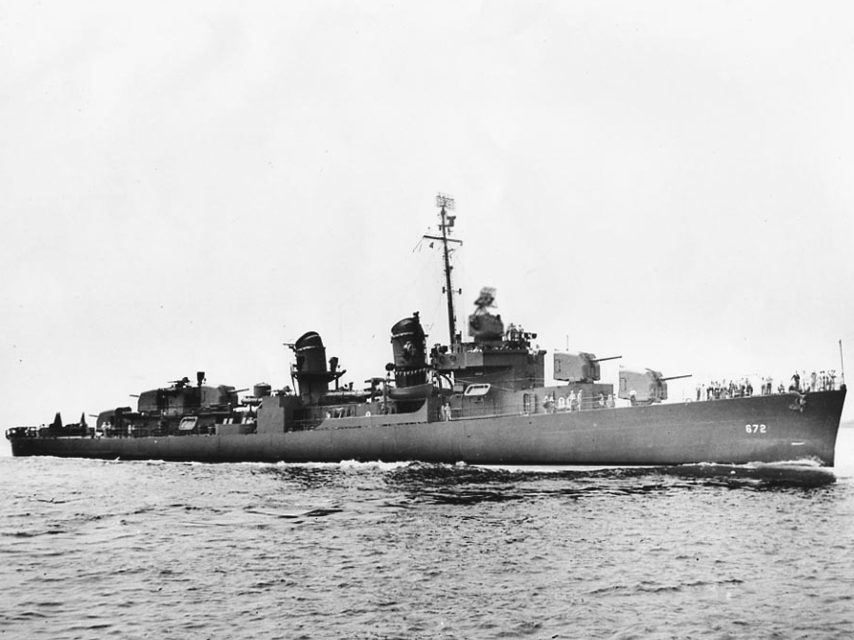
USS Healy was a Fletcher-class destroyer. She was launched on 4 July 1943 and commissioned on 3 September 1943, and J. C. Atkeson took command that day. Shakedown off Bermuda brought her back to New York on 31 October. On 10 November she left for a week of coastal patrol, met a convoy at sea, and entered Norfolk on 18 November 1943. Two days later she sailed for the Pacific, passed the Panama Canal, and reached San Francisco on 4 December. Pearl Harbor followed on 11 December. Through the weeks after that she trained in Hawaiian waters with Yorktown and other ships that were to make up Task Force 58 under Vice Admiral Marc Mitscher (DD-672).
The wider island offensive had already opened with the capture of the Gilberts when Healy sailed on 16 January 1944 for the Marshalls. Until detached on 1 February she screened Enterprise and Yorktown during the raids on the target islands, Kwajalein among them. That same day she was sent to escort Washington and Indiana to Majuro, and she rejoined the carriers there on 4 February. The next major blow was aimed at Truk, a principal Japanese base. The carrier group left Majuro on 12 February and attacked on 17 and 18 February so thoroughly that most of the shipping and aircraft were sunk or left useless, and Truk ceased to be a serious threat to Allied plans. Healy and the carriers then went on to the Marianas, drove off several air attacks on 22 February, and struck Saipan, Tinian, and Guam, the islands marked out as the next American objectives.
Before those landings she remained Enterprise's screen for a series of western Pacific raids meant to ease the coming assault. After a stop at Espiritu Santo the ships hit the Palau Islands on 30 March, beat off Japanese air raids, and attacked Yap and Ulithi the following day. Aircraft from Enterprise struck Woleai on 1 April 1944, and the force was back in Majuro five days later. On 14 April Healy put to sea to screen Enterprise during strikes on New Guinea in support of the landings at Tanahmerah Bay. Another heavy raid on Truk on 29 and 30 April closed that cruise, and she returned to Majuro on 4 May.
A period of hard training and preparation followed. She departed Majuro on 6 June for the invasion of the Marianas, an amphibious operation mounted nearly a thousand miles from the nearest advanced base, Eniwetok. Screening the carriers once more, she covered the preparatory raids of 11 to 15 June and stayed with them while Admiral Richmond Kelly Turner's Marines landed on Saipan on 15 June. Two days later she moved out with the other ships to join Mitscher as the Japanese came on to contest the islands. The fleets met on 19 June in the Battle of the Philippine Sea, the largest carrier battle of the war. Four large air raids struck the American formation. Fighters from the ships of Healy's task group and gunfire from the ships themselves broke those attacks apart. American submarines assisted Mitscher in sinking two Japanese carriers, and the enemy naval air arm suffered losses from which it could not recover, the fighting of 19 June remembered as the Great Marianas Turkey Shoot. On 21 June Healy helped pick up pilots from aircraft down in the water, and she arrived at Eniwetok on 9 July. The Marianas invasion was secure, and the Japanese counterstroke had been turned back.
From Eniwetok the carrier force launched repeated strikes on Guam, steamed into the Carolines, and on 25 July began attacks on the Palaus. Still cruising with Task Force 58, Healy screened the carriers for strikes on the Bonin and Volcano Islands on 4 and 5 August and was back at Eniwetok on 11 August 1944. She sailed on 28 August. Through 17 September the group hit the Bonins, the Palaus, and targets in the Philippines. Detached that day, she joined a carrier group giving direct support to the Peleliu invasion, the next island step toward Japan. With those carriers she returned to Manus on 21 September, then shifted to Ulithi to form up for operations farther west.
The force that gathered, seventeen carriers and their supporting ships, rendezvoused at sea and struck Okinawa on 10 October. On 12 October the carriers turned to their real objective, Formosa. Three days of air attack did much to wreck Formosa as a base that could support the Japanese in the island fighting ahead. Land-based aircraft answered with heavy, repeated attacks. Healy brought down one bomber and assisted in shooting down many more. Canberra and Houston were damaged in the same raids. After covering those crippled ships as they retired, a group known as CripDiv 1, Healy returned to screening duty, and on 19 October the carriers struck Philippine installations again. When troops went ashore at Leyte, she and her carrier group gave the landing direct support and hit airfields on southern Luzon.
By 24 October the Leyte invasion had drawn out a last great Japanese effort to destroy the American fleet. Three major enemy forces closed on the Philippines for the Battle for Leyte Gulf, hoping to pull Admiral William F. Halsey's carriers north and then hit the assault forces in the gulf from two directions. Healy was with Rear Admiral Frederick C. Sherman in Task Group 38.3 near Luzon on 24 October when land-based aircraft attacked the group early in the day. Planes from the task group then struck Vice Admiral Takeo Kurita's ships in the Sibuyan Sea, sinking Musashi and damaging other heavy units. While the Battle of Surigao Strait and the Battle off Samar were fought, Halsey took his carriers north to meet the decoy carrier force under Admiral Jisaburo Ozawa. Atkeson remained Healy's captain until he was relieved on 28 January 1945. She survived the war and was sold for scrap on 12 April 1976.