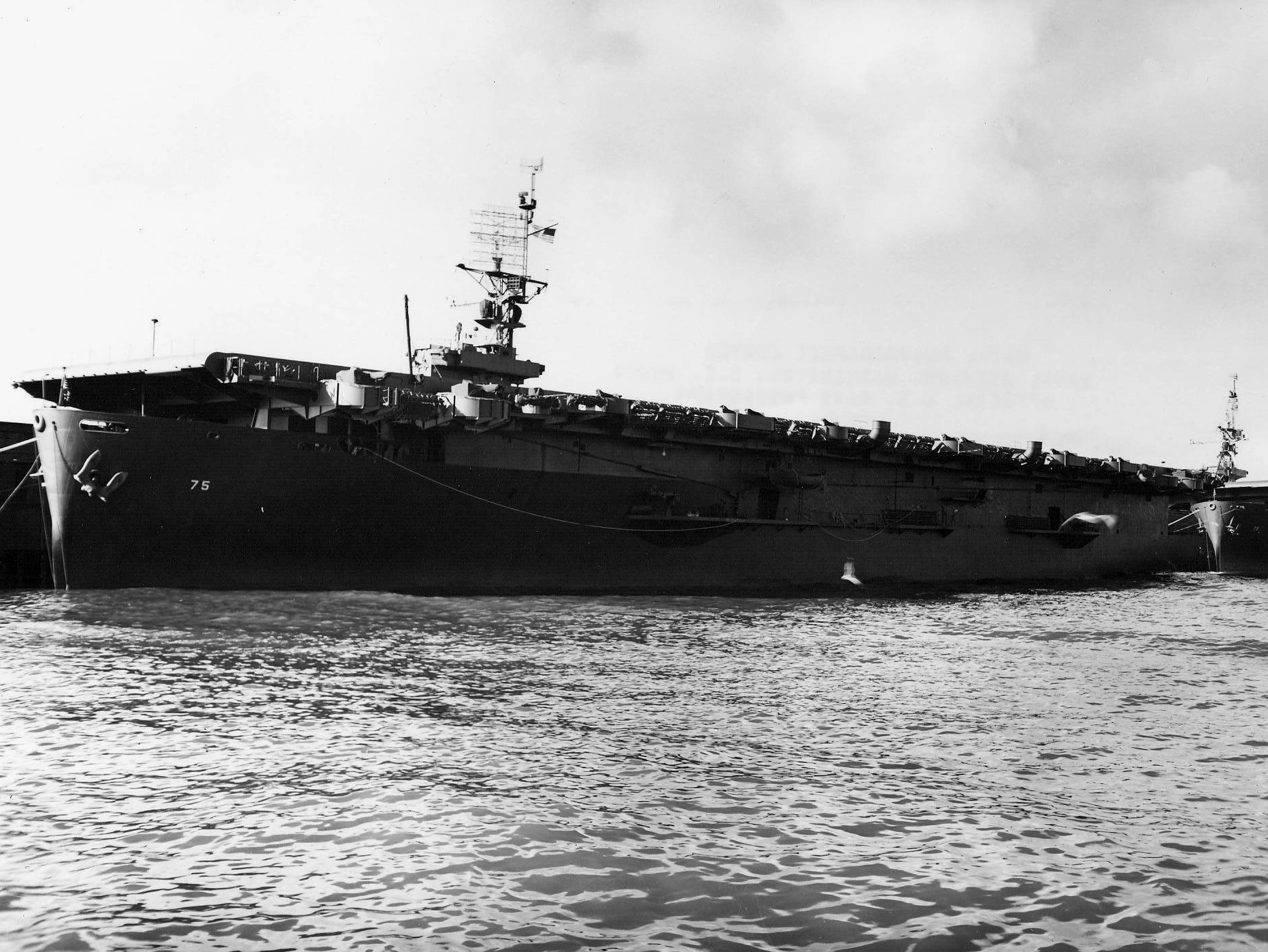
Hoggatt Bay was named for a bay on Baranof Island, in Alaska. She was a Casablanca-class escort carrier, Maritime Commission hull 1112, one of the fifty Kaiser built at Vancouver, Washington. The contract was let on 18 June 1942. Her keel went down on 17 August 1943, and she was launched on 4 December. Esther Irene Sundvik, the wife of a shipwright in the yard, sponsored her. The Navy took her at Astoria on the morning of 11 January 1944, and Captain William Vincent Saunders had her. The crew called her Hokey Pokey Maru. She was a small carrier: reciprocating engines, two screws, about 19 knots, one catapult, and a single 5-inch gun.
January was outfitting at Tongue Point. She shook down the coast and reached San Diego on 23 February. Gunnery and air-defense drills filled the first half of March. On 10 March she ferried aircraft and passengers to Pearl Harbor, arrived on the 16th, and was back on the West Coast on the 25th. Composite Squadron 14 came aboard the next day. On 27 March Saunders made the first landing on her deck. April was an overhaul. On 1 May she headed west for antisubmarine work off Emirau.
She stopped at Pearl Harbor on 8 May and left on 11 May for Majuro, in Escort Division 39. On 16 May her aircraft attacked what might have been a submarine, and little came of it. From 22 May she patrolled south of Truk. Codebreakers had put a Japanese scouting line, the NA line, northeast of the Admiralties. By the time she joined on 26 May, that division had already sunk five boats. With her escorts the formation became Task Group 30.4. Early on 31 May the destroyer escort England claimed a sixth submarine in thirteen days. That boat was England's.
After a stop at Manus, a Wildcat from Hoggatt Bay found an oil slick on 10 June, about eight miles west of the ship. Taylor was sent. The boat was RO-111. Taylor's charges brought her up, the guns hit her, she went under, and two explosions at 15:58 finished her. On 19 July aircraft found I-5 on the surface. The escorts Wyman and Reynolds attacked. A heavy blast on the second run broke the boat up, hard enough to shatter lights on Wyman. On the evening of 28 July a lookout saw a submarine come up about eight miles to starboard, the boat the reports name as I-55. Nobody was seen at her guns. Wyman shelled her. Reynolds closed and held her depth charges while Wyman was still firing. The boat went under, explosions followed, and an oil slick spread. Those three boats belong to the escorts.
In September she was in a new group, Task Group 30.7, with Samuel S. Miles among the escorts, covering the ships off Peleliu and Angaur. At 3:11 on the morning of 3 October her radar found a surfaced submarine about 20,000 yards out. Miles was sent. The boat was I-177. She dived as the escort closed inside 5,000 yards. The first Hedgehog salvo did not finish her. On the second run, three heavy explosions did. No one came up. The place was 7°48′ N, 133°28′ E. A score later painted on the carrier counted boats her groups had sunk. The sinkings were the escorts'.
She then helped bring home the cruisers Houston and Canberra, torpedoed off Formosa. This Houston was not the cruiser sunk in 1942. The group was there against submarines, and it was credited with turning away at least one attempt on the two damaged ships. November was an air screen and a submarine patrol for the ships off Leyte. At Manus on 29 November, Composite Squadron 88 replaced Squadron 14. On 22 December, still at Manus, Captain Josephus Asa Briggs relieved Saunders. The force sailed for Luzon on 27 December. On 3 January 1945 a kamikaze was shot down about a thousand yards from her. On 13 January another, turned away from Tulagi, dove at Hoggatt Bay and was torn apart by her 5-inch gun. She was in Lingayen Gulf from 6 January, and her planes flew close support. On 15 January an Avenger piloted by Lieutenant Commander E. N. Webb landed with a 500-pound bomb that would not drop. The bomb exploded on deck. Thirteen men were killed and fourteen wounded. The deck was pushed in. The fire was put out, and she was flying again in three hours.
She reached Ulithi on 23 January, then San Diego on 15 February, for repairs and a conversion that let her carry a flag. On 2 April Rear Admiral Harold M. Martin, commanding Carrier Division 23, raised his flag in her. He was not her captain. She ferried aircraft to Guam, embarked Composite Squadron 99 at Saipan on 1 May, and opened over southern Okinawa on 12 May. Through May and June she flew combat air patrol, photographs, supply drops, and close support, with short stops at Kerama Retto. On 5 June, in Typhoon Connie, she rolled as much as 27 degrees. On 7 June her guns took a kamikaze that was after Sargent Bay, and another, aimed at Natoma Bay, was shot down about fifty yards off the starboard bow. Squadron 99 had flown 1,327 sorties by the time she left on 24 June.
Leyte on 27 June. On 11 August she sailed for Adak, to join Vice Admiral Frank Jack Fletcher's Ninth Fleet in the Aleutians. Japan surrendered on 15 August, while she was still on the way. She lay at Kuluk Bay from 18 to 30 August, then went to Mutsu Bay. Fletcher took the surrender of the Japanese forces in northern Honshu and Hokkaido on 6 September. She arrived the next day, flew patrols, and dropped supplies to prison camps. On 14 September Captain Frederick Norman Kivette relieved Briggs. The next day Lieutenant Colonel James Devereux, the Marine commander taken on Wake, came aboard and was flown home. She rode out Typhoon Ida on 18 September, covered Eighth Army landings at Aomori, and entered Tokyo Bay on 28 September. Martin left her there. She sailed the next day. Squadron 99 went ashore at San Francisco on 21 October. At Richmond the hangar was fitted with 704 bunks, and she joined the Magic Carpet fleet. One trip brought about 1,200 men into San Pedro on 7 December. The next left on 13 December, called at Buckner Bay and Guam, and reached San Francisco on 28 January 1946. Captain Marvin Pabodie Evenson relieved Kivette on 30 January. She came off Magic Carpet duty, took aircraft and 450 Marines through the Canal, unloaded at Jacksonville on 7 March, and reached Boston on 20 March. Commander William Paul Schroeder, who was also her executive officer, had her from 11 June and decommissioned her on 20 July 1946. She lay in the Atlantic Reserve Fleet at Boston. On 12 June 1955 she was reclassified CVHE-75, and on 7 May 1959 AKV-25. She was struck on 1 September 1959, sold on 31 March 1960, and broken up at Bilbao that May. She had five battle stars.