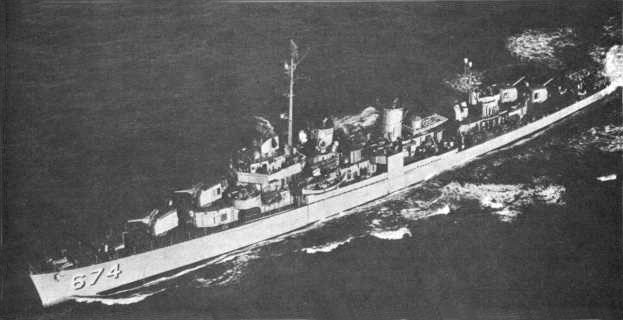
Hunt was a Fletcher-class destroyer, named for William Henry Hunt, Secretary of the Navy under President Garfield. Federal Shipbuilding and Drydock launched her at Kearny, New Jersey, on 1 August 1943. Mrs. Henry Kent Hewitt, wife of Vice Admiral Hewitt and granddaughter of the namesake, sponsored her. She was commissioned on 22 September under Commander Frank Paull Mitchell, Jr.
The Navy’s ship history names Mitchell at the commissioning, and it names Commander Lynn Forbes Barry when she came back in 1951. The dates between those two sentences are the NavSource list of her captains, compiled by Wolfgang Hechler and Ron Reeves. That list has Mitchell until 8 December 1943, Lieutenant William Kittridge Rogers for the next ten days, and Commander Halford A. Knoertzer from 18 December 1943 to 31 March 1945. Commander Fred Earle McEntire, Jr., had her from 31 March 1945 through the decommissioning on 15 December.
After shakedown off Bermuda and work at the New York Navy Yard, she left Norfolk on 2 December 1943 and reached Pearl Harbor on Christmas Eve. She joined Vice Admiral Marc A. Mitscher’s Fast Carrier Task Force as part of the screen for a group that included Essex, Intrepid, and Cabot. In January 1944 she screened the strikes that opened the Marshalls. On 30 January she left the screen and shelled the northern beaches of Roi and Namur with North Carolina, South Dakota, and Alabama, then went back to the carriers.
In mid-February she was off Truk. Carrier planes and a circling surface force wrecked the lagoon anchorage the Japanese had treated as untouchable. Her job that day was to protect the carrier group. The ships and the aircraft sunk there are not credited to her. Through the spring she screened the carriers at Palau and at Hollandia. On 1 April, with Hickox, she sank two patrol craft that had been firing on American planes.
During the Battle of the Philippine Sea she stayed with the flattops. The fighters cut down the Japanese air groups. That fight is not credited to her. On the way back she picked up four pilots and seven crewmen from planes that could not land on their carriers. Later that year she was in the screen for the Leyte landings and for the strikes on Formosa and the Philippines. In February 1945 the same force hit the Tokyo Bay area and then supported the landings on Iwo Jima. On 19 February her guns brought down one plane in the first raid against the ships off the island.
Her sharpest day came on 19 March 1945, off the Japanese home islands, while Knoertzer still had her. A single bomber dropped out of the clouds and put two bombs into the carrier Franklin. Ammunition, bombs, and rockets cooked off. Franklin went dead in the water within 50 miles of the coast. Hunt closed in, hauled 429 men out of the water, and then circled the burning carrier with three other destroyers until the cruiser Pittsburgh got a tow on her. Pittsburgh got her to Ulithi on 24 March. The three destroyers with Hunt are not named in the ship’s history.
McEntire had her by the time she went on radar picket off Okinawa. On 14 April a kamikaze came in low, was hit by her guns, and still struck at deck level, shearing the mainmast and slicing into the forward stack. The fuselage fell into the water about 25 yards off the side, and left a wing in the stack. The crew put out small fires. A second kamikaze that day was shot down before it reached her. By the time she left the Ryukyus on 30 May, the crew had been called to general quarters 54 times. She sailed for the States on 19 June, arrived in San Francisco on 6 July, and was decommissioned at San Diego on 15 December 1945.
She came back for the Cold War. Recommissioned at San Diego on 31 October 1951, under Commander Lynn Forbes Barry, she spent the next years out of Newport on antisubmarine work and plane-guard duty. In 1954 she made a world cruise, by Yokosuka, the Philippines, Hong Kong, Singapore, the Suez Canal, and Naples, and she was back in Newport on 18 December. In November 1956 she went to the eastern Mediterranean during the Suez crisis and the Hungarian uprising. On 1 August 1958, on a Caribbean cruise, she raced from San Juan to join the later carrier Saratoga (CVA-60) with the Sixth Fleet for the landings in Lebanon. She won the Battle Efficiency “E” for 1957–58 and again for 1958–59, decommissioned for the last time on 30 December 1963, and was sold for scrap on 14 August 1975.