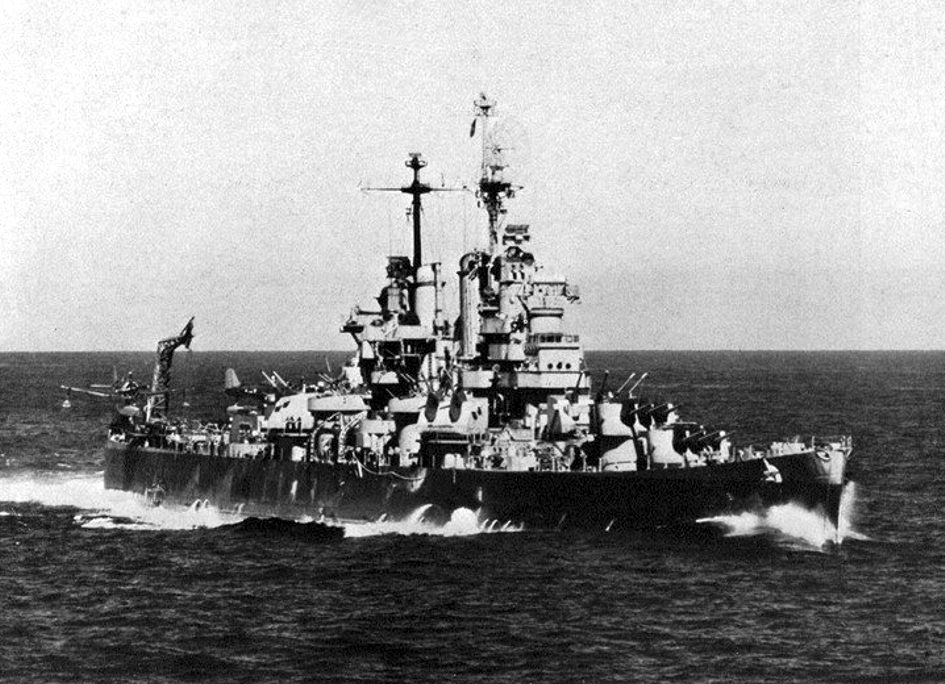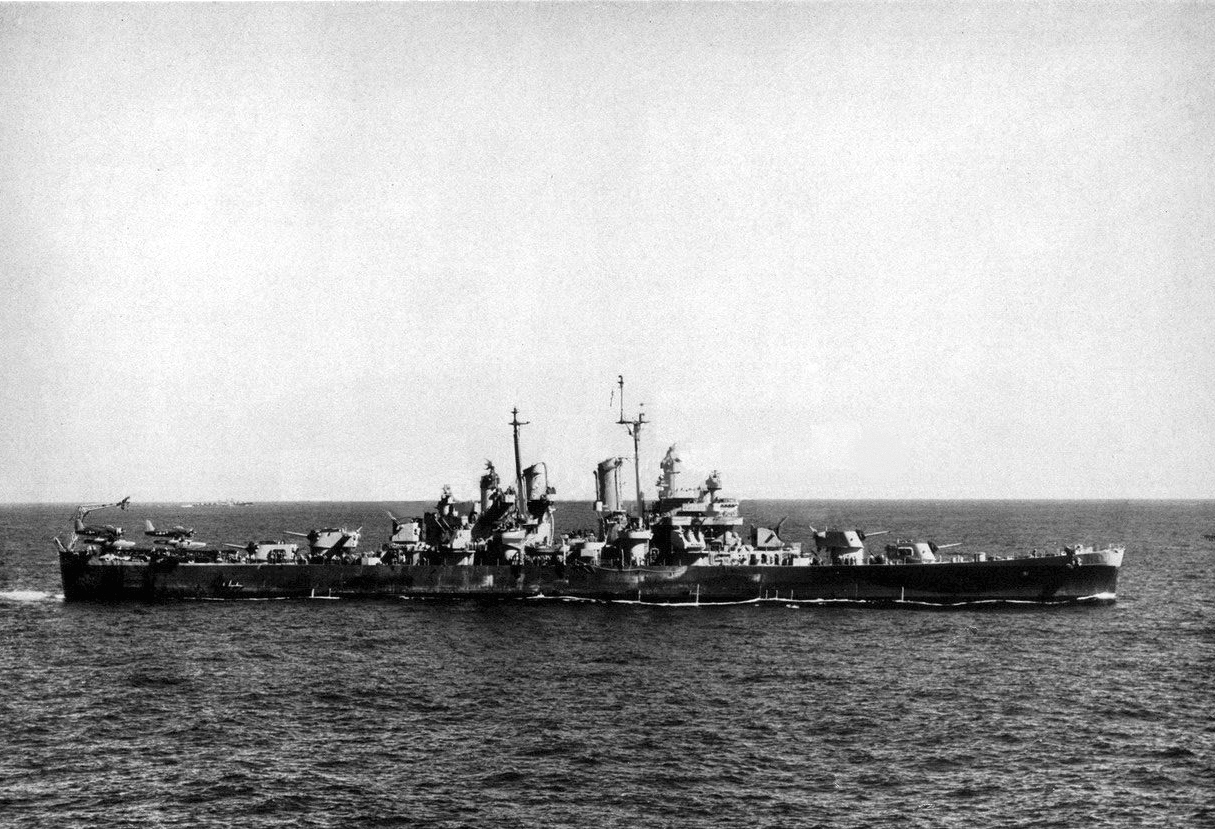
Oklahoma City (CL-91) was the first Navy ship named for the capital of Oklahoma. Cramp Shipbuilding Co. laid her down at Philadelphia on 8 December 1942. She was launched on 20 February 1944, sponsored by Mrs. Ella D. Classen, widow of the Oklahoman Anton H. Classen. The Navy commissioned her on 22 December 1944, with Captain Charles B. Hunt in command. The DANFS hull line gives a displacement of 14,400, a length of 610 feet 1 inch, a beam of 66 feet 4 inches, a draft of 24 feet 10 inches, 31.6 knots, a complement of 1,426, twelve 6-inch guns, twelve 5-inch guns, twenty-eight 40 mm guns, and ten 20 mm guns, and places her in the Cleveland class.
After outfitting at Philadelphia she shook down and trained in Chesapeake Bay and the Caribbean. Post-shakedown availability began on 10 March 1945, and training resumed on 9 April. On the 10th she lost her starboard anchor and 125 fathoms of chain overboard. Both were replaced on the 11th. At sea on 15 April she held a memorial service for President Franklin D. Roosevelt, who had died on the 12th at Warm Springs, Georgia.
She left for Pearl Harbor on 21 April, transited the Panama Canal, and reported to Commander, Cruisers, Pacific, on 2 May. She trained locally until 22 May, then sailed for Ulithi in the Carolines and arrived on 1 June. On 6 June she rendezvoused with Carrier Task Group 38.1 for the Okinawa Gunto campaign. Through the rest of June and into July she screened Third Fleet carriers during their air operations against Japanese forces. On 18 July she formed a bombardment group with other cruisers and destroyers, then rejoined the carrier group for further strikes on the Japanese home islands.
In the last days of the war the air attacks in her area grew heavier, including kamikaze attacks. She did not know of the atomic bombs on Hiroshima and Nagasaki. Her formation was still under air attack when hostilities ceased on 15 August. She kept the wartime watch and patrolled off Japan until 10 September. After 72 days of continuous steaming she escorted Bennington (CV-20) into Tokyo Bay.
On 15 September she left with Task Group 38.2, four carriers, three cruisers, and thirteen destroyers. After a month on patrol and a call at Eniwetok she was back in Tokyo Bay on 13 October, escorting Lexington (CV-16). Occupation duty lasted until 30 January 1946. She reached San Francisco on 14 February and stayed until 15 August, when she entered the Mare Island Naval Shipyard at Vallejo for inactivation. She was placed out of commission in reserve on 30 June 1947 and assigned to the San Francisco Group, Pacific Reserve Fleet.
NavSource gives Captain Charles Boardman Hunt the ship from 22 December 1944 to 31 October 1945, Captain Dashiell Livingston Madeira from 31 October 1945 to 5 June 1946, and Commander Horace Vonarx Burkhart from 5 June 1946 to 1 July 1946. Captain Charles Owen Humphreys had her from 1 July 1946 through the decommissioning on 30 June 1947. DANFS's own table uses the same days and spells the second captain Dashiell L. Maderia.
On 7 March 1957 she arrived at the Bethlehem Steel yard in San Francisco to be rebuilt as a Galveston-class guided-missile light cruiser. The conversion began on 21 May, and two days later she became CLG-5. It left her forward 6-inch turret and one 5-inch mount, and fitted a Talos launcher aft. The work was finished on 31 August 1960. She was towed to Hunter's Point and recommissioned at 1534 on 7 September 1960. The same account then has her as a Seventh Fleet flagship, on gunfire support off Vietnam, and, on 4 February 1972, firing the first successful combat surface-to-surface missile shot by a U.S. warship, a Talos missile against a North Vietnamese radar. She was redesignated CG-5 on 30 June 1975. She was decommissioned and struck at San Diego on 15 December 1979. On 27 March 1999, as a target, she was sunk by a torpedo from the South Korean submarine Le Chung (SS-062), in 6,000 feet of water, 230 miles southwest of Guam. She earned two battle stars for World War II and 13 campaign stars for Vietnam. She was not sunk in the war.
A note on sources. The narrative follows the Naval History and Heritage Command's Dictionary of American Naval Fighting Ships entry for Oklahoma City (CL-91), including the later missile service and the 1999 sinking. The dates and places are from digitized copies of that entry. The wartime commanding officers and their dates are NavSource's list for CL-91. That list and the DANFS table agree on the days. The table prints Maderia where NavSource and uboat.net print Madeira. NavSource's class block gives 10,000 tons, a maximum draft of 25 feet, 32.5 knots, and a crew of 1,255. DANFS gives 14,400, 24 feet 10 inches, 31.6 knots, and 1,426. DANFS is followed. NavSource alone gives an order date of 29 October 1940. It reclassifies her CG-5 on 1 July 1975, strikes her on 12 December 1979, and sinks her on 25 March 1999 as Lee Chun (SS 062). DANFS redesignates her on 30 June 1975, decommissions and strikes her on 15 December 1979, and sinks her on 27 March 1999 as Le Chung (SS-062). The HyperWar copy is the older short entry. It prints the displacement as 14,400 (f), the sponsor as Mrs. Anton H. Classen, and the captain as C. B. Hunt. It has her arrive at Pearl Harbor on 2 May 1945, where the current entry says she reported to Commander, Cruisers, Pacific, that day. It has her enter Tokyo Bay on 10 September and does not name Bennington. It has her become Seventh Fleet flagship six days after reaching Yokosuka on 20 December 1961. The current entry designates her flagship of Vice Admiral William A. Schoech in the sentence on that arrival, and this account does not use the six-day delay. A bracket on the HyperWar page says her name was dropped as of 2 May 1985. The current entry does not. The July 1945 bombardment and the strikes on Japan are not a separate battle on the list used here. She was not off Okinawa for the landings of 1 April 1945. The June cruise is the Okinawa row.