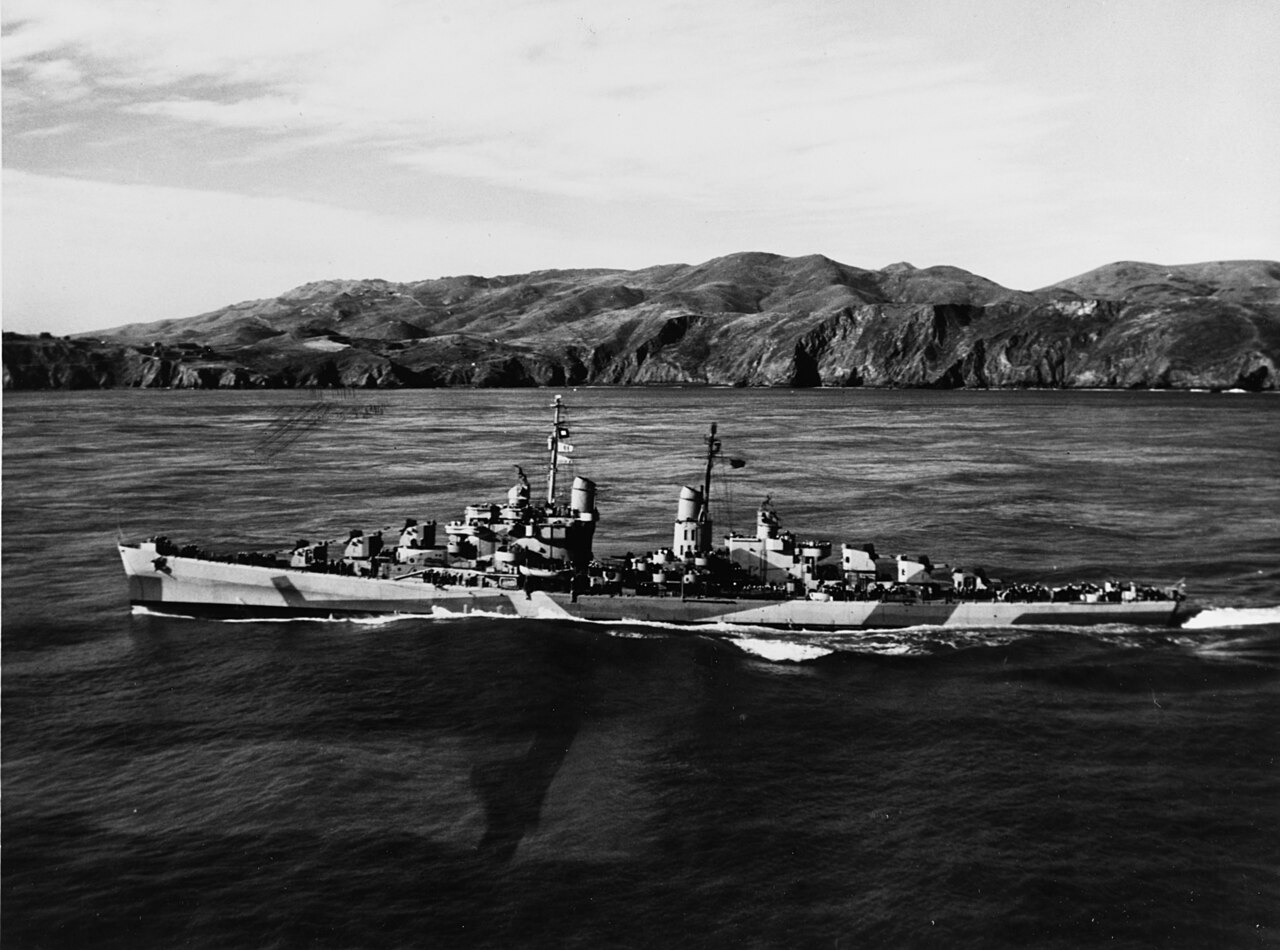
Reno, CL-96, was an Atlanta-class light cruiser, the second Navy ship of the name, for the city in Nevada. The first Reno, DD-303, had honored Lieutenant Commander Walter E. Reno. Bethlehem Steel Company laid CL-96 down at San Francisco on 1 August 1941. She went down the ways on 3 December 1942, sponsored by Mrs. August C. Frohlich, and the Navy commissioned her on 28 December 1943 with Captain Ralph C. Alexander in command. The DANFS line for the hull gives 8,600 tons full load, a length of 541 feet, a beam of 53 feet 2 inches, a draft of 26 feet 6 inches, 31 knots, a complement of 688, twelve 5-inch guns, sixteen 40 mm guns, sixteen 20 mm guns, eight 21-inch torpedo tubes, and two depth-charge tracks. NavSource dates Alexander, Naval Academy class of 1918, from the commissioning.
After shakedown off San Diego she left San Francisco on 14 April 1944 to join the Fifth Fleet. In Vice Admiral Marc A. Mitscher's Task Force 58 she first met the enemy covering air strikes on Marcus Island on 19 and 20 May, and three days later strikes on Wake Island. In June and July she was with the fast carriers for surprise attacks on Saipan on 11 June, Pagan on 12 and 13 June, and the Volcano and Bonin Islands, Iwo Jima, Haha Jima, and Chichi Jima, on 15 and 16 June. Three days later she helped beat off the Japanese carrier force that tried to break the invasion of Saipan, in the Battle of the Philippine Sea. From 20 June to 8 July she covered the capture of Saipan. She covered the landings on Guam from 17 to 24 July, struck the Palaus from the 26th to the 29th, hit the Bonins again on 4 and 5 August, and was back at the Palaus on 7 September.
She went on west. Raids on Mindanao and the nearby Philippine islands followed on 9-13 September, then support of the Palau invasion on 15-20 September, and strikes against Manila and the neighborhood on the 21st and 22nd. On 8 October, striking the Nansei Shoto with Task Force 38, she came nearer the home islands of Japan than any other major unit of the United States Fleet had been, as DANFS puts it. During the three-day strike on Formosa, 12-14 October, she shot down six enemy planes. At the height of it a torpedo plane crashed and exploded on her main deck aft. Mount 56 was partly knocked out. The turret captain kept it firing.
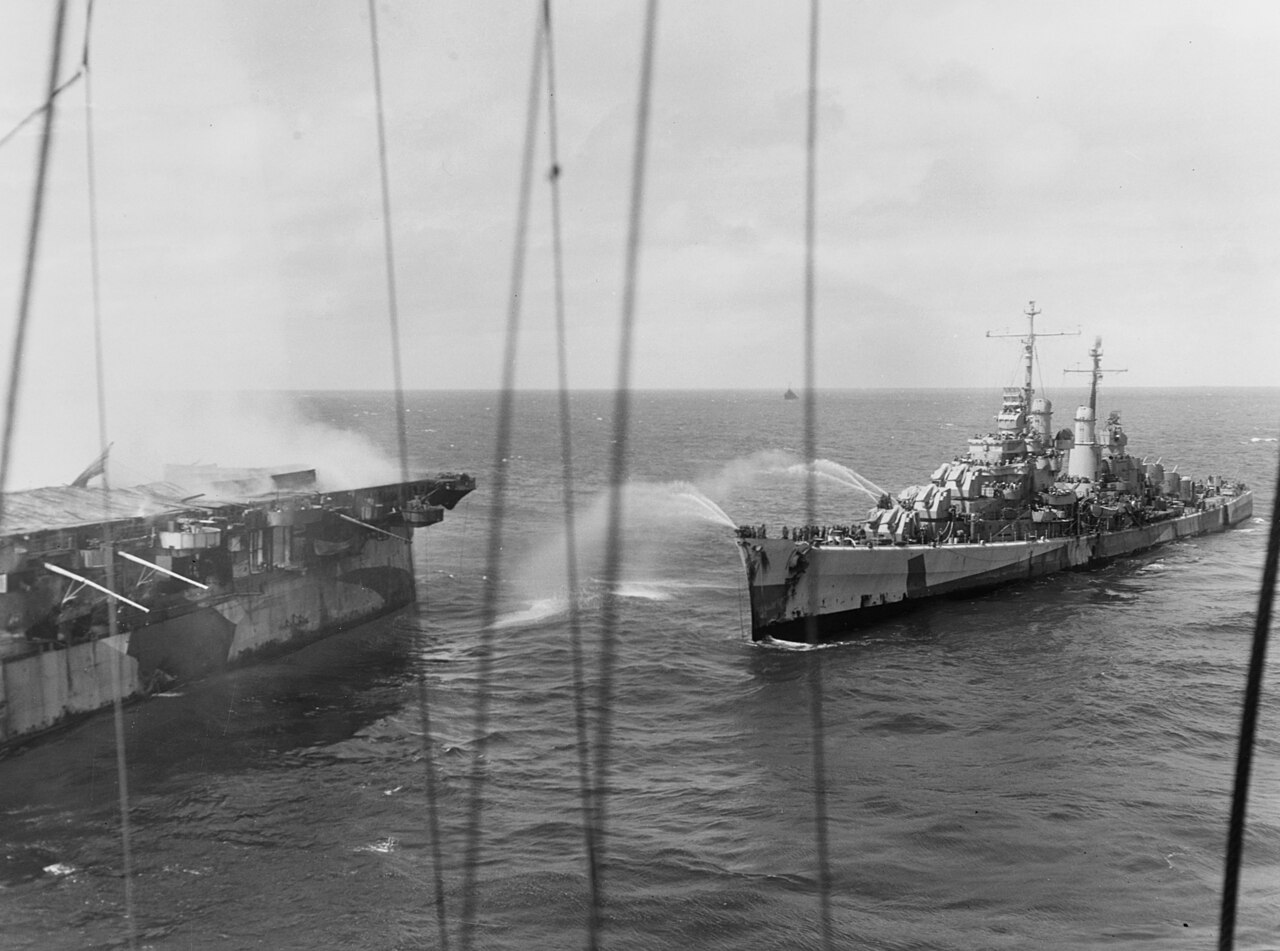
On 24 October 1944, four days after the Leyte landings, Task Force 38 was supporting air strikes against Luzon when Japanese planes from Clark Field attacked in strength. Combat air patrol and rain squalls limited the damage. A Judy, a Yokosuka D4Y1 carrier bomber, bombed the light carrier Princeton (CVL-23) and forced her out of the group. Birmingham (CL-62) and the destroyers Morrison (DD-560), Gatling (DD-671), and Irwin (DD-794) were damaged trying to lie alongside her. Birmingham took very heavy damage when a cataclysmic explosion, set off by fires that could not be controlled, went off as she lay there. Reno came alongside five times and could not stay, because of the heat and the smoke. While she was taking off wounded men and trying to get the fires down, Princeton's listing flight deck crushed one of Reno's 40 mm mounts. After the carrier's torpedo-warhead stowage exploded, Reno was ordered to scuttle her. With Irwin, she sank the carrier. On 25 October she rejoined the task force and went north to engage the northern Japanese force closing for the Battle of Cape Engaño, the last engagement of the Battle for Leyte Gulf.
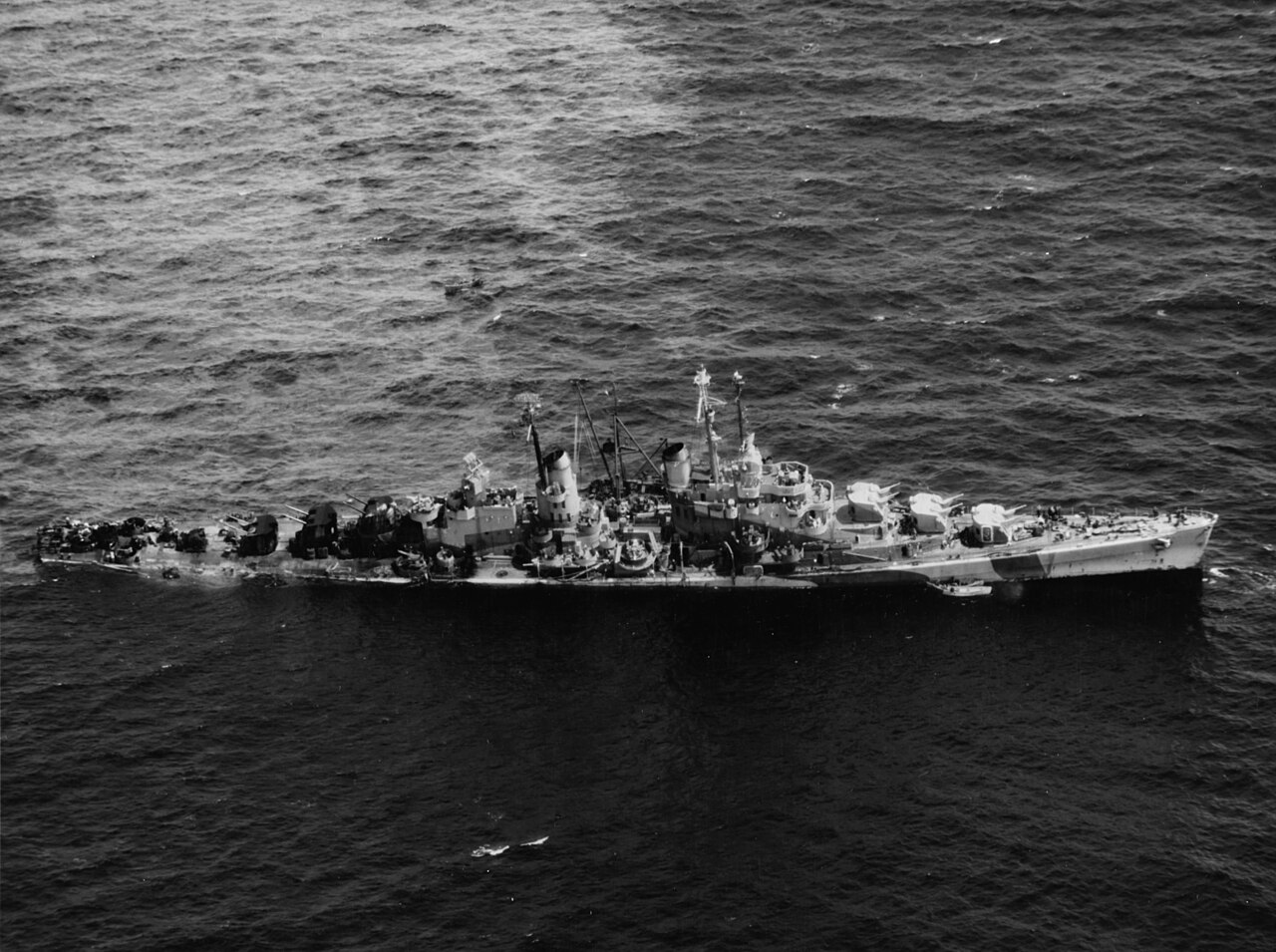
On the night of 3 November 1944, off San Bernardino Strait, the Japanese submarine I-41, Lieutenant Commander Kondo Fumitake, attacked Task Group 38.3. She loosed four Type 95 torpedoes. Two hit Reno on the port side. One did not explode. DANFS says it was the first time since 1942 that a Japanese submarine had attacked a ship operating with a fast carrier task force. A typhoon was nearby. Heavy seas and high wind made the salvage harder. She listed quickly to 16 degrees and lay dead in the water. Men not needed for the damage-control work were taken off. Those who stayed got her moving. The fleet tug Zuni (ATF-95) towed her 1,500 miles to Ulithi, where she arrived on 11 November for temporary repairs. Kondo claimed an Essex-class carrier and received a citation from the Emperor. I-41 was last heard from on 12 November, the day after Reno reached the western Carolines.
She then steamed under her own power to Charleston, South Carolina, and entered the Navy Yard on 22 March 1945. Alexander had been relieved on 13 February 1945 by Captain Thomas Francis Darden Jr., Naval Academy class of 1921. Darden left her on 26 March, four days after she entered the yard, and Captain Thomas Joseph Hickey took command. Hickey was relieved on 22 May. Captain Merle Alexander Sawyer, class of 1924, took her on 23 May. The list names no captain for the day between them. She was in the yard seven months. When she came out, the war was over. She steamed to Texas, then back to Charleston for more bunks, reported for Magic Carpet duty, and made two runs to Le Havre, France, and back with returning Army troops.
Sawyer was relieved on 11 April 1946 by Captain Rowland Clifford Lawver, class of 1930. Early in 1946 the ship steamed for Port Angeles, Washington. She was decommissioned there on 4 November 1946, the day Lawver's command ends, and entered the Pacific Reserve Fleet, berthed at Bremerton. She was reclassified CLAA-96 on 18 March 1949 and stayed at Bremerton until her name was struck on 1 March 1959. Her hulk was sold on 22 March 1962 to Coal Export Company of New York to be broken up. She earned three battle stars for World War II. She was not sunk.
A note on sources. The narrative follows the Naval History and Heritage Command's Dictionary of American Naval Fighting Ships entry for Reno II (CL-96), updated by Robert J. Cressman on 3 June 2020, for dates, the Princeton work, the torpedoing, and the disposal. That page prints the damaged gun as "Mt. 56" and the submarine commander's name as Kondo Fumitake. A digitized copy on the HyperWar site is an older text of the same history. It is not followed where it differs. HyperWar dates the launch to 23 December 1942. The NHHC page says 3 December 1942. HyperWar calls the damaged gun Turret Six and prints Mitscher's name as Mare. It leaves out Birmingham, the three destroyers, the 16-degree list, the unexploded torpedo, Zuni, Kondo's claim, and the last word of I-41. It says only that she was torpedoed in the port side well off San Bernardino Strait. The commanding officers and their dates are the local NavSource list for CL-96. DANFS names only Alexander, as Ralph C. Alexander, at the commissioning. Uboat.net gives Sawyer the ship from 22 May 1945 through the decommissioning on 4 November 1946 and cites NavSource. The list used here starts him on 23 May 1945 and relieves him on 11 April 1946, with Lawver through 4 November. The list is followed. She is not given a Sibuyan Sea row. The NHHC page never names that battle. It places her on 24 October with Task Force 38, supporting strikes on Luzon and then alongside Princeton, and on 25 October it names the Battle of Cape Engaño. The July 1944 strikes on Iwo Jima are not the February 1945 landing. She was in the Charleston yard from 22 March 1945 and was not at Okinawa.