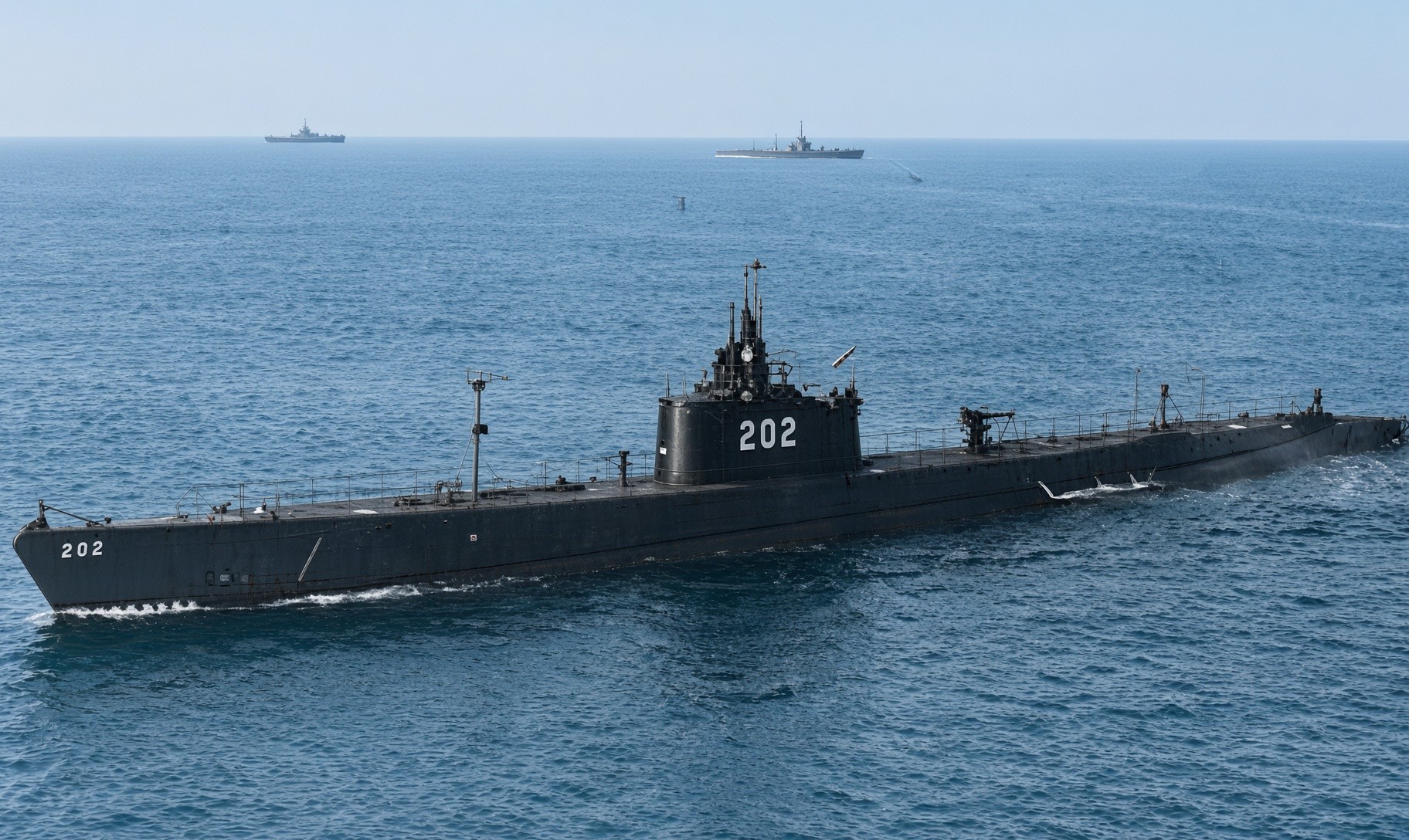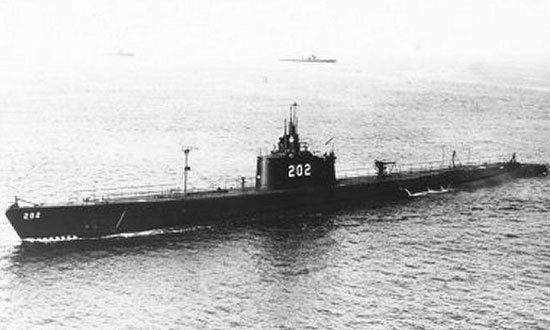
Trout was a Tambor-class fleet submarine. Portsmouth Navy Yard laid her down at Kittery on 28 August 1939, launched her on 21 May 1940, and commissioned her on 15 November 1940. Mrs. Walter B. Woodson sponsored the launch. Frank W. Fenno took command that day. She was 307 feet long, about 1,475 tons on the surface, with ten torpedo tubes and a 3-inch deck gun. On 2 July 1941 she and Triton left New York, crossed the Panama Canal, and reached Pearl Harbor on 4 August.
She was already at sea on a practice patrol off Midway when the war began. On the night of 7 December 1941 her lookouts saw Ushio and Sazanami shelling the island. She closed on the surface at full speed. The destroyers were gone before she could shoot. She came back to Pearl Harbor on 20 December. She had not fired a torpedo.
On 12 January 1942 she sailed again with about 3,500 rounds of 3-inch antiaircraft ammunition, and with food and medicine. Torpedoes had been taken off to make the room. She fueled at Midway and reached Corregidor on 3 February. PT-34 led her through the minefield to South Dock. She landed the ammunition. The load had been light, and she needed ballast, so she took on gold bars, silver pesos, securities, mail, and State Department dispatches that the High Commissioner's staff wanted kept from the Japanese. The paper money was burned ashore. She lay on the bottom of Manila Bay through the day, took on more that night, and was led back out.
On the way home, on 10 February, she sank the freighter Chuwa Maru, 2,719 tons, east of Keelung, at 25°30′N, 122°38′E. That evening, near the Bonins, she sank a small patrol vessel. Wartime credit put that craft at about 200 tons. The postwar assessment does not count it. She reached Pearl Harbor on 3 March, and the gold and silver went aboard the cruiser Detroit. Fenno received the Navy Cross and the Army Distinguished Service Cross. The crew received Army Silver Stars. The boat received a Presidential Unit Citation.
The third patrol, 24 March to 17 May 1942, was in Japanese home waters. The citation for it claimed a large tonnage. The postwar assessment keeps two ships: the cargo ship Uzan Maru on 2 May, and the converted gunboat Kongōsan Maru on 4 May. After the second she took a long depth-charge attack. In the middle of April she covered the approaches while the carriers went in for the Doolittle raid. The boat received another unit citation, and Fenno a second Navy Cross.
She sailed on 21 May for the submarine screen at Midway and made no attack. On 9 June she found two Japanese sailors on wreckage in the oil from Mikuma and took them aboard. She was back at Pearl Harbor on 14 June. After that patrol she was fitted with radar and a better sonar and went to Australia. Fenno left her. Lawson P. Ramage, called Red, had the fifth patrol, from 27 August to 13 October 1942. Off Truk she sank the net tender Koei Maru on 21 September and damaged the escort carrier Taiyo on 28 September. Aircraft bombs damaged her near the entrance to the lagoon. A third Presidential Unit Citation followed.
From Australia, through the sixth patrol to the tenth, late 1942 into the autumn of 1943, the work mixed attacks, mining, and landings. During the November fighting off Guadalcanal she fired at the battleship Kirishima and missed. She laid mines in Api Passage, off Borneo. She put guerrilla parties and officers ashore on Mindanao and took them off. She sank tankers, freighters, and small craft with torpedoes and the deck gun, and she took prisoners. Torpedoes that exploded early, failed to go off, or circled cost her targets. For a time the tenth patrol was credited with the submarine I-182 in Surigao Strait on 9 September 1943. Later work has questioned that credit. Across the first ten patrols the postwar count is on the order of a dozen ships.
At Mare Island the conning tower was cut down, the 3-inch gun was replaced by a 4-inch, and bunks were added. She returned to Pearl Harbor early in 1944. Albert H. Clark had the command. He had been in her from the commissioning, and he had been executive officer.
She left Pearl Harbor on 8 February 1944 for the eleventh patrol, fueled at Midway on the 16th, and headed for the East China Sea. She was not heard from again. On 29 February a convoy carrying troops of the 29th Division toward the Marianas was attacked near 22°40′N, 131°45′E. The transport Sakito Maru, 7,126 tons, was sunk, and another ship was damaged. The escorts were Asashimo, Kishinami, and Okinami. Asashimo then made a heavy depth-charge attack. Oil and debris came up, and a last charge was dropped on the slick. Trout was the only American submarine known to be there. A torpedo that circled back is still possible. The depth-charge attack is the account that is accepted. She was declared overdue on 17 April 1944. Eighty-one men were lost, Clark and his executive officer, Harry E. Woodworth, among them. The wreck has not been found.
She received eleven battle stars. The Presidential Unit Citation covers the second, third, and fifth patrols. Of the twelve Tambor boats, five came home.