Ships
- IJN Yamato Captain from 17 December 1942
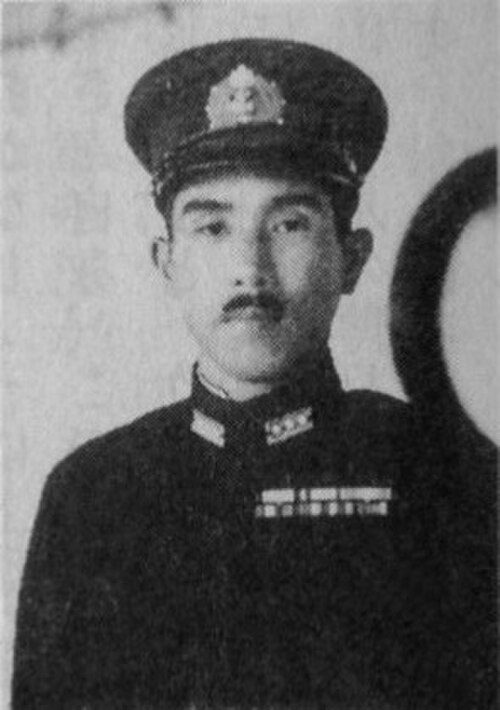
Chiaki Matsuda was born on 29 September 1896 in Kikuchi District, Kumamoto Prefecture. He entered the Naval Academy at Etajima in 1913 with the 44th class and graduated on 22 November 1916, fourteenth in a class of ninety-five. Gunnery became his specialty, and in 1928 he finished the 26th class of the Naval War College. In May 1929 the navy sent him to the United States as a resident officer, and in May 1930 he was made assistant naval attaché. He returned in 1931, served briefly in the light cruiser Kiso, and joined the Navy General Staff on duties that followed the United States Fleet. His wife, Koma, was a sister of the poet Kaoru Maruyama.
In the mid-1930s he worked on the building plans that followed the naval treaties, including the basic design of the battleships of the class led by Yamato. He doubted that their speed, and the firing rate of their 46-centimeter guns, would decide a battle with the faster American battleships then on the drawing board. From April 1935 he was executive officer of the light cruiser Abukuma. That November he joined the faculty of the Naval College. After the rising of 26 February 1936 he came under police suspicion over sympathy with the young officers who had struck at the government. He was promoted to captain on 1 December 1937 and assigned to the staff of the China Area Fleet. In August 1938 he took command of the seaplane carrier Kamoi. A journey through Europe and the United States followed in 1940, and that October he joined the Total War Research Institute. On 1 September 1941 he became captain of the old battleship Settsu, by then a target ship, and prepared a guide for defense against aircraft. He judged the raid on Hawaii a strategic failure, since American industry remained intact and able to replace the ships lost there.
On 20 February 1942 Matsuda became captain of the battleship Hyuga. On 5 May, during gunnery practice, a gun in her after turret burst and killed many of the men serving it. Temporary repairs let her sail in June with the Main Body for Midway. Before the fleet left, the staff ran a chart exercise and, because he knew American practice, gave him the United States side. Using long-range land-based aircraft, his side found the Japanese carriers and sank three of them on the board. Matome Ugaki, chief of staff to Isoroku Yamamoto, rewrote the score to steady the officers. The battle that followed cost Japan four carriers. Hyuga carried an experimental Type 21 radar on the cruise. Matsuda came home convinced the set had helped the scattered ships gather again, and he pressed the navy to fit radar widely.
On 17 December 1942 he relieved Gihachi Takayanagi and became the third captain of Yamato. The battleship lay at Truk as flagship of the Combined Fleet. She remained in the lagoon through the close of the Guadalcanal campaign. Her 46-centimeter shells were being saved for a fleet battle, the waters off the island were poorly charted, and her fuel burn was more than a bombardment run could justify. On 11 February 1943 the flag moved to Musashi. Matsuda filled the long anchorage with lectures and officer drills, and the ship gained the name of a naval college afloat. Promoted to rear admiral on 1 May 1943, he stayed in Yamato until 7 September, when Takeji Ono relieved him. He then went to the Naval General Staff.
In May 1944 he was given Carrier Division 4, and he was the first flag officer to lead it after the conversion of its ships. Under him were Ise and Hyuga, rebuilt with a short flight deck where the after turrets had stood. At Leyte Gulf those decks carried no aircraft, and the two ships fought with their remaining guns. He took them with Admiral Ozawa's carriers, the force sent to pull American carrier aircraft away from the battleships under Takeo Kurita. Off Cape Engano on 25 October the American strikes fell on Ozawa's carriers. Ise and Hyuga came through and returned to Japan.
In February 1945 he led Ise and Hyuga, with a light escort, from Singapore toward Japan loaded with oil, rubber, and other scarce cargo. The movement was Operation Kita. American submarines and aircraft searched the route. Twice the ships came under attack, and twice a rain squall closed over them and let them pass. The cargo reached the home islands. On 20 March 1945 he took command of the Yokosuka Naval Air Group and held it through the surrender. He retired on 1 November 1945.
American officers questioned him in Tokyo about the hybrid battleships and the battle off Cape Engano, and he answered in full. He lived on for half a century as an inventor and a businessman, and died in Japan on 6 November 1995 at the age of ninety-nine. In later years he likened Yamato and Musashi to fine dresses in a poor house: bought by going without, kept folded in a chest, and worn so seldom that they never changed the outcome.