Ships
- USS Burns (DD-588) Captain, 3 April 1943 – 28 July 1944
Donald Temple Eller (28 June 1906 – 30 October 1994) was a United States Navy officer, born in Washington, D.C., and raised in Petersburg, Virginia, who graduated from the Naval Academy in 1929 and retired as a rear admiral in 1964. He spent the years between the wars as a junior officer in battleships, cruisers and destroyers, much of it in Central American and Chinese waters and most of it in gunnery. In 1941 and 1942 he was gunnery and operations officer on the staff of an Atlantic Fleet destroyer squadron that escorted a troop convoy to Cape Town, served with the British Home Fleet on the North Russia convoy route, and covered the landings in French Morocco. From 1943 to 1944 he commissioned and commanded the Fletcher-class destroyer Burns in the Pacific. He received the Navy Cross for a night gunfire attack on a small Japanese convoy in the Marshall Islands on 30 January 1944, and three weeks later his ship fought in the surface sweep around Truk. After the war he commanded a destroyer division, an attack transport, a destroyer squadron and a destroyer flotilla, then held flag commands with the Military Sea Transportation Service in the Atlantic and the Naval Reserve Training Command, and finished his career on a NATO staff in southern Europe. He is a different man from Rear Admiral Ernest McNeill Eller, a native of Marion, Virginia, who graduated from the Naval Academy in 1925, served on the Pacific Fleet staff during the war, and became Director of Naval History. The two men were never midshipmen at the same time, and the sources examined here do not show that they were related.
He was born in Washington, D.C., on 28 June 1906, the son of Wayne M. Eller and Mary Temple Eller. His middle name was his mother's maiden name. The sources examined here say nothing about his father's occupation, about brothers or sisters, or about when the family moved from Washington to Petersburg, Virginia, but Petersburg is the home given for him in the later records. He graduated from Petersburg High School in February 1925, and that year Congressman Patrick Henry Drewry of Petersburg appointed him to the Naval Academy. When the Evening Star of Washington listed the Virginians in the Academy's graduating class in May 1929, it gave his home as Petersburg. When the Associated Press reported his ship's first success in February 1944, it called him "Comdr. Donald T. Eller of Petersburg, Va."
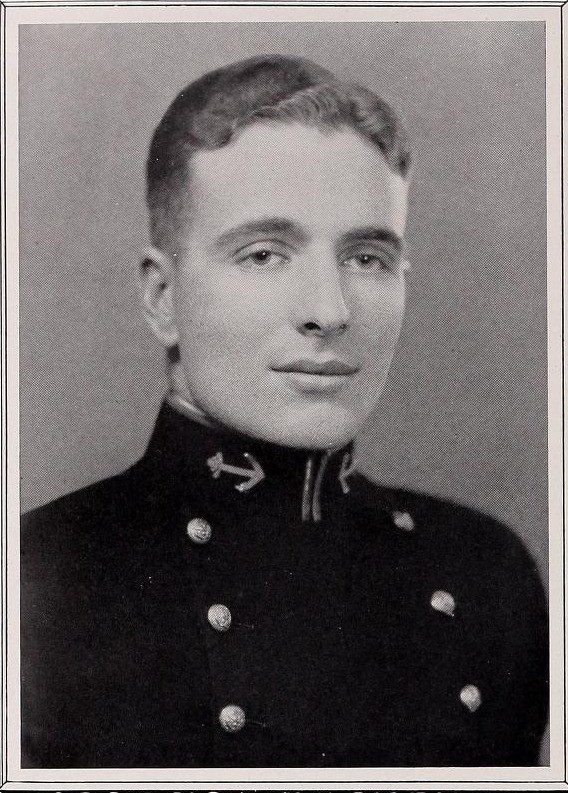
His classmates thought of him as a Southerner. The Academy yearbook described a "curly-headed blonde who thinks there is no place like the sunny South," with "that inviting broad grin on his face," and credited his popularity with young women to "his charming personality, or perhaps it is his southern drawl." It also says that he could spin yarns about canoeing in "those enchanted spots of Virginia." Little else about his boyhood can be found in the sources examined here.
He entered the Naval Academy in 1925 with the class that would graduate in 1929. The yearbook, the 1929 Lucky Bag, gives his nicknames as "Don," "Temple" and "Dutch." Its sketch is affectionate and short on solemnity: "Happy-go-lucky, never bothered about his studies. Yet a man who craves action." It describes his sport most fully. "A beginner at the start of Plebe year he developed into one of Navy's strongest saber men, narrowly missing that desired N." He fenced on the varsity for three years, and the yearbook's fencing section names him among the saber men of the Academy team. He also played class soccer, swam, played tennis and sailed. "If there is any sort of breeze blowin' down the bay, you'll see this man out in one of the boats." He qualified as an expert rifleman, and the Academy's annual register for 1928–29 lists him among the midshipmen who earned that rating. The yearbook also records an "N.A. Cane Championship" in 1928.
It gives one hint about his heart. "Somehow Baltimore has had an increasing influence over this lad. Just watch him at night; when the moon is out, he will be sitting at the open window dreaming of that fair femme." The young woman is not named, and the sources examined here do not show whether she was the woman he married. The sketch closes: "No one can have a truer and finer friend than Don — happy, patient, and square — a gentleman!"
He graduated and was commissioned an ensign on 6 June 1929. His first assignment was communications duty in the battleship Wyoming, which was then flagship of the Scouting Force in the Atlantic. In March 1930 he went to the old armored cruiser Rochester, the flagship of the Special Service Squadron, the small force that kept watch over American interests in Central America and the Caribbean. He served in her as a division officer for about a year in those waters. That year, according to the ship's official history, she carried a commission of inquiry to Haiti and brought Marines home from there. In 1931 an earthquake devastated Nicaragua. The Rochester was the first relief ship to arrive, and she carried refugees and then returned to counter the bandits who took advantage of the disorder. His later decorations included the Second Nicaraguan Campaign Medal. On 25 February 1932 the cruiser left Balboa for the Far East. She reached Shanghai on 27 April 1932, joined the American naval forces in the Yangtze River that June, and was decommissioned at Cavite in the Philippines in April 1933.
He stayed on the Asiatic Station. From June 1932 to June 1934 he was torpedo officer of the four-stack destroyer Pope of Destroyer Squadron 5, which divided its year between winter training out of Manila and summer operations on the China coast, based mainly at Chefoo. The Pope's official history records the one episode of those years in which he can be seen under pressure. On 2 September 1933, during the squadron's summer in northern Chinese waters, a carpenter's mate second class named Edward Steiger entered the cabin of the commanding officer, Lieutenant Commander Robert O. Glover, with a Colt .45 pistol. He forced the captain into the wardroom and lined him up with three other officers. Glover escaped when a mess attendant came in, and Steiger fired at him and missed. An ensign who entered the wardroom was fired at, but the cartridge misfired. A chief boatswain's mate who rushed in with a pistol failed to release its safety, and Steiger's next shot also misfired. While Steiger was trying to clear his jammed weapon, three of the officers in the room rushed him. "In the ensuing scuffle," the history says, "Steiger hit Lt. (j.g.) Donald T. Eller in the head twice with his gun, leaving Eller with two scalp lacerations." The officers overpowered the man in the captain's stateroom. Placed in irons, he broke free on deck and jumped overboard, was picked up by the ship's boat, and was taken in double irons, lashed to a stretcher, to the tender Black Hawk for confinement and observation. The record does not say whether Eller was one of the three officers who rushed the gunman or was struck as he came to their aid. Either way, he was in the room and within the gunman's reach when the struggle began. The sources say nothing about how the episode affected him. It is the only incident from his years in China that can be documented.
His decorations from these years included the Yangtze Service Medal. He came home in 1934 and spent about a year as gunnery officer of the destroyer King, then operating with the Battle Force out of California. He then served as a division officer in the Utah, the former battleship that had been converted into a radio-controlled target ship. In June 1935 a fleet machine gun school was set up on board her, and he attended the gunnery school there. In 1936 he was selected for the general line course at the Postgraduate School at Annapolis, and he then took further instruction at the Marine Corps Schools at Quantico, Virginia. The sources examined here do not say what he studied at Quantico.
From June 1938 to April 1941 he was gunnery officer of the destroyer Smith, a ship of the Battle Force that later operated with the Hawaiian Detachment. The Navy Register of 1940 lists him in her as a lieutenant. Since 1932 he had specialized, as far as his record shows, in guns and torpedoes, the weapons a destroyer used to fight on the surface.
In April 1941 he joined the staff of Commander Destroyer Squadron 8 as gunnery and operations officer, with the staff embarked in the destroyer Wainwright. A ship-listing compilation names the squadron commander in November 1941 as Captain Don P. Moon. The United States was not yet at war, but the Atlantic Fleet was already escorting convoys. On 10 November 1941 the Wainwright sailed from Halifax in the screen of Convoy WS-12X, a convoy of American ships carrying British and Commonwealth troops toward the Middle East by way of the Cape of Good Hope. The destroyers refueled at Trinidad and went on across the South Atlantic. His Navy biography records that "at the outbreak of war in the Pacific his squadron was entering the bay at Cape Town, South Africa." The Wainwright's official history gives the convoy's arrival at Cape Town as 9 December 1941, two days after the attack on Pearl Harbor. The destroyers had sailed from Halifax as neutrals, and they sailed home as belligerents.
In March 1942 the squadron went to join the British Home Fleet. On 25 March the Wainwright left Casco Bay, Maine, "with ComDesRon 8 embarked," in company with the carrier Wasp, the battleship Washington and the heavy cruisers Wichita and Tuscaloosa, and reached Scapa Flow on 3 April. His biography calls the squadron "the first American unit to join the British Fleet in World War II." Through the summer the Wainwright worked on the convoy routes between Iceland, the Orkneys and northern Russia, where air and submarine attack were common.
Her hardest day there was 4 July 1942. She was in the screen of the cruiser covering force for Convoy PQ-17, bound from Iceland to Archangel, and had joined the convoy to refuel when German aircraft attacked. Her official history describes how her long-range fire held off one torpedo-plane raid and how she then met about twenty-five Heinkel 111 torpedo bombers in two groups. She engaged the first group at about 10,000 yards and then turned her fire on the second, which was more dangerous. All but one of the aircraft in that group dropped their torpedoes well short of her. The torpedoes from the group off her quarter still hit the Liberty ship William Hooper and the Soviet tanker Azerbaidjan. That evening the cruisers and their destroyers were withdrawn to meet a German surface sortie that never came, and the convoy was ordered to scatter. More than two-thirds of its ships were lost. If the squadron staff was still aboard, as it had been when the ship sailed in March, Eller was in the Wainwright that day as the staff's gunnery officer. The sources examined here do not say directly where he was.
In November 1942 the Wainwright was one of four destroyers screening the Covering Group of the Western Naval Task Force, the battleship Massachusetts and the cruisers Tuscaloosa and Wichita, during the landings in French Morocco. Off Casablanca on 8 November the group fought French aircraft, submarines and surface ships. His biography states that he "took part in the Casablanca landing," and the two engagement stars on his European–African–Middle Eastern campaign medal agree with service on the convoy route and in North Africa. The sources examined here do not describe his own work on the staff in either campaign.
Early in 1943 he left the Atlantic to take his first command. His biography dates his command of the Burns from February 1943, which probably reflects the months of fitting out. The ship was a new Fletcher-class destroyer built at the Charleston Navy Yard, and she was commissioned there on 3 April 1943 with Commander Donald T. Eller in command. He was thirty-six years old and had been commissioned for nearly fourteen years. After six weeks of shakedown off Guantánamo Bay, the Burns passed through the Panama Canal and reached Pearl Harbor on 17 September 1943. Her first operation was the carrier raid on Wake Island on 5 and 6 October. In the invasion of the Gilberts in November she was in the destroyer screen of the transport group of the Northern Attack Force, which landed Army troops on Makin.
In the Marshalls she was assigned to the fast carriers. In January 1944 she belonged to Destroyer Squadron 46 in the screen of Rear Admiral Frederick C. Sherman's carrier group, Task Group 58.3, built around the Bunker Hill. Late on the afternoon of 29 January, after the first strikes on Kwajalein, a torpedo plane from the Bunker Hill went down about eighty miles away, and the Burns was sent to recover its crew. She picked up the three men from their raft shortly before sunset. One of them was badly injured, and she transferred him to the battleship South Dakota of another carrier group before heading west in the dark to find her own group.
Shortly after midnight on 30 January, off Ujae Atoll, her radar picked up a contact at about 20,000 yards. It was a black, moonless night with rain clouds. The combat information center at first took the echo for a rain cloud, and then considered whether it might be ships of the other American carrier group, which was known to be nearby. Two accounts survive of what the captain said when he was told. The ship's official history, compiled after the war, has the officer of the deck asking: "Shall I order flank speed and try to slip through them, sir?" and Eller answering: "Slip through them, my foot. I've been waiting for a chance like this for years, and we're not going to run for it now." Captain Amedeo H. Galvani, who was then a twenty-three-year-old lieutenant (junior grade) and the ship's assistant gunnery officer, published his memory of the night in Naval History in 2011. He recalled that the captain was in his sea cabin abaft the bridge and answered: "Slip past them, my foot. I've been waiting for a chance like this for 20 years. I'll be right out." The two versions differ in their words but agree in substance. Both come from people who wrote with affection for the ship, and neither is a contemporary transcript.
General quarters sounded at 0042. The Burns worked up to 25 knots and maneuvered to cross the head of the enemy line so that all five of her guns would bear. Galvani's account records the decision that preceded the first salvo. With the contacts unidentified, and with an American carrier group in the area, the captain called them on the voice radio used by all American and Allied ships: "This is Deputy. Identify yourself or we will open fire." There was no answer. "What a grave decision for our skipper," Galvani wrote. "Heaven forbid that we might be opening fire on some of our own or Allied ships." The ship's history gives the time of the challenge as 0103 and says that firing began at 0107 at a range of 9,000 yards.
The first salvos set the leading ship afire. Galvani wrote that postwar records showed her to be a tanker. The Burns shifted fire to a second, larger target and set it burning, then lit up the scene with her searchlights and ran through the convoy with all guns firing, five-inch, 40-millimeter and 20-millimeter, while her main battery sank the two small escorts. About then the other carrier group, which had seen the flames, asked over the radio whether she needed help. Galvani remembered the captain's reply: "No thanks. This is our picnic." The action lasted thirty-four minutes. The ship fired 494 rounds of five-inch, 400 of 40-millimeter and 900 of 20-millimeter ammunition. As the Burns pulled away, Galvani saw a single man hanging from a rope at the bow of the burning tanker, "with flames above and a sea of flaming oil below." "I couldn't help feeling sorry for the poor fellow," he wrote, "who may have momentarily been the only survivor of our attack."
The Burns rejoined her group the next morning with a broom at her masthead for a clean sweep, and the crew of the battleship Iowa cheered her when she came alongside to refuel. The Pacific Fleet's press release of 9 February 1944 announced that the Burns, "a destroyer commanded by Lieutenant Commander Donald T. Eller, sank an entire convoy of four enemy ships," a tanker, a medium cargo vessel and two smaller craft. Newspapers across the country carried the Associated Press version of the story. According to Galvani, one of those articles gave the ship the nickname "Battlin' Burns," which stayed with her for the rest of the war.
The Navy Cross citation repeats the claim. It credits Eller, as commanding officer "during a War Patrol of that vessel in enemy Japanese-controlled waters," with having "launched a bold, aggressive attack in the face of heavy and persistent hostile countermeasures, to sink an entire Japanese convoy including one tanker, one supply ship and two smaller craft." The postwar record is less generous. Samuel Eliot Morison wrote in his official history that "Burns claimed to have sunk them all by radar-controlled gunfire, but the postwar checkup indicates that she got only two of over 500 tons." He named the two as the Paran Maru, of 562 tons, and the Akibasan Maru, of 4,600 tons, and noted that the second sinking was attributed to aircraft as well as to surface ships, and that the joint Army–Navy assessment did not record vessels under 500 tons. The revised official history of the Burns names the ships sunk as the transport Akibasan Maru and the guardboat Nichiei Maru. The sources thus agree that he took his ship into a night action against unidentified ships, alone and far from support, and sank at least two of them. They disagree on whether there were four.
Three weeks later the ship fought again. During the first carrier raid on Truk, Admiral Raymond A. Spruance took a surface group of the battleships Iowa and New Jersey, the heavy cruisers Minneapolis and New Orleans and four destroyers, among them the Burns, around the atoll on 17 February 1944 to catch ships trying to escape. Early in the afternoon they found the light cruiser Katori, already damaged by carrier aircraft, two destroyers and an armed trawler. Spruance ordered the two heavy cruisers and two destroyers to close and sink the Katori. Morison wrote that the Bradford and the Burns "first engaged the light cruiser at 17,400 yards." A later Navy history adds that the two destroyers fired torpedoes, all of which missed. The Katori fought until she rolled over and sank. The Burns received credit for assisting in the sinking of the cruiser and of the trawler Shonan Maru No. 15.
Late that afternoon the Burns was detached to deal with a small vessel sighted on the horizon, the Japanese submarine chaser CH-24. The subchaser opened fire and straddled the destroyer, but she sank at 1655. Morison wrote that "of 60 survivors observed to be floating only 6 allowed themselves to be rescued," and that the way the Japanese sailors fought "gained the respect and admiration of the Fifth Fleet." The ship's own history speaks of "half a dozen reluctant prisoners" taken from the water "right under the noses of the garrison on Truk." A 2019 account by the Navy's Director of Naval History adds a grimmer detail that the older histories omit. It says that the destroyer's whaleboats hauled about six unwilling men out of the water and that, with the rest refusing rescue but close enough to Truk to be picked up by their own side, "the Burns dropped three depth charges onto the survivors, ensuring they would not live to fight another day." That account does not cite the ship's action report, and that report was not examined here. The sources therefore do not show who gave the order or what the captain said about it. They do show that it happened aboard his ship, under his command, on the same afternoon that his crew took prisoners from the same water.
The ship's history counts eighteen awards to the captain and crew for the two actions, including the Navy Cross for "Skipper" Eller and the Silver Star for the gunnery officer, Lieutenant James P. Jamison. The revised official history links the Navy Cross to the fighting at Truk. The citation itself describes only the destruction of the convoy.
For the next five months the Burns steamed with the fast carriers. She took part in the raids on Palau, Yap, Ulithi and Woleai at the end of March, the Hollandia landings in New Guinea in April, and the raids on Truk, Satawan and Ponape at the end of April. In June, in the Marianas campaign, she was in the screen of Rear Admiral J. J. Clark's Task Group 58.1. She was there for the Battle of the Philippine Sea on 19 and 20 June and the raids on Iwo Jima and Chichi Jima in the Bonin Islands. The ship's history says that during one of the Marianas strikes, when she was serving as a picket and fighter-director ship, the two fighters under her control shot down four enemy aircraft. Eller's letter of commendation from the Commander in Chief, Pacific Fleet, which carried the Combat "V," records that in this period his ship "participated in carrier strikes on the Marianas and Bonin Islands; contributed substantially to the rescue of our aviators after an air attack on important units of the enemy fleet, and assisted in bombardment of the Bonin Islands." The rescue it mentions was presumably the recovery of aviators who went down after the long-range strike on the Japanese fleet on the evening of 20 June, though the commendation does not say so.
The records disagree about when he left the ship. His Navy biography says he commanded her until June 1944 and returned to the United States that month. The ship's history and her revised official history give 29 July 1944 as the date he was relieved by Commander Jacob T. Bullen, Jr. A ship-listing compilation gives the same dates. In October, under Bullen, the Burns helped screen the torpedoed cruiser Canberra away from Formosa, and in January 1945 she rescued more than 160 survivors of the escort carrier Ommaney Bay. Eller was by then ashore in Washington. The same compilation dates his temporary promotion to captain from 30 March 1945. The Navy Cross citation, as quoted in his biography, calls him "Captain (then Commander) Eller," which suggests that it was issued after that promotion.
From the summer of 1944 he spent three years as officer in charge of the Advanced Technical Service Schools in Washington, D.C. The sources examined here do not describe the schools or his work there. He went back to sea in June 1947 as commander of Destroyer Division 72, and for four months of that year he also commanded Destroyer Squadron 7. In June 1948 he became assistant chief of staff for administration to the Commander in Chief, Atlantic Fleet, and served under Admirals William H. P. Blandy and William M. Fechteler until June 1951. He then spent a year as a student at the National War College in Washington.
From June 1952 to June 1953 he commanded the attack transport Cavalier. The ship had carried troops to Korea in the first years of the war there. During his year in command, according to her official history, she was on the West Coast, training along the California coast and in Hawaii. She sailed again for the Far East in July 1953, after he had left her. He then served in the Office of the Chief of Naval Operations in the naval intelligence organization. On 24 October 1955 he took command of Destroyer Squadron 6. He was promoted to rear admiral with rank from 1 August 1956, and that month he became Commander Destroyer Flotilla 6.
His flag assignments were largely administrative and logistical. From November 1957 to January 1960 he was Commander, Military Sea Transportation Service, Atlantic Area, with headquarters in New York. That command was responsible for the armed forces' ocean shipping in the Atlantic. In 1960 he went to Omaha, Nebraska, as Commander Naval Reserve Training Command. The Oregon Statesman of Salem reported in July 1961 that "Rear Adm. Donald T. Eller, commander of the U.S. Naval Reserve Training Command, Omaha, Neb." would come to inspect the city's Naval Reserve surface division and be the guest at a civic luncheon.
In September 1961 he became Deputy Chief of Staff for Logistics and Administration to the Commander in Chief, Allied Forces Southern Europe, NATO's command for its southern region. His Legion of Merit, for service there from 17 September 1961 to 15 April 1964, is the fullest official description of any of his work. It describes "a myriad of challenging, complicated and extraordinary problems, both operational and administrative, evolving from the tactical and support requirements of the joint six-nation force," and credits him with raising the region's communications to "an enviable standard of efficiency and reliability," building "a wide variety of vital infrastructure facilities," creating "fully operative alternate command and control facilities," and instituting financial and budgetary safeguards and improving "the lagging personnel posture of the Command." It also praises "his outstanding professional competence, perseverance, and diplomacy." The citation describes a staff officer who worked across six national services and spent much of his time on budgets and communications rather than on ships.
In April 1964 he went to the Potomac River Naval Command in Washington for a short assignment, and he was transferred to the retired list on 1 July 1964, thirty-five years after he was commissioned. Besides the Navy Cross, the Legion of Merit and the Commendation Ribbon with Combat "V," his official biography lists the Second Nicaraguan Campaign Medal, the Yangtze Service Medal, the American Defense Service Medal with bronze "A," the European–African–Middle Eastern Campaign Medal with two engagement stars, the American Campaign Medal, the Asiatic–Pacific Campaign Medal with one silver and one bronze star for six engagements, the World War II Victory Medal, the China Service Medal (extended) and the National Defense Service Medal. Together they cover the main stations of his career: Central America, China, the North Atlantic and the Arctic, North Africa, and the Central Pacific.
He lived for thirty years after retirement. He died on 30 October 1994, at the age of eighty-eight. A ship-listing compilation gives the place of death as Pinellas County, Florida. A memorial website gives his wife's name as Dorothy Wood. It says that his ashes were buried at Arlington National Cemetery and that some of them were also buried beside her in the churchyard of Pohick Church at Lorton, Virginia. Neither of these details could be confirmed from a stronger source, and the sources examined here do not give the date of his marriage or show whether he had children.
The record he left is thin in personal material and has a few vivid moments. There is the yearbook's grinning Virginian saber fencer, "happy, patient, and square." There is a lieutenant (junior grade) twice struck on the head in the Pope's wardroom as officers wrestled down an armed sailor. There is a destroyer captain who, told that unknown ships lay ahead in the dark, refused to slip past them, challenged them by radio, waited through the silence, and then opened fire. That night produced his Navy Cross and the claim of four ships, later reduced to two. Three weeks later, off Truk, his ship took six prisoners from the water and, according to one modern Navy account, dropped depth charges among the men who would not be taken. After that came twenty years of staffs, squadrons, sealift, reserve training and NATO logistics, and a long retirement about which almost nothing has been found.