Ships
- HMAS Hobart (D63) Captain from 28 August 1939
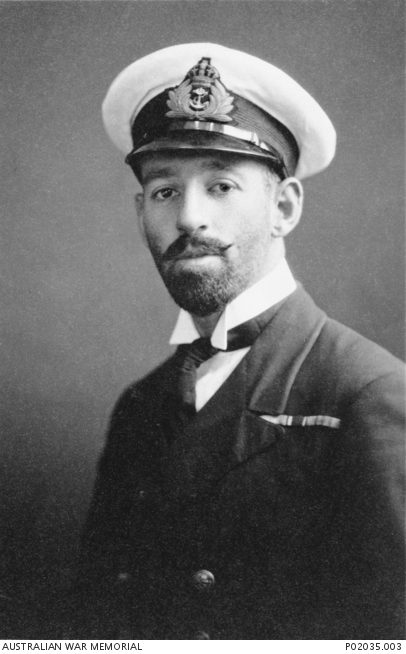
Harry Leslie Howden was born on 4 July 1896 at Vogeltown, Wellington, New Zealand, the son of Patrick Grieve Howden, a merchant from Scotland, and Mary Elizabeth Howden, born Niblett, who had come from England. He was educated at Wellington College and, as a youth, sailed the Pacific in trading vessels. He made his own way to Britain and in October 1915 was appointed a midshipman in the Royal Naval Reserve, going to sea in the battleship HMS Benbow with the Grand Fleet. On 5 October 1916 he transferred to the Royal Australian Navy. He joined the light cruiser HMAS Sydney in December 1917, while that ship was trying aircraft flown off a platform on a gun turret.
He became a sub-lieutenant in July 1917 and a lieutenant in May 1919. After courses in England in 1923 and 1924, and a run of Australian sea and shore appointments, he commanded the destroyer HMAS Tasmania, with the rank of lieutenant commander from May 1927, and served in HMAS Australia from 1928. In 1930, on exchange with the Royal Navy, he took the Insect-class gunboat HMS Mantis on the Yangtze. That December he steamed her upriver from Hankow through the night, the channel sounded with bamboo poles, and paid a ransom that brought two Irish priests out of the hands of bandits. On 21 May 1931, at the British Consulate General in Hankow, he married Vanda Mary Sanders Fiske. They had three sons and later divorced. His ship-handling earned him promotion to commander in December 1931.
Back in Australia he was executive officer of the seaplane carrier HMAS Albatross from 1932 to 1933, of HMAS Canberra from 1933 to 1935, and from 1935 at Flinders Naval Depot on Westernport. He was appointed an Officer of the Order of the British Empire in 1937 and spent that year and the next with the Admiralty's Naval Intelligence Division in London. Promoted captain on 30 June 1938, he came home in October to a string of short commands, among them the cruiser HMAS Adelaide, which he commissioned in March 1939 after her conversion from coal to oil. On 28 August 1939 he relieved Captain Robert Stewart in the modified Leander-class cruiser Hobart.
War found Hobart on patrol in Bass Strait on 3 September 1939. In October Howden took her to the East Indies Station, and through the months that followed she escorted troopships between India, Ceylon, the Red Sea and the Bay of Bengal. At Christmas, spent at sea, he had laid in a hundred gallons of beer at Colombo for the messes. In the Red Sea he received the Prince of Yemen off Hodeida. Italy entered the war on 10 June 1940 while Hobart was at Aden, and two days later her guns fired on Italian aircraft over the port. Late that month she carried men of the 2nd Punjab Regiment to Berbera with her upper deck packed with soldiers. The Italian advance then made British Somaliland untenable. From 14 to 19 August Howden directed the naval side of the withdrawal, with Hobart as the combined headquarters. Her people built a pontoon, manned tugs, ferried the exhausted troops, treated wounded from several armies, and sent boats back for stragglers while the harbour was bombed. Some 7,140 soldiers and civilians were taken off. On the last morning the cruiser bombarded what remained at Berbera and sailed for Aden. For that operation he was made a Commander of the Order of the British Empire.
Hobart reached Sydney again on 3 January 1941 and wore the flag of Rear Admiral J. G. Crace as flagship of the Australian Squadron, working the Australia and New Zealand stations. In June her catapult gear was landed and she sailed to relieve HMAS Perth in the Mediterranean. On the night of 14 July, at the southern end of the Suez Canal, German bombs set the troopship Georgic on fire. Howden sent his boats in among the troops. Georgic's attempt to beach herself ended in a collision that also set the landing ship Glenearn alight, and Hobart later passed a line across and towed Glenearn clear. From Alexandria, in a Royal Navy cruiser squadron, she ferried men along the desert coast through the relief of the Australians at Tobruk, bombarded Tobruk and Bardia, and joined sweeps with the battleships Queen Elizabeth, Barham and Valiant. Air attack was routine, and she came through it intact. Her last Mediterranean operation brought the supply ship Breconshire into Alexandria on 7 December 1941, the day Japan attacked Pearl Harbor.
Turned back from the voyage home, Hobart joined the American, British, Dutch and Australian forces in South-East Asia. She lay in Keppel Harbour, Singapore, at the beginning of February 1942 under repeated raids, then left for Tanjong Priok. On 3 February she and HMS Tenedos closed the merchant ship Norah Moller, burning after an air attack, and took off her wounded, including women and children. Through the rest of the month Howden kept Hobart alive under heavy bombing by violent changes of course and engine speed. On 15 February, the day Singapore surrendered, bombs burst so near the bridge that the heat reached him. On 25 February, while she was oiling at Tanjong Priok, a raid of twenty-seven bombers sprinkled her with splinters, caused casualties, and stopped her finishing fuel. Still short of oil, she stayed behind when the Allied striking force went out to the Battle of the Java Sea. He was mentioned in dispatches. Hobart sailed for Colombo on 1 March. In May she fought in the Battle of the Coral Sea, in Crace's cruiser force sent to guard the Jomard Passage against a Japanese landing bound for Port Moresby. On 7 May Japanese bombers and torpedo aircraft attacked that force, which had no fighter cover, and Hobart came through by manoeuvre. Howden left her on 7 June 1942. His ship's company, who called him Captain Harry and sometimes Den, gave him a farewell they talked about for years. Outside the ship he was Lucky Harry.
An arterial injury at the base of the brain, later ascribed to the strain of that sea service, ended further command afloat and any real chance of flag rank. In February 1943 he was treated at the Alfred Hospital in Melbourne. He commanded the new Sydney shore establishment HMAS Penguin in 1942 and again from 1943 to 1946, and for a short interval acted as Naval Officer-in-Charge, Sydney. In September 1946 he became Naval Officer-in-Charge, Western Australia, at Fremantle, and he retired on 4 July 1951, his fifty-fifth birthday. The day after he left Hobart, Henry Arthur Showers assumed command. The cruiser later passed to Frederick Cook and, in November 1944, to Roy Russell Dowling. In July 1943 a Japanese submarine put a torpedo into her after end and thirteen of her people were killed. She was repaired, returned to the war, and was in Tokyo Bay for the surrender. Howden was founding patron of her association, and in March 1962, before she was towed away to the breakers, he spoke to his old company and their families on board.
He was a small, neatly turned-out man who kept fit by riding, sailing and rowing. He took trouble over the welfare of people under him, and he was hard on anyone who fell short of the standard he set. On 26 September 1960, at the district registrar's office in Chatswood, Sydney, he married Freda Sybil Oates, born Harradence. He travelled, watched a portfolio of shares, and kept a house on the Swan River, moving between Western Australia and England. While holidaying in London he died on 16 February 1969 at St Bartholomew's Hospital, Smithfield, and was cremated. His second wife survived him, as did the three sons of his first marriage.