Ships
- HMAS Norman (G49) Captain from September 1941
- HMAS Bataan (I91) Captain from 25 May 1945
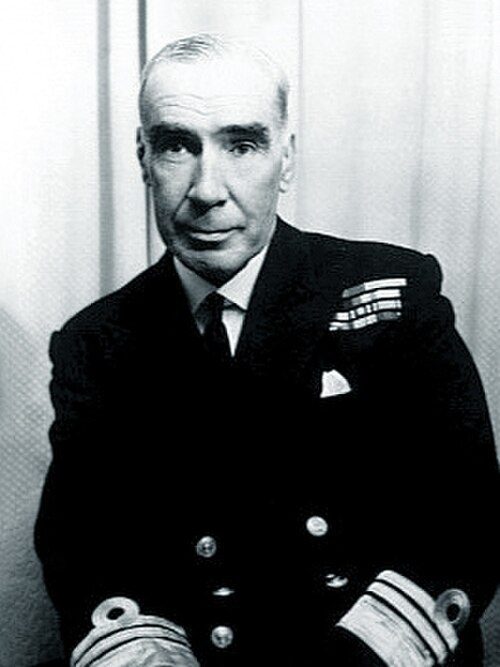
The photograph is credited there as Australian War Memorial 306783, public domain. He is not Commander Herbert James Buchanan, who relieved him in Norman on 23 June 1943. He is not the other Burrells who turn up in naval lists under different initials. The flag rank, the knighthood and the years as Chief of the Naval Staff came afterwards.
Origins
He was born on 13 August 1904 at Wentworth Falls, in the Blue Mountains of New South Wales, the only son and the third of five children of Thomas Henry Burrell and Eliza Heather Burrell, née Mackay. The father was a schoolteacher from England. The mother was Victorian-born. The Dictionary of Biography says the household was steeped in patriotism and community service, and gives the proof it has: in the First World War the father, already fifty-five, enlisted in the Australian Imperial Force and served in Egypt as a sergeant. The names of the four siblings are not in that entry. What became of them is not there either.
What Burrell himself later said about the house is in his autobiography, Mermaids Do Exist (1986), as Tom Lewis retells it for the Naval Officers Association. He called his father a “frustrated sailor.” He said the father had been in the Army Reserve, that a grandfather and a great-grandfather had served in the Royal Navy, and that the grandfather, also Thomas, had spent more than thirty years as a chief boatman. The father, on this telling, was interested in almost everything, from shooting to the arts, and at church was organist, warden and reader. None of that family naval service is in the Dictionary. It is his own account, not a checked service record. The mother, he wrote, was not pleased when, in 1917, with the father away, the boy turned toward the Navy. He applied anyway. He was given a cadetship.
Formation
He had been at Parramatta High School. In January 1918 he entered the Royal Australian Naval College at Jervis Bay, in what was then the Federal Capital Territory. He was thirteen. Lewis, following the book, dates the entry 1 January 1918. The Dictionary says only January. He gained his colours for hockey and graduated in 1921. The autobiography, again through Lewis, is harder on the place than the official life is. He thought some of the training too practical — he learnt to use a lathe — and he disliked the thinness of the literature and the stress on manners. His later joke was that the College’s product would be “an illiterate engineer who could enjoy to the full sailing and stargazing during weekends in a French condominium.” He disliked the College yacht Franklin. He did not, by his own account, excel at games there, though he liked them. He was given a second-class pass and graduated tenth. Of an intake he remembered as thirty-six, fourteen were kept. The Washington Treaty was cutting the officer corps, and a second-class tenth was enough to stay. The Dictionary does not give the class place or the cut. Those figures are his.
He became a midshipman in May 1922. The Dictionary then draws a curtain: he served in a number of RAN and Royal Navy ships in Australian and European waters in the 1920s, and specialised as a navigator in Britain in 1930. The ships of those years are named in the autobiography, not in the Dictionary, and they are used here as his later memory of a formation, not as a Navy List extract.
He went first, he wrote, to the light cruiser HMAS Sydney, the ship that had fought Emden, and decided to specialise in navigation for a reason he was willing to admit was modest: navigators, like telegraphists, were excused coaling ship. There was a month in the destroyer HMAS Stalwart, which he “thoroughly relished.” In April 1923 he went to Britain in the liner Orient with two other Australian midshipmen, too poor on their pay to join the social life, and joined the cruiser HMS Caledon late, because they had lingered over lunch. Captain Sir Dudley North gave them extra duties for three weeks. Burrell noticed that the Australians were behind the British midshipmen in dress and in the journals they were supposed to keep, and he rewrote his. Caledon went to the Baltic — Riga, Stockholm, Copenhagen, where he left two dozen stiff collars behind — and then to a fleet review. He was posted on to the battleship HMS Malaya and to the Mediterranean, sat the seamanship examination in August 1924, and passed well. Lewis dates an acting sub-lieutenant’s rank from 15 September 1924, with confirmation in April 1925. The Dictionary says only that he rose to sub-lieutenant in April 1925. The acting date is the book’s.
Courses followed: Greenwich, gunnery at Whale Island, navigation at HMS Dryad, mines and torpedoes at HMS Vernon. Vernon was the hard one. He came off it with a second-class pass against four firsts. He played some rugby and cricket. A bridge watchkeeping certificate meant time in the battleship HMS Valiant, then the cruiser HMAS Melbourne and the passage home. He was promoted lieutenant on 15 July 1926, which is both the Dictionary’s month and the autobiography’s day.
The next captain, in the destroyer HMAS Tasmania, was Acting Lieutenant-Commander Harry Howden, whom Burrell found eccentric. He was correspondence officer and had charge of the confidential books. The ship went to Tasmania and formed part of the escort for HMS Renown when a vice-regal party went to open the new Parliament House in Canberra. He was in the naval guard. Back in the old Sydney, one report said “In every way the right type.” In 1928 he went to the new cruiser Canberra, commissioning in Britain. He had decided, he wrote, to stay at sea as long as he could, to learn how to handle men, and to put off a further specialisation. Canberra showed herself around Australia and reached Sydney on 16 February 1929. A circumnavigation followed. In January 1930 he left her for the navigation course in Britain. His reports were “Above Average.” That mattered. The Depression was sorting officers into those to be kept and those to be asked to go, and he was marked to be kept.
The course done, he navigated the new Indian sloop Hindustan from her British builder to Bombay, came back in a troopship, and was sent to the minesweeper HMS Pangbourne. He knew it was a backwater. He also thought some Royal Navy officers resented a navy that had been grown, since 1911, under British tuition and was now competent. His method, in his own phrase, was to “hide his light under a bushel.” He took part in the reworking of night sweeping, navigated around much of Europe, and helped search for the submarine M2 after her hangar flooded and she was lost. One report, he remembered, carried two nines. He left Pangbourne on 16 October 1931, after a meteorological course. On 5 December 1932 he was back in Australia as first lieutenant of the destroyer HMAS Tattoo. The marks there were ordinary. The fleet had shrunk, then begun to grow again with the old destroyers later called the Scrap Iron Flotilla. He went to the largest of them, HMAS Stuart, as navigator.
The Dictionary picks up the thread here, and the two accounts meet. In the early 1930s he was navigating officer, successively, of Pangbourne, Tattoo, Stuart and the cruiser HMAS Brisbane. On 27 December 1933, at Scots Church, Melbourne, with Presbyterian forms, he married Margaret Isabel MacKay. The spelling of her name in the Dictionary is MacKay, not the Mackay of his mother. They were divorced in November 1941. He was promoted lieutenant-commander in July 1934. He wrote that he took up drink at thirty, having been a teetotaller, perhaps in celebration of the marriage. That sentence is his. The cause of the marriage’s failure is not in the Dictionary and is not guessed at here.
After an advanced navigation course in 1935 he served in the cruisers HMS Coventry and HMS Devonshire. The autobiography puts Brisbane first as the old coal-burner he navigated to Britain to be scrapped, while her company went on to commission the new Sydney and he went to Dryad. Coventry was converting at Chatham to an anti-aircraft cruiser and then went to Alexandria. He played a little tennis ashore, avoided what he called a sordid night life, and avoided the local food. Devonshire, a County-class cruiser and a sister of Canberra, took him into the Mediterranean while the Spanish Civil War was being fought and the cruiser’s job was to interfere with the shipment of war material without, he thought, any real law behind the interference. The Dictionary does not name that war. Lewis does, from the book. The fact the Dictionary does record, and the one that stayed with him, is the captain’s criticism. He was too familiar with the sailors. Burrell’s answer, which the Dictionary quotes, was that the ship “would have been more efficient if officers and ratings had been in closer touch.” Lewis’s fuller version of the report adds that he had not yet developed his powers of command and was “far too kindhearted.” A later flag officer, quoted by Lewis, read the rebuke the other way: it was the style, the ease with people younger than himself, that lasted.
He finished the Royal Naval Staff College at Greenwich in 1938. The staff-course reports, on his own telling, were the lowest of his career: fours, a poor delivery, a nervous manner, a lack of “personality.” Whether that was the course’s habit or a real verdict on him is not something the reports, unread here, can settle. The Dictionary says only that he completed the course and was posted to Navy Office, Melbourne, as staff officer (operations). War was close. The Navy had to be made ready. Lewis says the Munich crisis first pointed him at the cruiser HMS Emerald and then, when the crisis eased, at Melbourne, and that he thought Chamberlain naive and Churchill sincere if exaggerated. That political judgment is the memoir’s. What the Dictionary puts in the job is concrete: after September 1939 he was concerned with enemy surface raiders in Australian waters and with the convoying of troopships to the Middle East. He was promoted commander in June 1940. Lewis calls a May 1940 reorganisation a move to “Director of Operations,” covering troop convoys, their air cover, local defence and staffing. The Dictionary and the Sea Power Centre keep the title staff officer (operations) and the promotion in June. The grander title is not used here as an official one.
The war, as he lived it
Five months after that promotion he went to Washington. The Dictionary’s account is the one to trust for the shape of it. He joined the Australian delegation headed by Richard Gavin Casey, later Baron Casey, at secret talks between Britain and the United States on the Pacific. From January to April 1941 he was the first Australian naval attaché in Washington. The British-American staff conversations were drawing a plan for a war Japan and the United States had not yet entered. The plan gave priority to Europe. Major American fleet units would move from the Pacific to the Atlantic. Burrell’s progress reports, the Dictionary says, showed a growing fear that the United States would be prepared to abandon the Far East. The author of the Dictionary entry, Sam Bateman, thought that realisation may have marked him for the rest of his career. The Canberra Times obituary of 10 February 1988, quoted on a Victorian naval site and cited by the Dictionary, puts the discovery in February 1941: the United States, if forced into the war, would secure the Atlantic and Europe before dealing with Japan; the Philippines were regarded as essentially indefensible; Singapore was largely irrelevant to the defence of the region; Britain, with its other commitments, would not be able to send the fleet it had promised. He told Canberra. The troops went to Malaya and Singapore anyway.
The autobiography adds colour the Dictionary does not: a false passport, civilian clothes, a bed in an Australian diplomat’s house, because a foreign naval officer in the American capital was a delicate thing while the United States was still neutral. He proposed a permanent attaché and was then made the man he had proposed, because Norman, building in Britain, had her launch delayed by an air raid. A New Zealand naval office, Lewis says, told the Secretary of the RAN that his reports were of the “utmost value,” so complete that the New Zealand War Cabinet had commented on them. His own reports in this period, he remembered, carried nines and eights. The marriage did not survive the same months. In his words, as Lewis gives them, it “had failed” and “had been terminated.” The Dictionary dates the divorce to November 1941, which is after he had already taken Norman. The Washington work and the end of the marriage sit on top of each other in the record, and the record does not say which broke what.
He took command of the new N-class destroyer HMAS Norman at Southampton in September 1941. The Sea Power Centre dates the commissioning 15 September 1941, under Commander Henry M. Burrell, RAN. She was one of eight N-class destroyers ordered for the Royal Navy; five — Napier, Nestor, Nepal, Nizam and Norman — went to the RAN. Thornycroft built her at Southampton. He had stood by her, he wrote, while the Luftwaffe came over night after night. The ship he signed for, on a crumpled piece of paper a builder’s man took from his pocket — “Received Warship No. 235” — was, on his figures, good for about 35 knots, with six 4.7-inch guns, ten torpedo tubes and a modern set of radar and asdic. The unit history’s specification is a little different in the small print: 36 knots, a 2-pounder pom-pom, Oerlikons, depth charges, a crew of 226. The difference does not matter. She was a new fleet destroyer, and he had not commanded one before.
Trials in the Channel, then Scapa Flow. On 7 October 1941 she went to Iceland to embark Sir Walter Citrine and a Trades Union Congress delegation for passage to northern Russia. Four days at Archangel, then she sailed for Scapa and was recalled off Bear Island to wait. The party was taken off on 27 October. That is the unit history, and it is enough of a first operation: a political cargo, a recall in the Arctic, a wait. The autobiography fills in what the official paragraph leaves out, and it should be read as his memory. Ashore, Archangel depressed him: wooden roads, the people mostly gone, the vodka to be treated carefully. Ken McRorie, who served with him and whom Lewis cites, remembered the ship frozen to the wharf when it was time to leave. A family scrapbook, again through Lewis, preserved a melodramatic cutting in which an able seaman, Fred Miles, said a German bomber circled three times, was silhouetted against the moon, and exploded. The unit history does not record a bomber. The cutting is not treated here as a confirmed kill. It is the sort of story a ship keeps.
A short spell with the Home Fleet followed, including work on the screen of the battleship HMS Duke of York. In December she was back at Thornycroft for minor modifications. In January 1942 she was allocated to the Eastern Fleet and went out as senior officer of the escorting destroyers for the troop convoy WS 15, with the battleship Resolution, flying the flag of Vice-Admiral W. E. Campbell-Tait, covering as far as Freetown. She detached to Durban and then took WS 15 north through the Mozambique Channel. February and March were Indian Ocean escorts and the screening of heavy ships.
On 26 March Admiral Sir James Somerville assumed command of the Eastern Fleet at Colombo. Two days later, expecting a Japanese attack on Ceylon, he split the fleet. Force A, under his own hand, had Warspite, the carriers Indomitable and Formidable, cruisers and destroyers. Force B, under Vice-Admiral A. V. Willis, had the old R-class battleships Resolution, Ramillies, Royal Sovereign and Revenge, the carrier Hermes, cruisers, and eight destroyers, Norman and HMAS Vampire among them. The unit history is explicit that Norman was in Force B. The two forces joined about eighty miles south of Ceylon on 31 March and cruised for three days and two nights without seeing the enemy. On 4 April the fleet, less Dorsetshire, Cornwall, Hermes and Vampire, was at Addu Atoll. Somerville then had intelligence of a Japanese force some 360 miles off Ceylon: Vice-Admiral Nagumo’s carrier force, the same kind of instrument that had struck Pearl Harbor and Darwin. On 5 April the Eastern Fleet sailed again, Norman still on the screen of Force B, and stayed at sea between the Maldives and Ceylon, avoiding the stronger enemy by day and looking for a night air attack, until 8 April.
The ships that had been detached were not so spared. The Eastern Fleet war diary, in Don Kindell’s transcription, records Dorsetshire and Cornwall sunk on 5 April, and Hermes and Vampire sunk on 9 April off Batticaloa. On 8 April, with the Japanese in control of the Bay of Bengal, the Eastern Fleet left Addu. Force B went to Kilindini, on the African coast, to cover the routes to the Middle East and the Persian Gulf. Force A went to Bombay. Somerville put his headquarters at Kilindini on 14 April. Norman took up escort work and was in Bombay at the end of the month. The war diary’s disposition for 30 April puts HMAS Nestor and HMAS Norman in the Seychelles area with Warspite, Formidable and Indomitable, not with the force that had left Durban on 28 April for Operation Ironclad. On 1 May Norman and Nestor left the Seychelles with Formidable. On 10 May they arrived at Kilindini, three days after Diego Suarez had been captured. On 18 May Norman sailed from Kilindini with a clutch of cruisers and destroyers, toward the reinforcement of the Mediterranean.
That sequence matters, because the Dictionary and the Sea Power Centre’s short life of Burrell both say Norman was with the covering force at the capture of Diego Suarez and with the assault force at Tamatave and Majunga. The unit history of the ship, which is month by month, does not put her at the May landing at all. The old unit history of Nizam says plainly that Diego Suarez had already fallen when the N-class destroyers arrived for the later campaign. The war diary agrees with the unit history and not with the short life. The May capture is not narrated here as his battle. What he did live through, in April, was the week in which the Eastern Fleet discovered it could not stay in Somerville’s first anchorage and live. Years later, in Mermaids Do Exist, he argued with the British official history’s claim that Somerville was determined to avoid action. He thought the survival of that fleet was more good luck than good management. The Dictionary reports the argument. It is his judgment after the fact, not a signal from April 1942.
On 22 May it was decided to reinforce the Mediterranean from the Indian Ocean for two Malta convoys, one from Gibraltar and one from Egypt. The ships sent from Kilindini to cover the eastern, westbound convoy — Operation Vigorous — included the four Australian N-class destroyers Norman, Napier, Nestor and Nizam. Rear-Admiral Philip Vian’s convoy sailed from Port Said and Haifa on 12 June, with eight cruisers and twenty-six destroyers. The Italian fleet was at sea. Fuel ran short because of the diversions. The air attacks kept coming. The convoy turned back to Egypt. The cruiser Hermione, the destroyers Airedale, Hasty and Nestor, and two merchant ships were sunk. Several ships, including three cruisers, were damaged. In the air the Italian cruiser Trento was sunk. Nestor was the Australian loss, bombed on 16 June. Burrell brought Norman home from it. His later view, in the autobiography, was that the operation should have been pressed, and also that its prospects were already poor: the ammunition was down to about a third, largely because the admiral had thrown a heavy barrage over the fleet. He put Nestor close to Norman when the bomb hit. The unit history confirms that she was there and that the convoy failed. It does not confirm the distance between the two destroyers, or the fraction of ammunition. Those are his.
Back in the Indian Ocean she resumed escort and patrol. In September 1942, under Rear-Admiral W. G. Tennant of the 4th Cruiser Squadron, she took part in the second Madagascar campaign, 10 to 29 September, which ended with the occupation of the island. The Sea Power Centre’s history of Nepal is more particular than Norman’s own page. Operations began on 10 September with the capture of Majunga. Nepal was with the force assembled for Tamatave, the chief port, taken on 18 September in what that page calls a bloodless battle. “The only shots fired by the Australian ships came from Norman.” The autobiography, through Lewis, tells it as a small, sharp thing: Norman led a line into Tamatave harbour, the Vichy forces were called on to surrender, they fired on a boat sent inshore, the ships fired back, and a minute later a white flag went up. He believed the mention in despatches was for that minute. The London Gazette is wider. On 19 February 1943, in a supplement numbered 35915, the King approved awards “for bravery and resource during operations in Madagascar.” Among the names mentioned in despatches is Commander Henry Mackay Burrell, Royal Australian Navy, and also Rear-Admiral William George Tennant, who had commanded the September force. The Gazette does not isolate Tamatave. The Australian War Memorial’s honours roll records the mention against HMAS Norman and the rank of commander, and nothing else for the war. An Australian War Memorial photograph, accession 301114, shows Norman at Diego Suarez and is captioned 1942-12, which on the Memorial’s habit is December 1942, months after the port had fallen. Presence in the harbour that winter is not the May assault.
From October to December 1942 she was on ordinary Indian Ocean escort and fleet screening. In January 1943 she escorted between Kilindini and Madagascar. In February she was one of the escorts for the convoys bringing 30,000 AIF troops back from the Middle East toward Australia. March and April she was alongside at Simonstown for a refit. The unit history then says that from May to December 1943 she was almost constantly on Indian Ocean convoys, and that on 23 June 1943 Commander H. J. Buchanan, DSO, RAN, assumed command from Commander Burrell. At the handover she had steamed 124,000 miles and been underway some 7,500 hours. Buchanan is a different man. What Norman did after that day — the Nicobars, Burma, Okinawa with the British Pacific Fleet — was not Burrell’s cruise, and it is not told here.
The autobiography puts a body under those miles. He went into hospital with boils. He had already watched simple wounds fail to heal in the heat, on the diet, and under the hours. A man was lost overboard. Another was killed while the ship was in dry dock at Cape Town, and Their Lordships expressed displeasure that he had not enclosed the ship before the dock was pumped, though he later said that dock had not been enclosed for years. At the end of the command, on this telling, he was in hospital in Western Australia and again in Sydney, with what he afterwards called stress, bad diet and exhaustion. Lewis muddles the calendar here, and has him arriving at Geraldton at the end of 1943 with the 124,000 miles still on the clock. The unit history puts both the miles and the relief on 23 June. The hospital is his account of the weeks after he left the ship. It was not checked against a medical file.
In September 1943 he was back at Navy Office, Melbourne, as director of plans. Much of the work, the Dictionary says, was planning the use of British Commonwealth forces in the last stage of the war against Japan, and the basing of the British Pacific Fleet in Australia. On 21 April 1944, at the office of the government statist, he married Ada Theresa Weller, a mica specialist known by the surname Coggan. The autobiography, through Lewis, says the courtship lasted three weeks, that she had run away from home at fifteen, and that she had worked the mica fields of Western Australia and the Northern Territory. The Dictionary confirms the mica and the name Coggan, not the three weeks or the running away. The children of this marriage were two daughters and a son. Lewis names them from the book: a daughter, Fayne, in February 1945; a son, Stuart, on 21 March 1947; a daughter, Lynne, in 1948. The Dictionary does not name them. It says only that he was survived by the two daughters and the son of the second marriage. No child of the first marriage appears in that sentence. That is not the same thing as a proved absence.
In May 1945 he took command of the new Tribal-class destroyer HMAS Bataan. The Sea Power Centre dates her commissioning at Sydney on 25 May 1945, under Commander Henry Burrell, RAN, and says she was too late for active hostilities. Secondary lists, including uboat.net, put his command from 16 April. That earlier date is not in the unit history, and it is not used as the day he took her. Mrs MacArthur, the wife of General Douglas MacArthur, launched her.
She went to the Philippines in July and from there to Japan, reaching Tokyo on 31 August 1945 for the surrender signed on 2 September aboard USS Missouri. She stayed in Japanese waters, helping to evacuate Allied prisoners of war and serving as the Australian Squadron’s representative, until 18 November 1945. The Dictionary says he later assisted in the recovery of RAN prisoners from Sendai. It does not name HMAS Perth or give a count of survivors. A claim that he found Perth men at Sendai circulates in weaker accounts and is not repeated here as fact. The unit history of Nizam records four Perth survivors among recovered prisoners met at Wakayama on 14 September, by Nizam, not by Bataan. Different ship, different port.
What he himself later said about Tokyo is in the autobiography. He thought Bataan’s right to be in the bay was doubtful, because she was so new. He thought the atomic bombs justified, in a sentence Lewis quotes: they stopped, at the cost of many Japanese lives, a war that would have killed millions, “probably including my own.” That is his conclusion, not a citation. He embarked hundreds of prisoners and found them, and the Japanese he saw ashore, in very poor condition. A run up the river turned into barter, mostly in cigarettes, and the ship’s store was then robbed. He said the stocks would not be replaced, and that if the cigarettes came back the theft would not be pursued. They came back. Admiral Halsey, he wrote, commended him for the prisoner work: initiative and devotion to duty that helped free Allied prisoners and in many cases save lives, “in keeping with the highest traditions of the United States Naval Service.” No such commendation is on the Memorial’s honours roll beside the Madagascar mention. It stands as his account of what an American admiral said, not as an award this essay has seen gazetted.
On 18 November 1945 Bataan sailed for home. The autobiography then describes a curious job the unit history does not: the government was raising money, and Bataan took members of the public to sea from Brisbane, Sydney and Newcastle, 3,298 of them, as an inducement to subscribe. His last report as a commander, which he quotes, called him outstanding, quick, sound, strong in personality, and fit for higher rank at once. He was promoted captain in June 1946. Lewis dates an acting captaincy from 8 April 1946 and the substantive rank from 30 June, and says that on 2 April he was given the 10th Destroyer Flotilla and went back to Japan with the occupation force, intercepting smugglers, until a signal sent him home. The Canberra Times obituary lists “captain of the 10th Destroyer Squadron” among the appointments, which is some support for a flotilla command the Dictionary simply skips. The dates and the smuggling are the book’s. In October 1946 the Dictionary has him as deputy chief of the Naval Staff. Bataan’s Korean War, from 1950, was another man’s command. It is not his.
What it cost
The war did not kill him, and it did not decorate him beyond a mention. The costs that can be documented are smaller and more particular than a sinking.
The first marriage ended in the month after he commissioned Norman, or at any rate the divorce is dated November 1941. He was in the Arctic and then on the way to a war that had not yet reached him, and the household he had made in 1933 was already finished. He left no public account of Margaret MacKay beyond the fact of the failure. She is a name, a church, a date, and a decree.
The rebuke in Devonshire was earlier, but it was the kind of mark that follows a man into command. An RN captain had written him down for being too close to sailors. He refused the lesson. In Norman the same habit was the ship’s climate, if his later reputation is any guide, and it bought him, on his own telling, Their Lordships’ displeasure over a dry dock at Cape Town and a body that gave out in boils, exhaustion and hospital when the 124,000 miles were done. A man overboard and a man dead in the dock are in the autobiography and not in the unit history. If they happened, they happened on his watch. They are not confirmed here from a board of inquiry.
At sea the losses were beside him rather than under him. Vampire had been in his force off Ceylon and was sunk after she detached. Nestor was sunk on the Malta convoy while Norman was in the same operation. He came back from both, and he spent the rest of his life arguing, in one case, that the fleet’s survival had been luck, and in the other that the convoy should have gone on. Neither argument restored the ships.
Bataan cost him the battle he did not get. He commissioned her seventeen days after the war in Europe ended and brought her into Tokyo Bay for a surrender he thought she had barely earned the right to see. The work that was left was prisoners. The Dictionary’s Sendai sentence is the whole of the official trace. The faces, the cigarettes, Halsey’s words, are his.
There is also the thing he learned in Washington in the winter of 1941 and could not spend. He had reported that the great navies would fight Germany first and that Singapore was not the shield Australians had been promised. He then spent two years on the Indian Ocean edge of that decision, in a destroyer Britain had transferred, screening old battleships that could not stay in the face of Nagumo’s carriers. The knowledge did not keep Vampire or Nestor afloat. Bateman thought it shaped him afterward, when he was willing to buy American ships. That is an interpretation. The reports themselves are the fact.
After
The deputy chief’s job, from October 1946, was largely the Fleet Air Arm: getting carrier aviation into a navy that had not had it. For twelve months from October 1948 he commanded the flagship, the heavy cruiser HMAS Australia. He did the 1950 course at the Imperial Defence College in London and then served as assistant Australian defence representative there. In December 1952 he took the light fleet carrier HMAS Vengeance. The autobiography is sour about the politics of carriers and pleased with the ship’s company, who took up new work quickly. The Dictionary stays with the appointments.
In August 1954 he was temporarily deputy chief again. In February 1955 he was acting rear-admiral, the rank made substantive in July, and Flag Officer Commanding the Australian Fleet. In the middle of 1956 he was sent to look at a new officer structure. The result was the General List. He was not comfortable with the extra authority it gave officers who were not seamen. Lewis records one victim of the scheme, Commander Dacre Smyth, who found himself on a “dry” list and cursed Burrell for it by name. The reform was not universally loved, and he knew his own objection to it. In September 1956 he became Second Naval Member, chief of naval personnel. In January 1958 he was back as fleet commander, with his flag in HMAS Melbourne.
On 24 February 1959 he was promoted vice-admiral and made Chief of the Naval Staff. He was appointed CBE in 1955 and CB in 1959, and KBE in 1960. The minister he worked with was John Gorton, later Sir John. Together they got approval for Oberon-class submarines, Ton-class minesweepers, the survey ship HMAS Moresby, Wessex anti-submarine helicopters, and the commissioning of the fleet tanker HMAS Supply. The two decisions Bateman calls his greatest were the reversal, at least for helicopters, of the government’s 1959 decision to disband the Fleet Air Arm, and the purchase of three Charles F. Adams-class guided-missile destroyers from the United States. That purchase broke the habit of buying British-designed ships. Some officers suspected he had given up on fixed-wing flying because he would not back the papers that tried to save it. The Dictionary reports the suspicion. It does not resolve it. Lewis, who is frankly an admirer, says Burrell thought of resigning when Cabinet decided to abolish the Air Arm, decided a resignation would be a one-day wonder, and then argued from surface-to-air missiles toward keeping Melbourne. The fixed-wing component in fact lasted into the early 1980s. How much of that was his doing, and how much he had already conceded, is argued in the secondary literature and not settled by a single paper quoted here.
He retired on 23 February 1962. The farm was Illogan Park, on the Shoalhaven River near Braidwood, New South Wales. Heart trouble was diagnosed soon after he left the service. He had a major heart attack in 1980. The autobiography, through Lewis, puts earlier attacks in 1978–79 and a prognosis of about a year, which he lived past, stopping on country walks to look at the view so that other people would not see him rest. In August 1981 Ada died. Lewis says cancer, and says that a son-in-law, Lieutenant-Colonel Paul Mench, was killed in an accident. The Dictionary says only that the wife died in August 1981. In 1986 he published Mermaids Do Exist. The Canberra Times reviewer, Frank Cranston, found it remarkable and late: Burrell could write, and he had waited until the end to begin. The book, the obituary said, showed a man who had enjoyed the Navy even while he recorded the ordinary frustrations of command.
He died in Woden Valley Hospital, Canberra. The Dictionary says 9 February 1988, and that he was buried with Anglican rites in Gungahlin cemetery. He was eighty-three. The Canberra Times of Wednesday 10 February 1988, in the text carried by navyvic.net, says he died on Monday, which in that week was 8 February, and that the family had asked that there be no funeral with full military honours. The Australian War Memorial’s biographical record dates the death 15 February 1988. Lewis repeats the 15th and calls him eighty-five, which is wrong on the age whatever the day: he was born in August 1904 and had not reached eighty-four. The Chief of Naval Staff, Vice-Admiral Mike Hudson, told the Times that Burrell was dedicated, hard-working, friendly, humorous, and admired. Bateman’s closing judgment in the Dictionary is warmer still, and it is a judgment, not a fact: friendly, approachable, good at rugby, tennis and hockey, fond of a bet, owner of several successful racehorses, interested in his men, able to talk to the young, and perhaps the first “real” Australian to be Chief of the Naval Staff. The racehorses and the games are in that paragraph. They are not given dates.
Stuart, Lewis says, followed him into the Royal Australian Naval College in 1963. That is the one trace of what he left the children by way of a profession. The Dictionary’s last domestic sentence is simply that the two daughters and the son survived him.