Ships
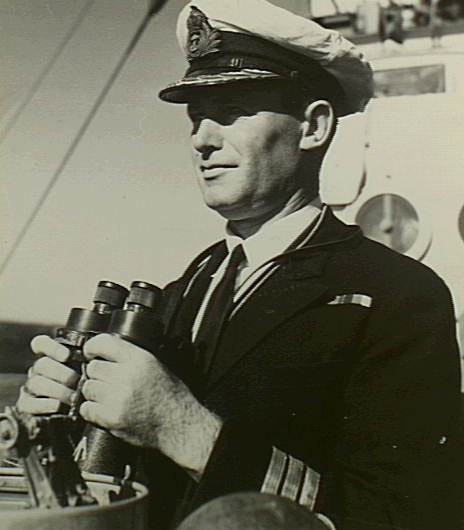
- HMAS Napier (G97) Captain from 2 November 1944
He is not Bert Franklin Brown, not C. R. Brown (Charles Randall Brown), and not Chesford Brown. The word captain there is the billet the list is using. What rank he held that day is a separate question, and the biographies answer it.
Both initials expand. The Australian Dictionary of Biography, in James Goldrick's article, and the Royal Australian Navy's Sea Power Centre, in its biography of the same man, name him Herbert James Buchanan. The London Gazette prints the same three names, Herbert James Buchanan, Royal Australian Navy, under the Distinguished Service Order in 1940 and again, already D.S.O., under a mention in despatches in 1946. He is not his father, also Herbert James Buchanan, the pastry-cook. He is not Hector Macdonald Laws Waller, the RAN captain who died in Perth. He is not Henry James Feakes. He is not Franklin Buchanan of the old United States Navy. No source read for this essay gives him the name Hector, or a second Henry.
What follows is the life those biographies, the gazettes, the Navy's ship histories, the Australian War Memorial's catalogue, and one National Archives catalogue description will support. Where they stop, or where they disagree with one another, the blank stays in the sentence. G. Hermon Gill's official history, the N Class book, Roskill, and the Sydney newspapers listed in Goldrick's bibliography were not opened.
Origins
He was born on 10 March 1902. Goldrick places the birth at Fitzroy, Melbourne. The Sea Power Centre says North Fitzroy. The two are the same city and almost the same ground. North Fitzroy is the more particular address. Neither biography prints a street, a house, or a certificate number.
The father was Herbert James Buchanan, a pastry-cook from Gippsland. The mother was Emily Jane, née Wood, English-born. That is Goldrick. Nothing read here is the father's own life beyond that trade and that origin, and the years sometimes hung on him in family trees were not opened. The boy carried the father's whole name.
He was educated at Scotch College, Melbourne. Goldrick says educated there. The Navy's biography says he briefly attended, and then, at thirteen, joined the Royal Australian Naval College as a cadet midshipman in 1916. Thirteen is the Centre's arithmetic on the March 1902 birth. The college was at Jervis Bay, then in the Federal Capital Territory, the place the Navy still treats as the spiritual home of its officer entry. He remained under training there until he graduated in 1919. What he was like as a boy, who taught him, whether he wanted the Navy or was put into it, is not in either biography. The pastry-cook's son from a Melbourne suburb had been taken, very young, into a service that sent its cadets to live by the sea at Jervis Bay and then, almost at once, to the other side of the world.
Formation
Graduation was not the end of training. Goldrick says he went to Britain the next year for sea-training and professional courses with the Royal Navy. The Centre says he was posted to sea as a midshipman. The day of that posting, and the names of the ships, are not in the biography that was read. A compiled rank table on uboat.net prints a midshipman's date of 1 January 1920 and a string of later days. That table was not used. The Navy's own biography is content to say he served in a variety of sea appointments through the 1920s and 1930s.
He specialised in gunnery. The Centre names the school: HMS Excellent, the Royal Navy's gunnery establishment. Goldrick is more particular about the courses and less particular about the place. In 1924 he returned to Australia. After two years he was back in England, and there he completed the Long and the Advanced gunnery courses. Home again, he was promoted lieutenant commander in February 1932 while in charge of the gunnery school at HMAS Cerberus, Westernport, Victoria. The Centre dates the lieutenant's promotion to 1924 and the lieutenant commander's to 1932, without the February. February is Goldrick's.
The man the Centre describes at this stage is already the man of the later trouble. Considerable physical presence. Energy. A reputation for the highest ability and for technical expertise. An impatience with obstacles and with interference. The Centre's judgment, written long after, is that those qualities made him an excellent practical leader at sea and would make life difficult for him in higher staff appointments. That is a verdict from the end of the story. It is also the only character the Navy's biography is willing to give him before the war, and it is not a quotation from a confidential report that was opened here.
On 21 March 1932, the month of the promotion or within days of it, he married Florence Ellis at Christ Church, South Yarra, with Anglican rites. Goldrick spells her Florence Knarhoi Ellis. The Centre spells her Florence Knarhoei Ellis. The second spelling adds a vowel. Which parish register is right was not checked. Both accounts give the same day, the same church, and a long marriage. The Centre says they had two sons, and that one of them joined the Naval College as a cadet midshipman in 1951. Goldrick, writing the death, says he was survived by his wife and two sons. Neither source prints the sons' names. A later death notice that a search engine summarised as naming James and Robert was not opened, and the names are not used.
The next six years, in Goldrick, were at sea, without the ships. The Centre fills one of them. In 1935–36 he was a gunnery officer in the cruiser HMAS Australia, a commission that included service in the Mediterranean during the Abyssinian crisis. He was not in command. He was the officer who made the guns work, in a fleet that had gone to the Mediterranean because Mussolini had gone into Ethiopia, and that did not fight. It was the nearest thing his peacetime career had to a war, and it was a watch kept, not a battle.
He was promoted commander on 30 June 1938. The Centre adds that the promotion came while he was serving as the Australian Squadron's gunnery officer. In 1939 he attended the Royal Naval Staff College at Greenwich. The war found him as executive officer of the British cruiser HMS Diomede. That is both biographies. What Diomede was doing in the first months, and how long he stayed in her, they do not say. His first command was already being got ready in a dockyard.
War years
The ship was HMS Valentine, an old V-class destroyer taken in hand for conversion to an anti-aircraft escort. Goldrick says Buchanan assumed command in February 1940. The Centre says the newly refitted ship commissioned at Devonport on 23 April 1940, and that there was little time to work up. The two dates can sit together if he joined her during the conversion and she only then became a commissioned command. They were not found together in one document. A naval-history.net chronology by Geoffrey Mason, using notes from Don Kindell, puts acceptance trials and work-up in April and deployment with the Nore Command for convoy defence, then a transfer to Dover. The same chronology's convoy list has her on coastal convoys in the last third of April and the first third of May. Those lines are a compilation. They are not a deck log. What both official biographies agree is that the work-up was short and that the coast of Europe then came apart.
Germany invaded Belgium and the Netherlands and drove into northern France. Valentine went to the Scheldt. The Centre's sentence is that she was protecting shipping in support of Dutch forces on the island of Walcheren. Goldrick's is that she was operating off the coasts of Belgium and the Netherlands in support of Dutch and French forces. On 15 May 1940 she was hit.
How she was hit is where the sources split, and the split is not small. Goldrick says the ship was damaged by bombs. Buchanan beached her and conveyed the wounded to safety. The Centre says she was bombed and sunk by Junkers 87 Stuka dive bombers, and that Buchanan survived unharmed. The catalogue of the National Archives at Kew, for a file that has not been digitised and was not read, describes the event as damage by enemy action, an aircraft attack, and then beaching near Terneuzen in the Netherlands. The file is ADM 358/3652. The beaching, and the place, are in that description. The type of aircraft is not.
The compiled chronology goes further, and it should be labelled as compiled. It puts Valentine and Whitley under orders at 1300 on 15 May to cover the Terneuzen–Borsele ferry. It puts Valentine, Buchanan in command, at the mouth of the Scheldt within a mile of Terneuzen, bombed by a Ju 88, struck by two bombs, a boiler blown up, run aground and abandoned as a total loss, in a position given as 51.20 N, 03.49 E. It counts thirty-one ratings killed and twenty-one wounded, and it names three of the wounded: a probationary surgeon lieutenant, a temporary lieutenant of the reserve, and an acting gunner. It says Whitley then blew the wreck up. A Dutch local account added to the same page says the captain ran her aground a few kilometres west of Terneuzen and that the wounded were treated and hidden from the Germans in the hospital there. None of that casualty list, none of those names, and neither the Ju 88 nor the Stuka, was read in a gazette, in Goldrick, or in the Archives catalogue line. The numbers are not narrated here as a return. What can be said without them is already heavy enough. It was his first command. It lasted weeks. The ship was bombed, beached, and lost near Terneuzen, and he got the living off her. The Centre says he himself was not hurt.
The King did not print the story. On 27 August 1940 the London Gazette, issue 34933, page 5265, appointed him a Companion of the Distinguished Service Order for good services in operations off the Dutch, Belgian and French coasts, and it named the ship: Commander Herbert James Buchanan, Royal Australian Navy, H.M.S. Valentine. There is no sentence about the beach, the wounded, or the bombs. The Centre calls the D.S.O. one of the first awarded to the RAN in the Second World War. That claim was not checked against a full list of RAN awards. The Australian War Memorial's honours roll attaches the Distinguished Service Order to him as commander of Valentine.
Dunkirk was the next month, and he was no longer in a ship of his own. Valentine was already ashore. Goldrick says he was sent to Dunkirk later in May, oversaw the evacuation of allied soldiers, and was mentioned in despatches. The Centre says he was sent to take charge of beach control parties during the evacuation, and that the mention and the D.S.O. were both for good services in Valentine and at Dunkirk. The gazettes do not divide the credit that cleanly. The D.S.O. names Valentine and the Dutch, Belgian and French coasts, which is the Scheldt fighting as much as it is the beaches. A separate supplement, 16 August 1940, issue 34925, page 5068, lists Commander Herbert James Buchanan, Royal Australian Navy, among mentions in despatches. The line does not name a ship. The names around it on that page are full of the evacuation: destroyers, drifters, transports, a yacht, a fire float. The page itself was read as a continuation, not as the gazette's first page, so the printed heading of the whole list was not in front of the line. Goldrick's division, D.S.O. for the beaching and the mention for Dunkirk, is the cleaner reading of the two dates. The Centre's phrase, good services in both, is what a staff officer might have written across both. Neither is a citation narrative. There is no quotation of what he said on the beach, and no count of the men who passed through his parties.
He was soon back in a destroyer. The Centre, and not Goldrick, gives him HMS Vanity until early 1941. The Memorial's honours roll attaches a mention in despatches to him as commander of Vanity. That attachment is awkward. The August 1940 mention is the one that sits in the evacuation list, and Vanity, if the Centre's sequence is right, came after Dunkirk. No second 1940 mention was found in a gazette opened for this essay. The Memorial may have filed the Dunkirk mention against the ship he went to next, or there may be a Vanity recommendation that was not printed in the pages that were read. The conflict is left standing. What the Centre does say, and it is the only judgment of him as a captain in that first year, is that in both Valentine and Vanity he earned glowing reports and, for the first time, was recommended for accelerated promotion. No report was opened. No cruise of Vanity was read. She is not turned into a story here.
He came home. For two years, 1941 to 1943, he was assistant director of plans at Navy Office in Melbourne. Goldrick has him in the development of Garden Island dockyard in Sydney and in equipping RAN ships with radar. The Centre adds the Captain Cook Graving Dock, the great dry dock then being cut into the island, and it adds the friction. His energy led him into a dispute with the staff of the Australian Squadron's commander over how responsibility was to be divided between the squadron and Navy Office. The problem, the Centre says, disappeared when Japan entered the war. The Chief of Naval Staff later observed that Buchanan's lack of tact sometimes introduced difficulties "in his work which would not otherwise arise." The sentence is the Centre's quotation. The report it came from was not opened. It is the first time a superior's voice, even second-hand, gets into the record, and it is not about courage. It is about a man who knew what he wanted the Navy to build and to fit, and who made the argument in a way that cost him.
On the timing of his return to sea the Navy disagrees with itself. Goldrick says May 1943, command of HMAS Norman, attached to the British Eastern Fleet. The Centre's biography says 26 May 1943. The Centre's own history of Norman says that on 23 June 1943 Commander H. J. Buchanan, D.S.O., RAN, assumed command from Commander H. M. Burrell. May, 26 May, and 23 June cannot all be the day he took the ship. Burrell is a different officer, Henry Mackay Burrell, and he is not a Buchanan. The day is left as a gap between two pages of the same institution. What is not in doubt is the ship and the ocean. Norman was one of the N-class destroyers manned by Australia and still, in law, a hard-worked unit of other people's fleets. By the stage the ship history associates with his taking command, she had already steamed, on that history's figures, 124,000 miles and been underway some 7,500 hours. He inherited a ship that had been at sea since 1941, not a new command to be broken in.
The ship history's operations across the months it gives him are escort and exercise more than battle: north through the Mozambique Channel, a dock at Durban, the United Kingdom-to-India convoy WS 32, Bombay, Colombo, Kilindini, the battleship Ramillies toward Aden at the end of 1943, then Force A of the Eastern Fleet at the opening of 1944. In April 1944 Norman reached Sydney for a refit, the ship's first time in Australian waters on that history's telling, and in July she was back at Trincomalee. In mid-October a striking force went against the Nicobar Islands to coincide with the American landing at Leyte. The ship history puts Norman in the night bombardment with HMS London and the Dutch destroyer Van Galen on 17 October, and then has her detach for Trincomalee. It dates the relief, Lieutenant Commander J. Plunkett-Cole, to 2 November 1944. If that relief date is right, the Nicobar bombardment fell in Buchanan's time. Goldrick does not mention it. It is not retold here as a cruise he narrated, only as the one sharp operation the ship history places before the handover.
The Centre's biography is more interested in how he commanded than in the convoys. In Norman and then in Napier he worked to get Australian ships their logistic support. Mail was a particularly vexing issue. He bombarded his superiors with suggestions for gunnery and for radar. That is the gunnery specialist who had run the school at Cerberus and fitted radar into the plans directorate, now writing from a destroyer leader's cabin because the sets and the letters were not good enough. The Centre calls him, in those two ships, a leader and a ship captain second to none. The adjective is the biography's. No signal file was opened to test it. The mail, at least, is a concrete quarrel. On a destroyer that had been away from Australia for years, the bag from home was not an amenity. It was the proof that the Navy at Melbourne still knew the names of the men it had lent to the Eastern Fleet.
The handover was Napier. Goldrick says he was promoted acting captain that day and transferred to Napier as senior officer of the 7th Destroyer Flotilla. The ship history says that on the day after she reached Trincomalee, Captain H. J. Buchanan, D.S.O., RAN, assumed command as Captain (D), 7th Destroyer Flotilla, and that she resumed her role as a leader of Eastern Fleet destroyers. The Centre's biography says the promotion to captain was confirmed at the end of 1944. The day of the confirmation was not read in a gazette. uboat.net's 31 December 1944 was not used.
Napier had been Arliss's ship, and then other men's, through the Mediterranean, the Indian Ocean, and the carrier strikes of 1944. None of that was Buchanan's. His Napier begins at Trincomalee in November. The ship history gives the next months in a few hard movements, and they are the skeleton, not a life. A run to Bombay screening the carrier Victorious. On 6 December, Chittagong, and then bombardments up the peninsula in support of the 74th Indian Brigade, Napier alternating with Nepal and going back to Chittagong every three days for ammunition. In January 1945, the capture of Akyab on the 3rd, and on the 21st Ramree Island, where the history says she silenced Japanese shore batteries with her 4.7-inch fire. At the end of January she was at Colombo, preparing to join the British Pacific Fleet.
From there the ocean changes. On 22 February she escorted the carrier Formidable toward Fremantle, and on the way the history records a wide, unsuccessful search for survivors of the torpedoed American merchant ship Peter Sylvester. On 1 April Napier, Norman and Nizam left for Manus and arrived on the 7th. The same month she was in the Philippines with the British Pacific Fleet. In May she was on the screen of the fleet carriers attacking Sakishima in the Okinawa campaign. In the last weeks she screened the forces striking the Japanese mainland. On 15 August, when the fighting stopped, the history still has her at sea with the combined strike forces.
There is a picture of him from that command, made before the end. In 1945, at Colombo, the war artist Roy Hodgkinson drew him in charcoal on the bridge of Napier. The Memorial's description of the sheet, not a diary, puts Buchanan on his seat studying a suspicious ship that has appeared. The first lieutenant, Gordon John Branstone Crabb, is at the microphone to the ship's company. The navigation officer, Lieutenant Commander James Maxwell Ramsay, is reporting a change of bearing. The artist, or the cataloguer, adds that Buchanan had joined in 1916, specialised in gunnery, commanded Valentine and Vanity, and received a D.S.O. for service at Dunkirk. The last clause is looser than the gazette, which ties the D.S.O. to Valentine and the coasts. The drawing is still the only scene of him in command that anybody bothered to fix: a big man in the captain's chair, a contact on the edge of the glass, the first lieutenant's voice in the broadcast, the navigator calling the bearing. Whether the ship was ever identified, the sheet does not say.
Tokyo Bay is the last of the war, and it is the place the sources argue.
Goldrick says that on 30 August 1945 Buchanan led a naval landing battalion in the occupation of Yokosuka, and that he was mentioned in despatches for his service in Napier. The Centre says the surrender found him commanding the Commonwealth elements of the landing force that occupied Yokosuka. The history of Napier says that she and Nizam anchored in Tokyo Bay at noon on 30 August, that she was present for the formal surrender, and that after taking part in the occupation landings she sailed for Sydney and arrived on 22 September. The formal surrender on Missouri was 2 September. The ship history does not say he was still on board for the ceremony or for the voyage home.
A Naval Historical Society "on this day" line says Captain H. Buchanan, in Napier, accepted the surrender of Yokosuka Naval Base, and in the next sentence has Nizam, Commander W. F. Cook, leading Napier, Lieutenant H. D. Stevenson, in behind King George V, the first RAN ships into the port after the fighting. Albert Birch's 1977 account of Stevenson's career, in the Society's review, says Stevenson was flotilla navigating officer in Napier, still a lieutenant, and that when Buchanan, in charge of the first British landing force in Japan, went ashore at Yokosuka, Stevenson "drove" the ship into Tokyo Bay. Birch calls it Stevenson's first command, and a temporary one. The Memorial files under Buchanan's name a photograph whose catalogue text, truncated where it was read, begins "Token of surrender" and a Japanese official handing over keys, Tokyo, August 1945. The full caption was not opened. It is not used as proof that the keys passed through Buchanan's hands.
Read together, the careful version is Goldrick's and the Centre's. He commanded the Commonwealth part of the landing force that went ashore at Yokosuka on 30 August. Birch and the Society's one-line history add that he left the ship to do it, and that a lieutenant took her in. "Accepted the surrender of the base" is only the one-line history. It is a larger claim than "led the landing," and no instrument of surrender was read. The mention in despatches is real, and it is bare. On 1 January 1946 the London Gazette, issue 37407, page 78, lists him under the heading Mention in Despatches: Captain Herbert James Buchanan, D.S.O., Royal Australian Navy. No ship. No sentence about Yokosuka, Sakishima, Ramree, or the mail. The Memorial attaches that mention to him as captain of Napier.
In October 1945 he was recalled to Navy Office as deputy chief of naval staff. The Centre says it was for a year, under Admiral Sir Louis Hamilton, that the two struck up a firm friendship, and that Buchanan played a leading part in the postwar planning, particularly a carrier force and better anti-submarine work. Goldrick has the posting in October and the same emphasis on the carrier. The destroyer captain who had spent the war writing to his superiors about radar, gunnery and stores was now, for a year, one of the men who would decide what kind of navy Australia meant to keep.
Cost
The first cost was other men's, and it was early. Valentine was lost on 15 May 1940 with her captain still new in her. He beached her. He came off unharmed, if the Centre is right, and he was decorated for it. The gazette would not say how many of his people did not come off. The compiled chronology's thirty-one dead and twenty-one wounded may be right and may not. They are not repeated as fact. They are the size of the question the official biographies leave open. A first command that ends in a beached wreck is a particular kind of beginning. He was given another destroyer within weeks, and then, after the staff years, two more. The Navy did not treat the loss as a verdict on him. He does not seem, in anything that was read, to have written a public defence of it.
The second cost was his own, and it came later, on shore, where his virtues worked against him. The Centre's quotation from the Chief of Naval Staff, the lack of tact that introduced difficulties which would not otherwise have arisen, belongs to the plans years, but Goldrick carries the same trait into the 1950s and gives it names. As chief of naval personnel, at a time of budgetary restraint, his attempts to improve pay and allowances achieved little. His interest in officer training did better: more weight on recruiting older entrants, and the start of plans to take the Naval College back to Jervis Bay, the place he had entered in 1916. His manner was forthright, determined, and sometimes abrasive, and it could provoke unnecessary conflict. His relations with the minister for the navy, William McMahon, later Sir William, were strained. The chief of naval staff, Vice Admiral Sir John Collins, politically acute where Buchanan was not, came to believe that Buchanan's obduracy was not helping the navy's cause. Goldrick's sentence is the one to keep, because it refuses the easy moral: the qualities that had made him an excellent seagoing leader were not suited to staff work.
That judgment is Goldrick's, written for the Australian Dictionary of Biography and resting on books and papers that were not re-read here, among them Robert Hyslop's Aye Aye, Minister and the privately held papers of J. B. Foley. It is not a quotation from Collins, and it is not a cabinet minute. It is allowed to stand as the biographer's conclusion, not as a scene that was witnessed for this essay. The shape of the career matches it. In February 1955 he was made acting rear admiral and flag officer in charge of the East Australia Area. Goldrick says that despite professional and social success in Sydney, he retired on 9 March 1957 as a substantive captain and an honorary rear admiral. The Centre says only that he retired in 1957 and received an honorary promotion to rear admiral. The harder formulation is Goldrick's, and it matters. The rank he had worn in Sydney was acting. The rank he kept was captain. The rear admiral was honorary. For a man who had been recommended for accelerated promotion in 1940, and who had spent a decade arguing for the Navy's people and its ships, that is the cost with his own name on it.
What he spent on other people is easier to like and just as well attested. At Cerberus in 1950–52, commodore superintendent of training, he enlisted Melbourne to found the White Ensign Club for sailors on leave. The Centre adds a chapel, and the support of prominent local people. The mail he had chased for the N-class ships and the club he built for libertymen are the same instinct. He noticed what the lower deck actually received. The pay fight, which would have put money in the same hands, is the one he lost.
After
He stayed in Sydney. Goldrick says he became managing director of Bell's Asbestos and Engineering (Australia) Pty Ltd and a board member of other companies. From 1957 he was president of the executive committee of the Australian Outward Bound Memorial Foundation. The Centre's biography ends at the retirement and the death, and does not follow him into the companies. Goldrick says he had a happy family life and enjoyed sailing. The wife of 1932 was still there. The sons were still there. One of them, if the Centre's earlier sentence is the same boy grown, had gone to the Naval College in 1951, while the father was at Cerberus or just leaving it. Whether that son made a career, and what the other son did, is not written.
He died of cancer on 15 March 1965 at Point Piper, and he was cremated. Goldrick is the source for the disease, the suburb, and the cremation. The Memorial prints the day, 15 March 1965, and the rank rear admiral, and does not print the cause or the place. He was sixty-three. The wife and the two sons survived him. No obituary text from the Sydney Morning Herald of 16 March 1965, which Goldrick cites, was opened. The portrait Goldrick points to, a photograph by Clifford Bottomley, is Australian War Memorial 017088. It was not studied for this essay.
The sea did not leave the family when he left the bridge. Sailing, Goldrick says, was the recreation. Outward Bound, which he chaired, is a school for taking the young out into weather and making them responsible for one another. It is not a strange last billet for a man who had been sent to Jervis Bay at thirteen and who had spent his commands worrying about whether the mail and the radar and the ammunition came.