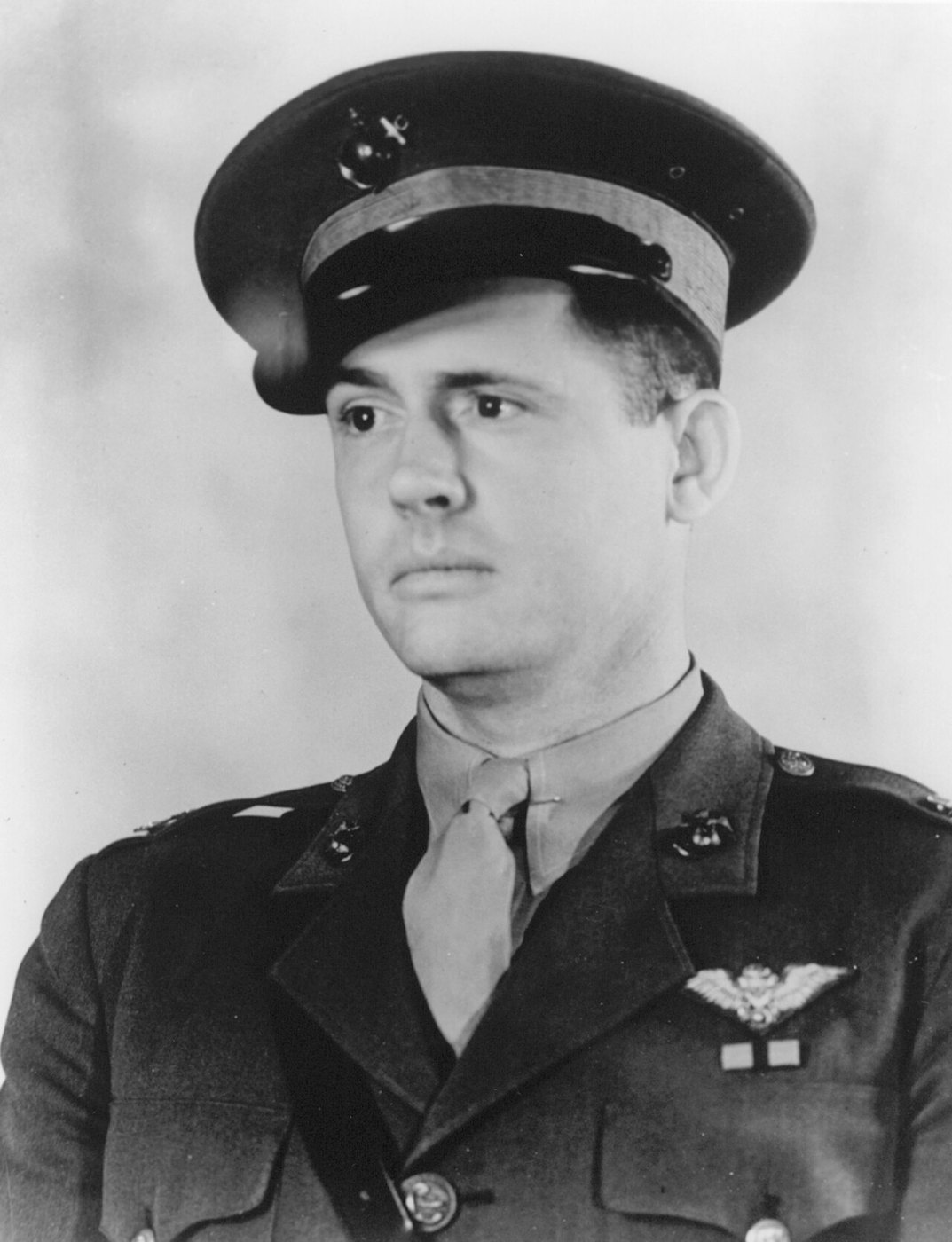
Henry Talmage Elrod was born on 27 September 1905 in Rebecca, Georgia. He attended the University of Georgia and Yale University, enlisted in the Marine Corps in December 1927, and was appointed a second lieutenant in February 1931. After the Marine Corps Basic School in Philadelphia he served at Pensacola as a company officer and as a student aviator. He was promoted to first lieutenant on 29 May 1934 and received his wings in February 1935. The captaincy he held in the Pacific was a Marine Corps rank. He was a Marine captain, not a ship's captain.
At Quantico he flew with a Marine aircraft unit until January 1938, and along with that flying he handled school, personnel, and welfare duties for the squadron. Promotion to captain came on 1 September 1937. From July 1938 to January 1941 he was at the Naval Air Station in San Diego as material, parachute, and personnel officer, and he was then ordered out to Hawaii. In December 1941 he was executive officer of the fighter detachment VMF-211 had placed on Wake Island. The airplanes were Grumman F4F-3 Wildcats. Enterprise flew them off on 4 December, and Elrod was one of the twelve pilots who landed them on the atoll. The carrier was not in the battle.
Japanese bombers struck Wake on 8 December and wrecked most of the Wildcats on the ground. Elrod kept flying with what was left. His Medal of Honor citation credits him with two enemy planes, dated 9 and 12 December, two aircraft out of a flight of twenty-two.
On the morning of 11 December four of those fighters were still fit to fly. Rear Admiral Sadamichi Kajioka brought the attack force in with his flag in Yubari. No American warship was there. The 5-inch guns on the island sank Hayate. That was Battery L, under Second Lieutenant John A. McAlister. Elrod's share of the morning was one ship. Cruiser accounts say his 100-pound bomb hit Kisaragi and that she blew up, probably when the bomb reached the depth charges on her stern. She sank with all hands, Lieutenant Commander Yoichiro Ogawa and 156 men. Her own account says a bomb blew off most of the bridge and that she went down within minutes, and it does not name the pilot. The two accounts do not agree on the time. The citation credits him with sinking one Japanese ship by small bombs from a fighter. It does not credit him with a second ship. The shell in Yayoi, the near misses on Oite, the straddles on Yubari, and the strafing of Tenryu and Tatsuta were the batteries and the flight.
His own fighter was wrecked. Antiaircraft fire disabled it over the ships, and he brought it down short of the airfield. On 23 December the Japanese landed. He fought on the ground, took command of one flank of the line, and held that sector while his men repulsed repeated rushes. In one charge he seized an automatic weapon, gave his own firearm to another Marine, and kept fighting, covering men who carried ammunition forward. He was killed that day.
The medal was awarded after his death. He was promoted to major, the promotion dating from January 1942. He was buried on Wake. On 8 November 1946 the Medal of Honor was presented to his widow, and in October 1947 his remains were moved to Arlington National Cemetery. Men who had watched him in the air knew him as Hammerin' Hank. The Navy later named a frigate Elrod for him.