Ships
- USS Houston (CA-30) Captain, 16 October 1939 – 30 August 1941
- USS Louisville (CA-28) Flag, not her captain, from January 1944
- USS Pennsylvania (BB-38) Flag, not her captain, 12 September 1944
- USS Tennessee (BB-43) Flag, not her captain, shifted to Pennsylvania on 12 August 1945
- USS Pennsylvania (BB-38) Flag, not her captain, 12 August 1945
Jesse Barrett Oldendorf was born in Riverside, California, on 16 February 1887. He was called Oley. He entered the Naval Academy in 1905 and graduated in 1909, 141st in a class of 174. He was commissioned an ensign in 1911. In the First World War he served with the armed guard on transports. He was aboard the troopship President Lincoln when the German submarine U-90 torpedoed and sank her off Ireland on 31 May 1918.
His first command was the destroyer Decatur, which he took in 1925 and left by 1927. He taught navigation. From 1935 to 1937 he was executive officer of the battleship West Virginia. He was not her captain. He commanded the heavy cruiser Houston from 16 October 1939 to 30 August 1941. He left her before the war. He was not aboard when she was sunk in Sunda Strait. In September 1941 he joined the staff of the Naval War College, which kept him out of the Far East when Japan attacked.
He was promoted to rear admiral on 31 March 1942. For the next two years he commanded convoy escorts in the Caribbean and the Atlantic, in the Aruba-Curaçao sector and then at Trinidad. He was given the Navy Distinguished Service Medal for that service. In January 1944 he took Cruiser Division 4 in the Pacific. His flag was in the heavy cruiser Louisville. Samuel Hansford Hurt had the ship. Oldendorf was not her captain. The division supported the Marshalls landings, the raid on Truk, the Marianas, and the Palaus.
At Peleliu the pre-landing bombardment ended a day early, and a known Japanese strongpoint was left largely untouched. He was criticized for that. On 12 September 1944 his flag for that fire-support group was in the battleship Pennsylvania. He was not her captain.
On the night of 24-25 October 1944 he commanded the Seventh Fleet's bombardment and fire-support group, Task Group 77.2, across the northern entrance of Surigao Strait. His flag was still in Louisville. Six older battleships stood in the line, five of them survivors of Pearl Harbor, with cruisers and destroyers in support and motor torpedo boats farther south. The destroyers attacked with torpedoes first. When the remaining Japanese ships came into range, the battle line crossed the T and opened fire. Fuso and Yamashiro were sunk by that force, not by one ship. Vice Admiral Shoji Nishimura was killed. Mogami left the strait on fire and was sunk later. Of Nishimura's ships, the destroyer Shigure got out that night. A following squadron under Vice Admiral Kiyohide Shima turned back after limited contact. Albert W. Grant was hit by gunfire from both sides and kept afloat. PT-493 was sunk. It was the last time a battle line crossed an enemy's T, and the last gun duel between battleships. He told the New York Times, "My theory was that of the old-time gambler: Never give a sucker a chance." He was given the Navy Cross. He was promoted to vice admiral on 15 December 1944 and given Battleship Squadron 1.
On 6 January 1945, during the Lingayen landings, he and the British admiral Bruce Fraser were on the bridge of the battleship New Mexico when a kamikaze hit it. Both lived. He was a guest on her bridge. His flag was not in her. On 11 March 1945, at Ulithi, his barge struck a buoy. He broke a collarbone and was given the Purple Heart. In July he took Task Force 95. On 12 August 1945 his flag was in Tennessee at Okinawa, and that day he shifted it to Pennsylvania. He was not captain of either ship. That evening a Japanese aircraft torpedoed Pennsylvania in Buckner Bay. He broke several ribs and was given the Purple Heart again. On 22 September 1945, at Wakayama, he accepted the surrender of the Japanese naval forces there.
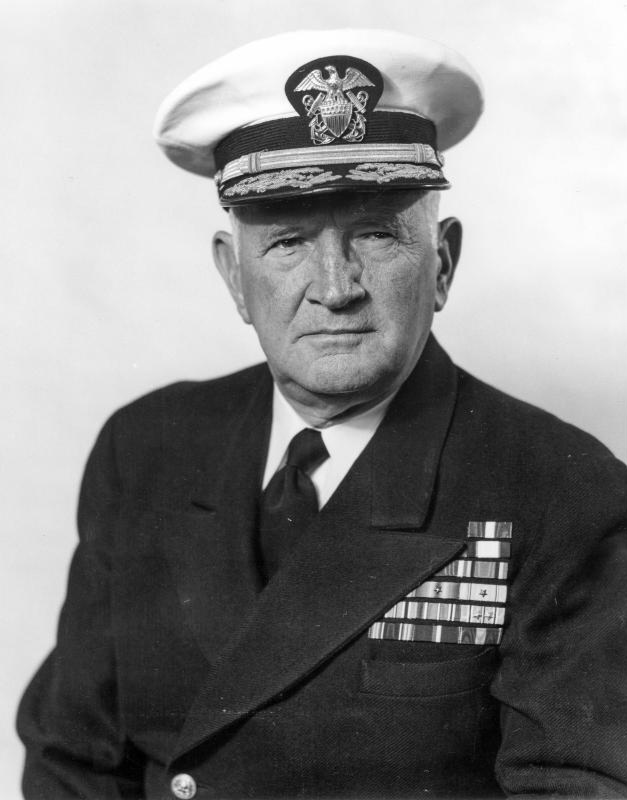
After the war he commanded the Eleventh Naval District and San Diego Naval Base, then the Western Sea Frontier and the Pacific Reserve Fleet. He retired in September 1948 and was advanced to admiral on the retired list. The portrait shows him in that later rank. He died in Portsmouth, Virginia, on 27 April 1974, and is buried at Arlington National Cemetery. A later destroyer was named Oldendorf. His decorations included the Navy Cross, three Navy Distinguished Service Medals, the Army Distinguished Service Medal, two Legions of Merit, and two Purple Hearts, and campaign medals with ten battle stars for Pacific service.