Ships
- USS Sterett (DD-407) Captain, 1 April 1941 – 18 January 1943
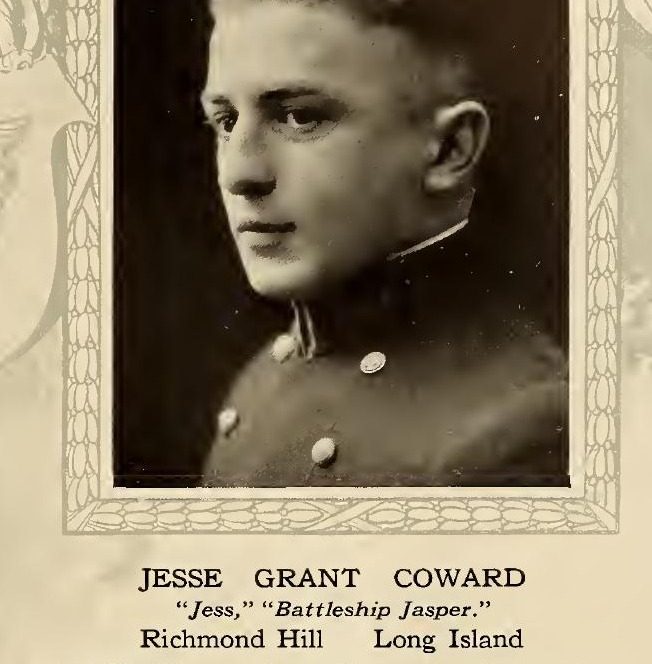
The card on the site calls him a commander and gives him Sterett (DD-407) from 1 April 1941 to 18 January 1943. That end date is the date a ship association and a photograph index both print. The start date is not. He is the Naval Academy class of 1922 from Richmond Hill, Long Island, the lieutenant commander the Navy Directory of 1 April 1941 still has as engineer of St. Louis, the commander the Guadalcanal citation names on Sterett the night of 12–13 November 1942, and the captain Destroyer Squadron 54 followed into Surigao Strait. He is not Asbury Coward, an ensign on Lexington in the 1939–1941 directories and a commander, designator 1100, on the 1 January 1952 register. He is not James Lester Coward, a warrant officer on the retired list. A retired rear admiral printed in that same 1952 volume and in the 1958 register as Jesse C. Coward, file 057509, is a separate problem, taken up below, because a medal compilation gives Jesse Grant Coward the service number 0-57509. What follows is the life the registers, the directories, the Lucky Bag, the ship histories, the damage report, the citations as transcribed, and his obituary will support. Where they disagree, the disagreement stays in the sentence.
Origins
He was born on 10 March 1900. The Register of Commissioned and Warrant Officers of 1 July 1945 prints that day on his line in the captains' section: 10 March 00, after the dittos for rank, and before the entry date. The retired-list line in the register of 1 January 1952 prints the same birth as the digits 3 10 00, beside Jesse G. Coward, captain, retired in August 1947. The New York Times, on 22 May 1963, said he was 63. A man born on 10 March 1900 was 63 in May 1963.
The registers do not give a town. The Times said he was born in Brooklyn. The 1922 Lucky Bag heads his page "Richmond Hill Long Island." That is the home a midshipman claimed, not a birth certificate. Richmond Hill is in Queens. Brooklyn is the borough the obituary names. Both are left as what those two books say. They are not the same fact. A Find a Grave memorial repeats Brooklyn and adds Arlington National Cemetery, section 34, site 82-A. That memorial was not checked against a cemetery register.
The obituary names the family that survived him. His widow was the former Margaret Rowe Williams. A brother, spelled Williard R. Coward in the text as retrieved, lived in Sarasota. A sister, retrieved as "Ms. Thomas J. Garrick" of Brookville, Long Island, is almost certainly Mrs. Thomas J. Garrick; a 1963 death notice did not say "Ms." The memorial that puts him at Arlington gives the wife as Margaret R. Coward, 1901–1967, which fits Margaret Rowe and does not prove the dates. The Times names no parents, and it names no son and no daughter. That is a blank in the survivor list, not a finding that he never had a child. Nothing in the registers names a father or a mother.
Formation
He entered the Naval Academy on 15 June 1918. That is the date of entry on the 1 July 1945 register, on the same line as the birth. Four years later he is in the Lucky Bag of the class of 1922, page 225, and the Times said he was graduated in 1922. The day he was commissioned ensign was not read off a register line. The class that entered in June 1918 and finished in the 1922 yearbook was not a class that had been turned back. "The man who came back," in the sketch, is a joke about dragging, not about academics.
The Lucky Bag is classmate prose, written to be clever, and it should be read that way. They called him "Jess" and "Battleship Jasper." Richmond Hill is the place. "Steeped in the depth of weekly drags during Youngster Year, 'Jess' came into his own in Second Class Year and has never dragged since." Dragging was the Academy's word for taking a date. After youngster year, they say, he stopped. He put the time into dancing, "the rosined square," and into tennis, "both his upper and lower limbs." On the youngster cruise in Panama, "the fellows had 'Jess' mind their valuables, for he never drinks, smokes, etc., his only bad habit being talking in his sleep." The abstinence is their sentence. It is not a medical record, and it is not a promise about the rest of his life. "His marcelled wave has been successful in vamping everyone except the Dago profs." Dago was their name for the Spanish instructors. The line they give him in class is a dictation: how many mistakes, señor? Twenty. The sentence they wanted kept, the one that sounds least like a roast, is the last: "Old 'Battleship Jasper' has a salty manner and is a strong advocate of the teachings of the Old Navy. He is ever ready to stand by the Service through fire, water, and hell." The activity line that usually sits under a Lucky Bag portrait did not survive the optical reading of that page. Tennis and dancing are in the prose. Class standing is not. The registers do not say he failed a year.
On 1 January 1925 the Navy Directory has him an ensign on McCormick. He is not her captain. He is a junior officer on a destroyer. The Directory of 1 January 1929 has moved him. He is a lieutenant (junior grade), under instruction, at Columbia University in New York. The Register of 1 January 1933 already credits him with course 22, and the explanatory notes of that book and of the 1945 book both say course 22 is a completed postgraduate course in mechanical engineering. The Times said something else: that in 1928 he received a master's degree in electrical engineering from Columbia. The Directory still has him under instruction on 1 January 1929, which is after the year the obituary gives the degree. Mechanical against electrical, and 1928 against a man still carried as a student at the start of 1929, are left as a conflict. What the Navy's own books agree on is that he was sent to school, and that the schooling they recorded was engineering.
The Asiatic Station comes next, in pieces. On 1 January 1930 the Directory has him a lieutenant (junior grade) on Canopus. The Register of that same day indexes him a lieutenant, signal 3270. The two books do not agree on the rank on the day they share. By 1 January 1931 the Directory has him a lieutenant on Oahu. Canopus was a tender. Oahu was a gunboat. He was not in command of either. The exact day he became a lieutenant was not read cleanly. A scrambled line in the 1930 register sits near "Oct. 29" and was not used.
On 1 January 1932 he is a lieutenant in the division of fleet training, Office of Naval Operations, Navy Department, Washington. The Directory of 1 April 1933 still has him there; the optical line shortens the office to "div fleet train." The Register of 1 January 1933 has him a lieutenant, course 22, station naval operations, signal 2963. He had come ashore from the gunboat to a desk that trained the fleet, with an engineer's ticket already in the book.
On 1 January 1935 the Directory sends him back out. He is a lieutenant, Destroyer Squadron 5, Asiatic Fleet, assigned to Black Hawk. On 1 October 1935 he is on the staff of the commander of that squadron, still in Black Hawk, and the squadron roster calls him assistant squadron material officer. The material job is the engineering course put to work: not a command, a billet that kept another man's destroyers running on the Asiatic station. The Directory of 1 January 1936 has a line too broken to use. It seems to put a Lieutenant J. G. Coward on Jacob Jones as an assistant of something the type will not resolve. That ship is not claimed for him.
On 1 January 1937 and again on 1 January 1938 he is a lieutenant at the Navy Yard, New York. The Register of 1 July 1936 already has him a lieutenant with the mark (V-1). In that book's notes, (V-1) means he was on the promotion list, eligible for advancement in order of seniority next after the junior officer of the same rank who carried (V). He was waiting for lieutenant commander. He had not yet received it. The Directory of 1 January 1938 still says lieutenant.
By 1 January 1939 he has the half stripe. The Directory has him a lieutenant commander on St. Louis, engineer. The same line is there on 1 June 1940 and on 1 April 1941. Three snapshots, more than two years, engineer of a light cruiser, not her captain. The Directory "includes orders issued to and including the 30th of the preceding month," so the book of 1 April 1941 is the Navy's list of where he was under orders through March. St. Louis spent 7 December 1941 at Pearl Harbor. He was not her engineer that morning if the next assignment, below, is right. Her war is not his.
The Register of 1 July 1940 indexes him a lieutenant commander, signal 1641. The Register of 1 July 1942 indexes him a commander, signal 1488. The Register of 1 July 1945, in the captains, gives the permanent status as commander and the permanent date of rank as 30 June 1942, both dittos running down a page from an explicit date on another officer, and gives the temporary rank of captain as 1 April 1943, a ditto that begins at an explicit "1 Apr. 43" and does not break before his line. The retired list of 1 January 1952 prints the same captain's date, 4 01 43, and calls captain the highest rank he held on the active list. A temporary commander's date before the permanent one of 30 June 1942 was not found on a line of his.
War years as lived
The card says he took Sterett on 1 April 1941. The Times said he took her in May 1941. The Sterett Association's chronology says 2 May 1941, Lieutenant Commander Atherton Macondray relieved by Jesse G. Coward, and it calls him a commander at that relief, which the April directory does not. A photograph index says 1 April 1941 to 18 January 1943. The April directory is the one contemporary list, and it still has him on St. Louis. Both of the May dates, and the April date, fall before 14 May 1941, which is the day the Dictionary of American Naval Fighting Ships has Sterett leaving Pearl Harbor in the screen of Mississippi. From that morning the ship's history and the claim that he commanded her can be read together. DANFS never speaks his name. The movements below are the ship's, in the months the obituary and the association say were his, and they are not a cruise log with his signature on every day.
Sterett had been commissioned on 15 August 1939 under Macondray. She screened Mississippi through the Canal and reached Norfolk on 28 June 1941. She screened the escort carrier Long Island on a Bermuda shakedown. She ended 1941 on neutrality patrol with Wasp. After Pearl Harbor she sailed from Bermuda with Wasp and a mix of cruisers and destroyers toward the Vichy ships at Martinique. The early months of 1942 were the eastern seaboard. In mid-January she went to Argentia to take a convoy toward Iceland, turned it over to two British destroyers on 23 January, and entered Hvalfjordur on the 26th. She was back in New York on 9 February, and on the 15th she met Queen Mary off the Boston breakwater and took her in. After two runs between Boston and Casco Bay she went with Wasp to the British Home Fleet. The task group entered Scapa Flow on 4 April minus its commander, Rear Admiral John W. Wilcox, lost overboard on the way across.
The Times said that from December 1941 until May 1942 she was attached to the Home Fleet at Scapa Flow, that he ran convoys to Murmansk and Malta, and that he received the British Distinguished Service Cross. DANFS puts Scapa Flow in April, not in December, and it names Malta, not Murmansk. While Wasp flew the first reinforcement into Malta, Sterett trained with the British fleet out of Scapa. She was with Wasp on the second Malta run, 29 April to 15 May, and the group made Norfolk on 27 May 1942. No London Gazette notice of a Distinguished Service Cross for him was found, and the 1 July 1945 register, which prints his two Navy Crosses and his Bronze Star, prints no foreign decoration on his line. The Murmansk run and the British cross stay in the obituary. They are not narrated here as a cruise.
On 5 June 1942 Sterett sailed for San Diego and arrived on the 19th. On 1 July she left with Task Force 18, by way of Tongatabu, for Fiji, and she was taken into Rear Admiral Richmond K. Turner's amphibious force for invasion practice until 1 August. The Solomons invasion fleet arrived late on 6 August. Early the next morning the carriers struck, the ships shelled the beaches, and the Marines went ashore at Guadalcanal, Gavutu, Tulagi, and Tanambogo. Sterett, with the Wasp group, zigzagged into a rain squall and the history says the group dodged an eighteen-plane raid from Rabaul. For three days the Wasp unit guarded the line to Tulagi. Sterett then screened Long Island east of San Cristobal while that ship flew off thirty-one Marine planes for Guadalcanal, rejoined Wasp, and stayed until Destroyer Division 15 was detached on 10 September. Five days later Wasp, which the history calls her long-standing companion, was gone, sunk.
For the next month she escorted reinforcements through the Solomons and, the history says, splashed at least one bomber. She took Bellatrix and Betelgeuse to Espiritu Santo, guarded Betelgeuse on to Nouméa, and came back to Guadalcanal with McCawley and Zeilin. While the transports unloaded she fired on bombers and on shore batteries shooting at Henderson Field. She refueled in the New Hebrides and on 31 October sailed with more reinforcements. The convoy reached Aola Bay early on 4 November. She covered the beachhead and then, with San Francisco and Helena, bombarded the shore. Two days later she was back at Espiritu Santo. Another convoy, to Lunga Point. On the morning of the 12th, as the troops landed, she waited for air attack. A coastwatcher on Buin had seen a large formation. In less than an hour the planes came in low, with Tulagi and Florida behind them. DANFS says Sterett, in the line of the approach, shot down four torpedo bombers and dodged at least three torpedoes, and that by 1450 thirty-two of the attackers were down, to guns and to American aircraft, and the rest left. The transports went back to unloading. A wartime combat narrative, adding up claims from every ship, shows how those counts worked: the ships and fighters together claimed many more bombers than the raid contained, and Sterett's own claim inside that footnote was four destroyed and two possibles. Four is what DANFS kept. The footnote is why a destroyer's score that afternoon should not be treated as a tally.
That evening, after the transports had been taken east, Sterett joined the van of the cruiser-destroyer force under Rear Admiral Daniel J. Callaghan and went back through Lengo Channel to meet Vice Admiral Hiroaki Abe. The Bureau of Ships war-damage report, built on the commanding officer's letter of 6 December 1942, names the American force she was in: the cruisers Atlanta, San Francisco, Portland, Helena, and Juneau, and the destroyers Aaron Ward, Barton, Monssen, Cushing, Laffey, O'Bannon, Fletcher, and herself. Force speed was 18 knots. The sky was overcast, the moon had set, the night was dark, a slight sea was running, and the wind was estimated at about 10 knots from the southeast. Visibility, the report says, was fair, about 4,000 yards for ships. She was at general quarters, condition Able set.
At 0130 on 13 November radar found the enemy. The report's estimate, "while not immediately determined," was four groups totaling three battleships, two heavy cruisers, three light cruisers, and eleven or twelve destroyers. That was the estimate written into the damage report. It is not a later order of battle. At 0149 she opened fire at 4,000 yards on the starboard bow. For about forty minutes she fired at targets from 1,000 to 4,000 yards on both sides. She expended ninety rounds of 5-inch and six torpedoes.
The hits on her were all on the port side, above the waterline, in two clumps, one amidships and one aft. Hit number 1, at 0151, was judged a 4-inch shell that did not detonate. It passed through the crew's quarters and the handling room and went out the starboard side. It cut the starboard steering-motor cable and other circuits. Steering was shifted to the port cable, the rudder jammed for a moment, and she steered with her engines. Hit 2, at 0205, and hit 3, which the timing line places with hits 3 through 11 at 0227, were judged 6-inch on the foremast. They took the emergency recognition lights, the SC radar antenna, and the TBS transmitting antenna. The same timing line puts hits 3 through 11 at 0227, so the mast pair is described together and clocked apart. Ready-service powder caught fire. Gun 3's shield and roller path were damaged. Fragments holed a torpedo tube and an air flask. The report itself is unsure whether the last cluster was three hits or two. The commanding officer estimated that her fighting efficiency was down 80 percent. She stayed in the action until the other ships began to retire. Machinery spaces took no direct hit. The Bureau called that ruggedness. It is also the margin by which a ship that has lost her after guns, her radar, her voice radio, and reliable steering is still a ship.
DANFS tells the same night as a story of targets. Callaghan ordered the odd ships to fire to starboard and the even ships to port. Sterett fired on a cruiser to starboard, took a pounding from the battleship Hiei to port, and the history says the first target blew up and sank under the combined American fire. She then put four torpedoes into the battleship and 5-inch into the superstructure. DANFS says the battleship neither sank nor took severe damage, and that Sterett had the satisfaction of two torpedo hits, and then that a destroyer crossed her bow, that she hit it with guns and two torpedoes, and that the destroyer was lifted and settled to the floor of Ironbottom Sound. By 0230, with the Japanese retiring toward Savo, her after guns and starboard tubes were out, the steering was damaged, and she had to slow to fight a fire on the after deck. By dawn, DANFS says, she was in formation on San Francisco's starboard quarter. Before leaving for Espiritu Santo she depth-charged a sound contact, "possibly the submarine" that about an hour later sank Juneau. She reached the New Hebrides on 14 November.
The Navy Cross citation does not score ships. As transcribed, it says that on the night of 12–13 November 1942, as commanding officer of Sterett, the force he was in engaged at close quarters and defeated a superior enemy force, inflicted heavy damage, and prevented the enemy's mission, and that his daring and determination contributed to that victory. The transcription attributes the text to Commander Task Force 67, serial 161105, of 17 November 1942, four days after the action. The rank in it is commander, which matches the permanent date of 30 June 1942 and the way the combat narrative styles him: "Sterett, Comdr. Jesse G. Coward." The original serial was not in hand. The words are the award's words.
The Times retold the night and moved it a year, to 12 November 1943, and said the ship was credited with sinking a Japanese destroyer and helping to sink a battleship. The year is wrong. The sinkings are the wartime credit, which DANFS still half grants: a destroyer down, a battleship hit and not sunk. The damage report, which is the closest document to his own letter, counts what she fired and what she absorbed. It does not claim a kill. A later Naval History and Heritage Command account, an H-gram on the battle, could not be retrieved; the page address returned an error. A search extract of that page says her torpedoes at the battleship missed or did not work, that she fired two torpedoes at a destroyer, that she took eleven hits including three 14-inch bombardment rounds, and that twenty-nine men were killed and twenty-two wounded. The association's chronology says twenty-eight killed, and four men burned who jumped, three of them picked up by Portland and one missing. The damage report's summary, as read, gives no casualty number at all. The dead are certain in the sense that a night action of that kind aboard a ship hit eleven times does not end with an empty muster. The number is not.
She had emergency repairs and left Espiritu Santo ten days after the 14th. She touched Pearl Harbor and entered Mare Island. DANFS says she stayed about two months and sailed from San Francisco on 10 February 1943. The war-damage report says the final repairs, with some alterations, were completed on 8 February 1943. The association says that on 18 January 1943, during that overhaul, Coward was relieved by Lieutenant Commander Frank G. Gould. The photograph index gives the same day. DANFS does not name the relief. What it does say is that the ship which went back to the Solomons, and which in August fought at Vella Gulf under Commander Frederick Moosbrugger's task group, was no longer the ship of the man who had brought her in. Vella Gulf, Bougainville, the Marianas, Okinawa, the kamikaze that hit her in April 1945: none of that is his. He had given the ship up in the yard, with the after end still the thing the yard had to rebuild.
The next twenty-one months are thin. On 1 April 1943, by the ditto in the 1945 register and the digits on the 1952 retired list, he was a temporary captain. The Register of 1 July 1944 indexes him a captain, signal 1223, with the number 67609 beside the name and page 35. That number is not the service number printed later. Where he served between the Mare Island relief and the autumn of 1944, the directories stop, because the wartime directory series used here stops in 1941, and the registers do not give a station.
The Times fills the hole with two sentences. It says he won the Bronze Star with the "V" as commander of the antisubmarine screen for the invasion of Saipan in June 1944, and a letter of commendation as commander of a close-support squadron at Tinian. The register of 1 July 1945 does confirm a Bronze Star: his name carries (G-1), and the notes say (G-1) is the Bronze Star Medal. It does not say "V," and it does not say Saipan. It does not carry a commendation mark. (H-1) in that book is a special letter of commendation with the ribbon; (I) is a special letter for war service. He has neither. A compilation that prints both Navy Cross citations does not, on the page read, print a Bronze Star citation. Saipan and Tinian are what the obituary says he did. They are not a command history.
What is solid is the night of 24–25 October 1944. The second citation, transcribed from Commander, 3d Amphibious Force, Pacific, serial 164 of 11 February 1945, awards a Gold Star in lieu of a second Navy Cross to Captain Jesse Grant Coward, commander of Destroyer Squadron 54, for Surigao Strait in the Battle of Leyte Gulf. Although illuminated and under fire, he brought his ships to short range of heavy Japanese ships, launched a torpedo attack that inflicted severe damage, and retired without loss or injury. The attack, the citation says, contributed largely to removing a threat to the transports and other ships in Leyte Gulf. The professional skill and the forceful leadership are the citation's nouns. They are not a diary.
DANFS, in the history of Remey, puts him in the water. Remey was flagship of Destroyer Squadron 54. The article does not say from which day he wore the pennant. It says that Rear Admiral Jesse B. Oldendorf deployed battleships, cruisers, and destroyers for what the history calls the last engagement of a battle line, and that Captain Coward, ComDesRon 54, divided his squadron into an eastern group and a western group to attack with torpedoes as the Japanese came up the strait. The western ships are not named in that article. The eastern attack unit is: Remey leading, then McGowan, then Melvin. Reports from the motor torpedo boats were slow. At 0211 on the 25th Remey moved south. Radar contact came at about 0235. Just before 0300 an enemy searchlight caught Remey for a moment. At 0300 the three destroyers fired, twenty-seven torpedoes in less than two minutes. Powder flashes gave Remey away. The light found her again. She was straddled by 6-inch shells. She made more smoke and wove up the Dinagat coast to a rendezvous off Hibuson Island, and from there the force watched the battle line fire. The next day Remey left Leyte Gulf.
The citation's "without loss or injury" and the history's "straddled" can both be true. A straddle is not a hit. Illuminated, fired on, and still able to get the torpedoes off and get out, is the night the second Navy Cross describes. It does not name the Japanese ships the torpedoes struck. DANFS Remey does not either. The severe damage is the citation's finding. It is not a list of hulls.
The register of 1 July 1945 is the wartime sum, as the Navy chose to print it. Signal 1187. Jesse Grant Coward. (B)(B)(G-1): Navy Cross, Navy Cross, Bronze Star. Course 22, the mechanical engineering postgraduate course. Temporary captain from 1 April 1943. Permanent commander from 30 June 1942. Born 10 March 1900. Entered 15 June 1918. He was 45. He had been a captain for two years and a destroyer captain, in the sense of commanding a destroyer, for the one ship.
After
The retired list of 1 January 1952 is a line-officer list with columns for the law governing retirement, the highest rank held on the active list, the date of that rank, the month and year of retirement, and the date of birth. Jesse G. Coward is a captain on that list, date of rank 1 April 1943, retired August 1947, born 10 March 1900. The Times said illness forced the retirement, and said August 1947. The register confirms the month and the year. It does not confirm the illness. Captain is the highest rank the active-list column gives him.
The obituary calls him Rear Admiral Jesse G. Coward. So does a medal compilation, which also says he retired as a rear admiral and gives him naval service number 0-57509. The 1 January 1952 register and the register of 1 January 1958 both carry an alphabetical retired entry, file 057509, that the optical reading prints as Jesse C. Coward, rear admiral, retired. The number matches. The middle initial does not. No page image was read to decide whether the initial is a G that the machine saw as a C. If it is the same man, the rear admiral's rank is a retired rank, not the rank he held on active duty, and the captain's date of 1 April 1943 remains the last active rank the line list records. The Times did not explain the promotion. Neither does the register line that was read.
He died at his home in Bradenton, Florida. The Times story is datelined Bradenton, 21 May, and says he died yesterday. Yesterday from the 21st is 20 May 1963. He was 63. The paper's headline called him a rear admiral and a two-time Navy Cross winner for Pacific service, and then it misdated the first fight by a year, misspelled the ship Sterrett, called the Navy Cross the Navy's highest decoration, and sent him to Murmansk. The paper is still the document that says where he died, whom he left, and that the Navy had let him go in the summer of 1947 because he was ill.
What the registers cannot say is what the sixteen years after August 1947 were like, or whether the illness was the wounds of a night they never recorded as a Purple Heart, or something else entirely. No letter of his was found. The Lucky Bag had given the class a man who would not drink, who would hold other men's valuables in Panama, and who would stand by the service through fire, water, and hell. The damage report is the only place those words meet a night: a dark strait, a rudder that jammed, powder burning aft, ninety rounds and six torpedoes, and a ship that stayed until the others turned. The report does not say what he thought. The citation says daring. The second citation says he took destroyers in close, under a searchlight, and brought them out. The retired list says that less than three years after Surigao he was done, a captain, and that the Navy dated the end August 1947. He lived until a May morning in Bradenton, and the only public sentence about those last years is the sentence that he had been ill when he left.