Ships
- USS Missouri (BB-63) Captain, 18 October 1951 – 4 September 1952
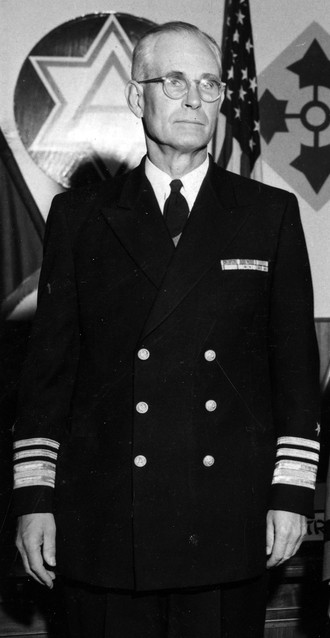
John Sylvester was born in Wellston, Ohio, in 1904. His grandfather, Dr. John E. Sylvester, had been the town’s first physician, and his father, of the same name, edited the Wellston Telegram. He grew up there with his brother George and his sister Janet, finished the local high school, and entered the United States Naval Academy. He stood near the head of the class of 1926. Commissioned that year, he went straight to sea with the fleet.
Asia took up a large share of the career that followed. In 1937 he was flag lieutenant to Admiral Harry E. Yarnell, commander of the United States Asiatic Fleet, and during that duty he married Yarnell’s daughter, Ruth. Shanghai, Tsingtao, Hong Kong, and the Philippines were among his stations in the years when the China coast was still the Navy’s forward Pacific post. He served through the Second World War in the Pacific fighting and in the American theater. Over the whole of his service his decorations came to include the Navy Distinguished Service Medal and the Legion of Merit three times, along with the campaign medals of that war.
On 18 October 1951 he took command of the battleship Missouri as a captain. The same day she entered the Norfolk Naval Shipyard for an overhaul that ran until 30 January 1952. This was the quiet Atlantic interval between her two deployments to the Korean War, and in that stretch she flew the flag of Rear Admiral James L. Holloway, Jr., commander of the Cruiser Force, Atlantic Fleet. The ship already carried a public history. She had been commissioned in June 1944 under William M. Callaghan, and on 2 September 1945, with Stuart S. Murray in command, her deck in Tokyo Bay was the scene of Japan’s surrender, Chester William Nimitz and William Frederick Halsey, Jr. among the senior officers there. Sylvester’s task was the less ceremonial one of taking that ship through the yard and back to sea.
When the overhaul ended he worked Missouri up in winter and spring training out of Guantanamo Bay, then took her north for a visit to New York. On 9 June 1952 she sailed from Norfolk on a midshipman training cruise and was back on 4 August. She returned to the Norfolk Naval Shipyard so the crew could fit her out for a second tour in the Korean combat zone. His time in command ended in that yard. On 4 September 1952, at ceremonies on board, he turned Missouri over to Captain Warner R. Edsall. The months under Sylvester had been the refit, the refresher training, the New York visit, and the midshipman cruise that left her ready to go.
He was promoted to rear admiral in 1953 and made special assistant to the chief of the Armed Forces Special Weapons Project, serving in California while the Navy folded nuclear weapons into its regular plans. In 1955 he commanded the task force for Operation Wigwam, a deep underwater nuclear test in the Pacific. From 1958 to 1960 he held seagoing flag command as Commander, Amphibious Force, Pacific Fleet, in charge of the ships and landing forces assigned to put troops ashore across that ocean. In 1960 he came to Washington as Deputy Chief of Naval Operations for Logistics, the post that handled supply, bases, and the material support of the fleet, and he stayed there until 1965. He retired that year as a vice admiral.
Sylvester died on 26 July 1990 at Georgetown University Hospital in Washington, D.C., at the age of eighty-six. He was buried in Ridgewood Cemetery in Wellston, the town where his family had practiced medicine and printed the paper. His marriage to Ruth Yarnell, begun while he served on her father’s Asiatic Fleet staff, had run the length of that career, from a lieutenant’s billet on the China station to the logistics office of the Navy. The captain who had Missouri at Norfolk in 1951 and 1952 left active duty as the vice admiral responsible for keeping ships of her kind manned, supplied, and able to sail.