Ships
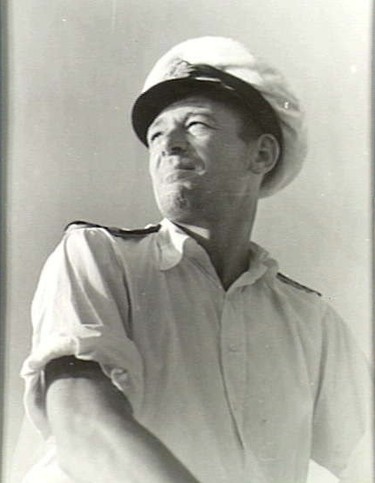
- HMAS Warramunga (I44) Captain from 18 April 1945
He was not an American. The United States Navy Registers held locally for 1933, 1936, 1940, 1942, 1944, 1945, 1952 and 1956–58 do not list an M. J. Clark, or a Max Joshua Clark, in command of anything. He was not Clark, Robert William. He was not Rear-Admiral Charles Carr Clark, the engineer officer of the 1916 Naval College entry, who appears on the same 1958 London Gazette page as a Companion of the Bath. The next line of the encyclopedia, “Clark, Max J.,” is that same name in a shorter form.
What can be said about him is almost entirely what two ships did while he had them, and what two official notices later attached to his name. Birth, parents, wife, children, and death were not found. The years between a college entry and his first command were not found in a Navy List page. Where a secondary list offers dates for those missing years, they are left in the gaps and not told as a cruise.
Origins
No birth certificate, no town, no parents. The earliest list that carries the initials is a compiled roll of Royal Australian Naval College entrants, 1913–1985, published by the Naval Officers Association of Australia. In the 1920 entry it has one line: Clark, M. J., male, graduated, final rank captain, and, in the honours column, DSC. There is no other Clark with those initials in that entry. The roll does not expand M. J., does not give a birthday, and does not mention the O.B.E. he was later given. It does not mark him killed in service. That is a compiler’s silence, not a death date.
The full name comes from elsewhere, and it has to be tied to the initials before it can be used. On 8 January 1942 the London Gazette awarded the Distinguished Service Cross, in a list “for outstanding gallantry, fortitude and resolution during the Battle of Crete,” to “Lieutenant-Commander Max Joshua Clark, Royal Australian Navy, H.M.A.S. Nizam.” There is no further sentence saying what he did. The Sea Power Centre’s history of Nizam says the ship commissioned on 19 December 1940 “under the command of Lieutenant Commander Max J Clark RAN,” and later that in January 1943 Commander C. H. Brooks relieved “Commander MJ Clark.” Same ship, same command, both forms of the name. A Navy List page that prints “Clark, Max Joshua” against both appointments in one entry was not found and not read. Until that page, or his service record, is opened, the identification is the ship histories plus the Gazette, not a single dossier. It is strong enough to name him. It is not strong enough to invent a second officer with the same initials and the same cross.
Formation
The college roll is the whole of his formation as it can be written. He is down as a 1920 entrant who graduated. The roll does not say which term, which place in the order, or which campus. Several of the men in that same 1920 entry later have full biographies — Harrington, Oldham, MacKinnon among them — and those biographies are not his. Nothing in them has been borrowed to fill his boyhood. Cadet age, parents’ trade, school before the college: none of it is in a source used here.
Nor is the ordinary ladder of rank. A widely copied command list gives him cadet on 1 January 1920, midshipman in 1924, sub-lieutenant in 1926 and 1927, lieutenant in 1929, lieutenant-commander in 1937, commander on 31 December 1942, transfer to the Emergency List on 30 March 1957, and retirement on 30 March 1966. Those dates were not re-checked against a Navy List. They are not used below as facts. What the documents that were read do fix is narrower. On 19 December 1940 he was a lieutenant-commander, and he commissioned a new destroyer. On 8 January 1942 the Gazette still called him lieutenant-commander. By the time Brooks relieved him, in January 1943, the ship history calls him commander. By April 1945 he is “Commander MJ Clark DSC.” On 1 January 1958 the Gazette calls him Acting Captain, still with the DSC, and appoints him O.B.E. The college roll’s “final rank captain” and the 1958 “Acting Captain” are not the same wording. Which was substantive, and when, was not settled.
The first firm picture is therefore not a classroom. It is a ship leaving a builder’s yard. Nizam was one of the N-class destroyers laid down in British yards in 1939 for the Royal Navy and transferred to Australia. John Brown and Co. built her at Clydebank. She commissioned on 19 December 1940 under Max J. Clark. He had her from that day until Brooks took her in January 1943. Everything the Sea Power Centre tells of Nizam between those two dates is his command, whether or not the paragraph bothers to repeat his name.
War years as lived
The ship history sends him first to the ordinary work of a new destroyer. Trials at Greenock, fleet duties at Scapa Flow, then convoy escort in the North Atlantic between January and March 1941. In April 1941 Nizam escorted a convoy to Gibraltar and went on south: Freetown, St Helena, Cape Town, Durban, then back toward the Mediterranean by Mombasa, Aden and Suez. In the Red Sea she swept ahead of the transports Queen Mary and Queen Elizabeth, which were carrying Australian troops to the Middle East. She reached Alexandria on 4 May 1941. Her next task, the same history says, was to screen, with the battle fleet, the movement of Queen Elizabeth from the western Mediterranean to Alexandria. The history does not say whether that Queen Elizabeth was the battleship or the liner already named in the Red Sea passage.
Then Crete. On 21 May 1941 Nizam, with the destroyers Ilex, Jervis and Havock, bombarded Scarpanto. Commandos were embarked at Alexandria for Crete, landed at Suda Bay on the second attempt, and wounded men and base troops were brought back. The history’s phrase for the conditions is “continuous German bombing.” Two further ferry trips took troops off Crete for Alexandria, the ships under bombing “from within a radius of 250 miles of Crete.” On the final trip Nizam embarked 698 troops. Her sister Napier brought back 705. The history says the majority of them were Australians. That passage is the operation for which, seven months later, the King approved Clark’s DSC. The notice does not isolate a single act of his. It puts his name in a long list under one heading: gallantry, fortitude and resolution during the Battle of Crete. The cross is his. The paragraph that would say what he did on a particular night is not in the Gazette.
After Crete the same history puts Nizam on a run to Tobruk and back, then three weeks off the Syrian coast bombarding Vichy French positions. On 23 June 1941, with Naiad, Phoebe, Jaguar and Kingston, she was in action in Beirut Bay against two Vichy destroyers. They escaped, the history says, though severely damaged. Then the Tobruk ferry: fourteen trips in all.
Two of those nights are dated, and they are the nearest thing the ship history gives to a cost paid in his own hull. On 14 August 1941, entering Tobruk at night, Nizam collided heavily with a wreck in the harbour and damaged her bow. On 17 September 1941, leaving Tobruk, she was near-missed by a bomb. Her oil-fuel pumps were damaged. Kingston took her in tow and got her clear. She repaired the damage enough to return to Alexandria, and she was docked. The history does not say who was hurt, or whether the collision was anyone’s fault. It says the ship hit a wreck, and later that a bomb close aboard disabled the pumps that fed her boilers.
In October and November 1941 she screened Malta convoys and took part in bombardments of Sollum and Bardia. On 25 November she was present when the battleship Barham was torpedoed and sunk, and she rescued many survivors and took them to Alexandria. The history does not count them. Nine destroyers, Nizam among them, then moved 30,000 troops between Famagusta in Cyprus and Haifa and back — 15,000 each way, the history says, British troops at Cyprus replaced by Indian troops, five days. In December 1941 she was in the screen of a force, heavy ships included, taking the ship Breconshire from Alexandria to Malta. The Italian battle fleet was at sea. A clash was expected. The Italians retired.
In January 1942 Nizam, Napier and Nestor left the Mediterranean for Singapore. At Aden they were detached, Nestor escorting the carrier Indomitable with Hurricane fighters for Java; the aircraft were flown off within sight of the island. Nizam and her consorts joined the Eastern Fleet at Trincomalee. She spent five weeks in dock at Bombay, then, by way of the Seychelles, joined the Eastern Fleet at Mombasa. In February and March 1942 she was on convoy escort. One task the history specifies is five days’ screening, from Trincomalee, of the first batch of AIF troops returning from the Middle East to Australia. Late in March, Nizam, Napier, Nestor and Norman took part in a large Indian Ocean sweep by the Eastern Fleet against Japanese forces known to be at sea. No action resulted.
Nizam and Napier then went back to the Mediterranean and, with Norman and Nestor, joined the screen of a large convoy from Alexandria toward Malta in June 1942. Nestor was lost in those operations. Clark was still in Nizam. The history does not give him a separate part in Nestor’s loss, and none is invented here.
In September 1942 came Madagascar. Diego Suarez had already fallen when the N-class destroyers arrived. They were attached to a convoy formed to attack the west coast. On 10 September Majunga surrendered. Nizam went with the assault ships to Tamatave, which surrendered on 18 September. The same day, the history says, Nizam and Hotspur, on the way to Durban, intercepted and captured the Vichy French merchant ship it spells Marshall Galleni, which had escaped from Madagascar, and took her to Durban. Two days later they chased another Vichy ship, spelled there Antral Pierre. That ship opened her sea cocks and could not be salvaged. Both spellings are the unit history’s. They are kept here because correcting them from memory would be a second source that was not opened.
Nizam then went to Simon’s Town for a refit. Three months had passed since the last boiler clean. The history estimates she had steamed about 1,450 hours in that period. The refit was not finished until 28 December 1942. She arrived at Kilindini on 4 January 1943. In January 1943 Commander C. H. Brooks relieved Clark. The sentence that records the relief styles Clark “DSO.” That is a mistake, or a different decoration that no gazette read for this essay supports. The cross he had been given, and the cross the Warramunga history still attaches to him in 1945, and the cross beside his name in the 1958 honours, is the DSC of 8 January 1942. He is not called DSO again in this essay.
Then a blank of more than two years. No ship, no staff appointment, no shore job, between Brooks’s arrival in January 1943 and 18 April 1945, was found in a source that was read. The blank is left blank.
On 18 April 1945 the Warramunga history says Commander M. J. Clark, DSC, RAN, assumed command. A secondary command list, the one that also expands his name, starts him on 19 April and runs him to 2 December 1946. The ship history is followed for the start. The December 1946 end date is not, because the history never says it. What the history does say is that he took a Tribal-class destroyer already deep into the Philippines campaign. Her previous commanding officer in that history is Lieutenant Commander J. M. Alliston, RN, who had relieved Commander N. A. Mackinnon at Manus on 30 September 1944. Leyte, Lingayen, Corregidor, Cebu: those were other men’s commands. They are not retold as Clark’s.
His first operation in her, the history says, was support of the AIF landing at Tarakan on 1 May 1945. On the way from Subic Bay to Tarakan, canoes were sighted. Some had Japanese on board. Several were captured. Others, the history says, either blew themselves up when approached or were shelled while trying to escape. For the four days before the landing, cruisers and destroyers of Task Group 74.3 supported the minesweeping and hydrographic groups. On 30 April Warramunga and the other destroyers bombarded. Withdrawing through the channel south of Menulum with USS Jenkins, Jenkins was mined. When the assault troops landed next day, Warramunga gave fire support, after first firing on what the history calls the suspected launching site of torpedoes reported among the ships of the convoy. Hobart and Warramunga then sailed for Morotai and Hollandia.
On 10 May Warramunga, Hobart, Arunta and HMS Newfoundland — the history calls them the Wewak Support Force — arrived off Wewak and bombarded shore positions. Next day Swan, Colac and Dubbo joined, and all the ships gave fire support for the assault. After the landing they stood off in case more was wanted. It was not. They sailed on the 12th for Hollandia. The following day Warramunga left for Sydney, by Milne Bay, for a refit finished in early July 1945.
She left Sydney on 9 July for Subic Bay with Commodore John Collins, Commodore Commanding the Australian Squadron, on board. She was in Subic Bay when Japan’s acceptance of the peace terms was announced. On 18 August she sailed for Manila and arrived the next day. On 25 August she sailed for Tokyo Bay and arrived on 31 August. On 4 September she transferred General Gardiner and the Commander-in-Chief of the British Pacific Fleet, Admiral Sir Bruce Fraser, from HMS Duke of York to the Customs House Pier at Yokohama. The history does not say that Clark had been relieved between 18 April and that day. It also does not repeat his name over each of these passages. They are told here as the ship’s work in the commission that began with him, not as a diary he signed.
The pressing task after that, the history says, was the recovery of Allied prisoners of war and internees. On 6 September Warramunga left with HMS Wizard for the port the history spells Hamamatau, and joined Task Unit 30.6.1: the American ships San Juan, Rescue, Nicholas, Taylor, Runels and Gosselin, HMS Tenacious, and HMAS Bataan. The object was to take prisoners from camps near Nagoya, “process” them in the hospital ship Rescue, and carry them to Yokohama. Warramunga carried 174 repatriates at 27 knots. The trip was uneventful except for a floating mine within fifty yards of the ship. The history says those prisoners were British and American soldiers and sailors, a few Dutchmen, and one Australian, captured at Singapore, Guam and Java.
On 10 September a second unit — the history numbers it 30.6.2, and includes Garrard, Rescue, Nicholas, Taylor, Gosselin, Runels, Wizard, Wakeful, Bataan and Warramunga — left Tokyo Bay for Sendai. Minesweepers worked to the north as the unit approached Shiogama, the port of Sendai, and the entry into the harbour was marked, the history says, by an explosion every few minutes. Contact teams landed. By the afternoon the internees from Fukushima camp were being dealt with in Rescue. Warramunga embarked 179, including some women and children, for Yokohama. Most of them, the history says, had been passengers in the Nankin. After a German raider intercepted that ship they had been transferred to the Regensberg and then to the Dresden, a merchant ship bound for Japan. The history lists English, Canadian, Australian, African natives, Indians, Malayans, Greeks, Arabs, Javanese, a New Zealander, an American, a Spaniard and an Armenian.
On 13 September she left Tokyo Bay with mails and stores for the task group at Sendai, and from there went with San Juan and Rescue, two floating docks and four landing craft, to Kamaishi, arriving on the 15th. Rescue teams landed again. The group sailed next day for Tokyo Bay with more former prisoners. Having completed the evacuation from northern Honshu — the history’s spelling is “Hohshu” — Task Group 30.6 was dissolved on 19 September. Bataan and Warramunga rejoined Task Group 70.9. On 22 September Warramunga left Tokyo Bay for Sydney by way of Manus and arrived on 3 October 1945.
A later witness adds the captain’s own words, and it does not match the ship history in every particular. In the September 1984 Naval Historical Review, Sam Whyte, writing on the prisoner recoveries, names Warramunga’s captain as Commander M. J. Clark, DSC, and Bataan’s as Commander H. M. Burrell. He lists the ports as Hamamatsu, Sendai and Kamashi, and he dissolves “Task Group 30.6.1” in mid-September rather than Task Group 30.6 on the 19th. On the Sendai trip he has the same 179 people, and he adds what the ship history does not: 32 women and 15 children, the largest nationality 79 English, five Australians, and a string of other nationalities that overlaps the history’s list but is not identical. The doctor and the sick-bay staff, he writes, were kept busy with seasickness among the children. He says Clark described the passenger list as “a very mixed bag,” and in many ways reminiscent of the Tobruk ferry. He says the majority of the prisoners could not believe the war was over, that they sat and lay in every deck space, and that at Yokohama, in tears, they shook hands with as many of the crew as they could. Those sentences are Whyte’s account of the passage, not a letter in Clark’s hand, except for the “very mixed bag,” which Whyte attributes to him.
Whyte also prints a letter Clark did sign. It is dated 19 February 1946, from HMAS Warramunga at Kure, Honshu. Clark tells the ship’s company that the Australian Naval Board had forwarded an extract from the Commander, Third Fleet, Admiral W. F. Halsey. The printed heading of the commendation calls him “Commander M. J. Clark, DSN, RAN.” DSN is not a decoration he is otherwise known to have held; the DSC is. The word is left as printed, and treated as a transcription error unless a better copy turns up. The citation, as Whyte gives it, commends him for outstanding service as commanding officer of Warramunga with a special task force evacuating Allied prisoners from Japan in 1945: he “skillfully executed the various duties assigned him,” and his “initiative and devotion to duty assisted materially in the prompt liberation and in many cases the saving of lives of thousands of Allied prisoners of war,” in keeping with “the highest tradition of the United States Naval Service.” Halsey’s signature is printed under it. Clark’s own last sentence, in the letter Whyte reproduces, is the one that fixes how he wanted the piece of paper read: “I wish it to be understood by the officers and Ship’s Company that I do not consider this to be a personal honour to me but to Warramunga and her entire company.”
That is the only extended statement of his that was found. It is not a memoir. It is a captain refusing, in writing, to keep a fleet commander’s commendation as a private decoration.
Cost
The cost that can be documented is mostly other people’s, carried or witnessed in ships he commanded.
At Crete the cost was the evacuation itself: continuous bombing, two ferry trips and a final embarkation of 698, the cross awarded afterwards without a personal citation. Off Syria, two Vichy destroyers were engaged and got away damaged. At Tobruk the ship’s own body paid: a bow wrecked against a sunken hull in the dark, then a near-miss that killed the fuel pumps and left Kingston to tow her clear. Fourteen trips are the history’s total, not a count of how many men he landed or how many he brought off wounded. When Barham went down on 25 November 1941 he was there, and Nizam took many of the survivors to Alexandria. The number is not given. In June 1942 the screen he was part of lost Nestor. The history does not say he saw her sink.
Off Madagascar the cost on the other side was two merchant ships: one taken as a prize, one scuttled by her own crew and, on the history’s wording, not saved. In October 1942, around the Cape, a secondary log compiled from reports of proceedings has Nizam picking up survivors of ships sunk by submarines. Those reports were not read for this essay. The pick-ups are not narrated as his cruise. They are noted only so that the gap is honest: the unit history skips that fortnight, and the day-by-day list was not promoted into fact.
Under him in Warramunga the fighting was shorter and late. At Tarakan, men in canoes who blew themselves up rather than be taken; Jenkins mined in the channel beside her; a bombardment, then fire support. At Wewak, a bombardment and a landing after which, the history says, further support was not required. No casualty figure for Warramunga’s own company in his time was found.
The prisoner recoveries are the part of the war he was still explaining in February 1946. A mine passed within fifty yards. Warramunga’s own complement is not stated in the pages used here, so the crowding is not converted into a ratio. What is stated is the load: 174 people at 27 knots, and then 179, including women and children. Whyte says the children were seasick and the mess decks were the only accommodation there was. The Halsey citation claims that the work helped save “thousands” of lives. That number is the citation’s, for the task force, not a count of the men and women who walked Warramunga’s gangway. Clark’s answer to the citation was to hand the credit to the ship’s company. Whether that was courtesy, or what he believed, the letter does not say. It says he did not want it read as a personal honour.
After
On 19 February 1946 he was still in Warramunga, at Kure, writing that letter. The ship history’s postwar chapter does not name him again. It says that in 1946 Warramunga spent some five months as the Australian Squadron’s representative in Japanese waters and returned to Australia at the close of June for refit, and that in January 1947, under Commander G. C. Oldham, DSC, RAN, she went back to Japan. Oldham was a 1920 Naval College entrant, as Clark was, on the same compiled roll. The history does not say that Clark commanded the whole of the 1946 deployment, only that Oldham was in command by January 1947. The February letter shows Clark still in the ship a winter before that. The day he left her was not found. The secondary list’s 2 December 1946 is exactly the sort of date that would close the gap, and it is exactly the sort of date that has not been checked against a Navy List or a report of proceedings. It is not used.
After Kure, the next document is the New Year honours. On 1 January 1958, on the advice of Australian ministers, the Queen appointed “Acting Captain Max Joshua Clark, D.S.C., Royal Australian Navy,” an Officer of the Military Division of the Order of the British Empire. The notice, as read, gives no campaign and no job. The same page makes Charles Carr Clark a Companion of the Bath. They are not the same man: different rank, different honours already held, different college entry on the compiled roll. The O.B.E. is Max Joshua’s. Why it was given, in 1958, is not in the notice.
The college roll’s last word on him is captain, DSC only, not killed in service. No death notice, no widow, no children, no grave, was found. If he lived long enough to wear the O.B.E. as an acting captain, the roll’s “captain” may be that acting rank remembered as substantive, or a later confirmation. Neither reading has a date.
The sea, on the evidence, shaped him into a destroyer captain who commissioned one ship, took her from the Clyde to Crete, Tobruk, Malta, the Indian Ocean and Madagascar, disappeared from the printed record for two years, and reappeared to bring another destroyer into Tarakan, Wewak, Tokyo Bay, and the prison camps of northern Honshu. What he thought of that, apart from one sentence giving a commendation back to his company, and one phrase about a mixed bag of passengers who reminded him of the Tobruk ferry, is not in the sources. What survived of him in print is the DSC, the O.B.E., those two commands, and that refusal to keep Halsey’s paper for himself.