Ships
- IJN Shokaku Captain from 25 May 1942 · Relieved on 16 February 1943
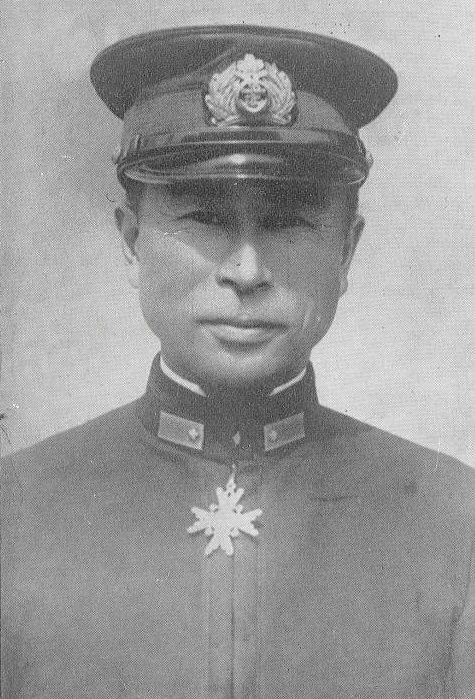
He was already a captain when he took Shōkaku on 25 May 1942. The command lasted until 16 February 1943. The carrier he took over was already broken. He left her in a dockyard. He was killed on 15 October 1944 in an airplane that was not, on the ordinary organization of his last command, his to fly. The photograph is the file Wikimedia Commons calls Arima Masafumi.jpg, described there as a portrait of about 1940, the source given as the Chiran Kamikaze Peace Museum, the author unrecorded. The Commons file is marked public domain.
He is not Rokuji Arichika (有近六次). He is not Arima, Tokiyoshi. The characters confirmed for this man are 有馬正文.
The name
The reading is not in doubt in the sources that print kana. The Japanese article ruby is ありま まさふみ. Kotobank heads the entry 有馬 正文, アリマ マサブミ. Masafumi is that reading. The identification does not rest on the reading alone. It rests on a chain that meets in one place: Shōkaku on 25 May 1942 in the compiled career tables, and a personnel gazette that prints the characters.
The gazette is the confidential Navy appointments extra of 12 July 1937. The Asia-historical-records catalog transcribes the order. Among the lines is 海軍大学校教官兼海軍経理学校教官海軍中佐 有馬正文 補第十戦隊参謀. Commander 有馬正文, instructor at the Naval Staff College and concurrently at the Paymasters' School, appointed staff officer of the 10th Squadron. The image of the page was not opened. The catalog text was. That is the first time the characters were read here as an official line rather than as an encyclopedia heading. The career tables put the same man, class 43, on the Naval Staff College faculty and then on the 10th Squadron staff in July 1937, and they put him in command of Shōkaku on 25 May 1942. The captain of Shōkaku on that day is that officer. No second Masafumi Arima turned up in the lists that were opened.
The tables do not quite agree with the gazette on the day. Hiroshi Nishida's class-43 roll and the Japanese Wikipedia chronology give 11 July 1937 for the 10th Squadron. The English Wikipedia's list of posts gives 12 July, which is the date on the gazette extra. The catalog does not print a separate effective date. Eleven or twelve is the size of the conflict. It is not a second man.
Where he came from
The birth date is the one every compilation prints: 25 September 1895. The place is Ijūin, in Hioki county, Kagoshima. The Japanese article gives the village as 中伊集院村, now part of Hioki city. Kotobank says 伊集院町. Nishida says only Kagoshima. The son's obituary, written in 2023 by a colleague in pediatric neurology, says he himself was born in Ijūin, Kagoshima, and names the father. The village name shifts with the later municipal mergers. The county does not.
Parents are not in any document read here. A wife is. The Japanese chronology says that on 7 October 1920 he married 遠矢文子. That line is not footnoted to a register, and the register was not opened. The 2023 obituary of the son calls the mother 文(フミ), the eldest daughter of a family of ten, who looked after the younger brothers and sisters who came and went in the Arima house. It does not give her family name, and it does not write 文子. Fumi and Fumiko can be the same woman. They have not been shown to be, from a record both of them cite. What the obituary does fix is that there was a wife still there to grieve an older son, and still there when the father did not come home.
The children, as that obituary gives them, were four. An eldest son, 正宏, seven years older than the third child, died of tuberculous peritonitis while the third child was still in elementary school. There was an older sister, not named in the obituary. The third child was 有馬正高, born 2 March 1929, died 12 December 2022. A younger brother, seven years younger than Masataka, is mentioned and not named. The Wikipedia article on Ishida Suteo, later the ninth chief of the Maritime Staff Office, says in its first sentence that his wife was Yuriko, eldest daughter of Vice Admiral Arima Masafumi. The son's obituary confirms an older sister and does not confirm the name or the husband. The marriage is used here only as that sentence. It was not checked against a register.
The Japanese chronology sends the boy through three schools before the Academy: the Kagoshima prefectural normal school's attached elementary from 1 April 1902, the Ijūin village elementary from 1 April 1906, and Kagoshima First Middle School, the school later called Tsurumaru, from 1 April 1908. On 31 August 1912, in the fifth year, he left the middle school without finishing. On 9 September he entered the Naval Academy, 43rd class, ranked 51st of 100 on entry. None of those school lines was checked against an admission book. They are the chronology. Nishida does not print them.
The long education of a gunnery officer
He graduated on 16 December 1915 and was appointed midshipman. The Japanese article says 33rd of 96. Nishida's roll says 33rd of 95. The English article repeats 33rd of 96. The difference of one in the denominator was not settled against the Academy's own register, which was not opened. The rank inside the class, thirty-third, is what they share. He was not at the top and not at the bottom.
The cruise that followed is printed in the Japanese chronology and, more shortly, in the English article. Iwate, the training squadron, a coastwise voyage and then, from 20 April 1916, Hong Kong, Singapore, Fremantle, Melbourne, Sydney, Wellington, Auckland, Jaluit, Ponape, Truk, and the Bonins, back on 22 August. The English article folds the first cruise and the second into a cleaner story than the Japanese dates allow, and it skips the day. The Japanese chronology has him to Shikishima on 23 August 1916. Nishida puts him in Shikishima on 22 August, the day the cruise returned. One day, two compilers. Ensign on 1 December 1916. The ports are a training-squadron list, not a diary. What he made of Australia or of Truk at twenty is not recorded.
The next years are the ordinary ladder of a gunnery officer, and they are ordinary only because the tables are full. They were still opened here as tables, not as gazettes, except for the one 1937 line. Back to Iwate on 10 September 1917, attached as an instructor to the midshipmen. Another coastwise cruise, then a foreign cruise from 2 March 1918 whose Japanese list runs San Francisco, Los Angeles, a Santiago the article itself does not locate, Manzanillo, Acapulco, Panama, Hawaii, Jaluit, Truk, Saipan, the Bonins, home on 6 July. Uzuki, a third-class destroyer, on 1 November 1918. Lieutenant junior grade on 1 December. Suwo on 18 January 1919. Torpedo School, ordinary course, 1 December 1919. Gunnery School, ordinary course, 31 May 1920. The marriage date falls in that interval. On 1 December 1920 he was acting division officer in the battlecruiser Kongō. Lieutenant on 1 December 1921, and the advanced gunnery course, which the chronology calls the 21st class and says he finished on 30 November 1922. Ashi on 1 December 1922. Division officer in Izumo on 1 December 1923. Division officer in Hiei on 15 April 1925.
One scene from the Izumo year is remembered by someone else, and it is the first thing that sounds like a person rather than a posting. In the summer of 1924 the 52nd Academy class came aboard for practical training. Minoru Genda was one of the midshipmen. The Japanese article, citing Genda's Kaigun Kōkūtai, Hasshin, has Genda calling the division officer a man of sincerity and of unusual force, one of the men he took as a model, and it gives the parting line Genda says he never forgot: do not drink for the sake of other people. The book was not opened. The line is Genda's recollection as the article prints it, not a letter, and not a remark from 1924 written down in 1924.
On 1 December 1926 he entered the Naval Staff College, A course, 26th class. Lieutenant commander on 1 December 1927, while he was still a student. The chronology says he graduated on 6 December 1928, 11th of 22. Nishida records the 26th class and not the place in it. On 10 December he was secondary gunnery officer and division officer in Haruna. The English list ends that job on 5 September 1929, which is the day the Japanese chronology sends him to the Sasebo Naval District as gunnery staff. Gunnery officer of Asama from 20 August 1931. Staff of Battleship Division 3 from 15 November 1932. Staff of Cruiser Division 7 from 20 May 1933. Commander on 15 November 1933. Instructor at the Naval Staff College from 15 November 1934, and from 15 December also at the Paymasters' School. Genda, by then an officer, was among the students. That, too, is the article citing Genda, and the book was not opened.
The English list calls the division jobs "senior staff officer." The 1937 gazette, for the one appointment where the wording can be checked, says 参謀, staff officer, not chief of staff. The Japanese article uses 参謀 for the earlier divisions as well. "Senior" is the English table's word. It is not used here.
The turn toward airplanes
On 11 or 12 July 1937, the gazette's day or the tables' day, the instructor became staff officer of the 10th Squadron. The Japanese article places him, with Genda, on a reconnaissance of Qingdao in early August, after the Tongzhou incident. The citation is again Genda's book, unread here. On 20 October he moved to the staff of the 14th Squadron. On 1 December 1937 he was promoted captain and given his first ship, the auxiliary seaplane tender Kamikawa Maru.
The Japanese article then says that in January 1938 he went south with Kamoi, that the two ships' floatplanes bombed trains and boats, that he learned from this what aircraft could do, and that he transferred into the air arm. The bombing and the motive are in that paragraph without a separate citation. They are not repeated here as things a log was seen to say. What the tables agree on is the sequence of commands that followed. Kamikawa Maru until 1 September 1938. Then the Sasebo Air Group. From 15 December 1938 the Kisarazu Air Group. From 15 November 1939 the Yokohama Air Group, the big-boat unit. From 17 April 1941 he was executive officer and chief instructor of the Yokosuka Air Group. A gunnery officer who had commanded one auxiliary tender was, by the time the war began, a training officer in naval aviation. The orders show the move. They do not show the hour he decided.
He was at Yokosuka, not at sea, on 8 December 1941. The tables next put him on the books of the Yokosuka Naval District on 10 May 1942, a fortnight in which he had no ship. On 25 May he was given Shōkaku.
The carrier he was given was already hurt
Shōkaku had been in the Coral Sea battle on 8 May 1942 under Captain Jōjima Takatsugu. The Combined Fleet chronology of the ship, a compiled secondary timeline and not her log, describes three bomb hits that morning, the forward elevator disabled, 108 officers and men killed and 40 wounded, and Jōjima asking to leave the action. She could not operate aircraft. She was not at Midway. Arima took her on 25 May, while that damage was still the reason she sat out the battle that destroyed the rest of the heavy-carrier force. The English Wikipedia's own prose says 25 May. Its table of posts says 17 May. The Japanese chronology, Nishida, and Combined Fleet say 25 May. The 17 May line is the one that does not match the others. No gazette for either day was opened.
She went into drydock at Kure on 16 June and came out on 27 June. The same chronology says a Type 21 radar was fitted on the island during that docking. On 14 July, when the Third Fleet was formed out of what remained after Midway, Shōkaku became flagship of that fleet and of Carrier Division 1, with Zuikaku and Zuihō. From 16 August the flag was Vice Admiral Nagumo Chūichi's. The ship spent late July and early August on short training cruises between Kure and Hashirajima. On the evening of 16 August she sailed for the Solomons.
Two carrier battles, and a ship that burned and did not sink
At the Eastern Solomons, 24 August 1942, the Combined Fleet chronology has two Enterprise scouts dive on Shōkaku while she was still launching. It says the radar warning did not reach the bridge in time, that lookouts saw the bombers late, and that Captain Arima put the wheel hard over. The bombs were near misses. One is put at ten meters. Slight damage to the starboard side, six men killed. The same chronology has her air group in the strikes that hit Enterprise, and has Nagumo using searchlights after dark so the second strike could land. How much of that minute-by-minute account is from a deck log, and how much is reconstruction, is not something this essay can separate. The chronology is where the claim sits that he conned her clear. It is not a quotation from him.
Through September the ship was at Truk or north of Guadalcanal, and the air group was off the ship at Kavieng from 28 August to 4 September. On 15 October she launched against a small American tow east of Guadalcanal. The chronology says the destroyer Meredith was sunk, and that Shōkaku lost one dive bomber. That is a ship's operation while he was captain. It is not a battle he is otherwise remembered for.
Santa Cruz, 26 October 1942, is the day the ship almost ended under his hand. The chronology has Hornet's dive bombers finding her at 0727, after her own strikes were already off the deck, and putting four and possibly six thousand-pound bombs into the flight deck around the middle and the after elevator. The deck buckled. The center elevator folded. Guns on the port quarter were destroyed. The hangar, nearly empty of aircraft, was wrecked. The strength deck held, she was not opened below the waterline, and she kept way, the chronology says at thirty knots. Fires were out in just under five hours. The dead, in that same account, were heavy: more than fifty gunners on each side aft, and about eighty handlers and maintenance men in the hangar. Those figures are the chronology's, not a muster that was read here. Her own first strike had already put torpedoes into Hornet. She lost ten of those torpedo planes and a fighter. By the time she was sent out of the fight she had four fighters and one torpedo plane left aboard.
The Japanese Wikipedia prints a speech he is supposed to have made to Nagumo while the ship was hit: that Shōkaku could still make speed, that she should go on and draw the bombs, that every bomb that fell on her was one that did not fall on the others. The paragraph has no citation. It is not used here as his words. The Combined Fleet chronology, which is also not a log, says something shorter and marks it as a paraphrase. It says the captain wanted to stay in the action and "absorb attacks," that Nagumo refused, that Nagumo would not slow the burning ship long enough to change flag into a destroyer at once, and that at 1307 he asked Arima to slow when he could, so the flag could go to Arashi and later to Zuikaku. Nagumo did not get across to Zuikaku until the next day. Shōkaku, still burning, was detached for Truk with Zuihō, escorted by Hatsukaze and Maikaze.
She was at Truk on 28 October. On the morning of 30 October the chronology says Admiral Yamamoto came aboard to look at the damage and to honor the dead. On 6 November she reached Yokosuka and went into the yard. The Naval Battle of Guadalcanal was fought on 12–15 November, while she was there. The English article's narrative and its battle list put Arima in that battle because he was still captain of Shōkaku. The ship's own compiled movements put Shōkaku in the yard. He did not fight it. The carrier's later life is not his either. He was relieved on 16 February 1943 by Captain Okada Tametsugu. The chronology's line for the drydock entry is misdated 8 February 1942, which is a year early and is a slip in that page, not a second docking. She left the dock on 28 February 1943, after he had gone. She was sunk on 19 June 1944 in the Philippine Sea under another captain. That sinking is not an event in his life.
What those nine months show, if the chronology is accepted even in outline, is a captain who took a damaged ship through two carrier battles, lost her as a fighting deck in the second, kept her afloat, and brought her home. The men who died on her deck and in her hangar on 26 October died while he had the command. No letter of his about them was read. The Japanese article says he wrote by hand to the families of men who were killed, and that he would not leave the bridge while aircraft were still out, and that he had the searchlights burned for them at the ship's risk. Those sentences have no citation on the article. They are not repeated as facts. One cited detail is small enough to keep, and it is still secondhand. A 2005 collection of oral history, at the page the article cites, has a commander of an antiaircraft group saying that at sea Arima did not use the bridge office, ate in a captain's rest room about the size of one tatami mat, and stayed on the bridge. The book was not opened.
The same article cites a 1987 essay by Ichioka Yōichirō for a conversation with Nagata Hisashi, then Shōkaku's paymaster, a short-service officer. In that telling, Arima said he had been drawn to communism as a lieutenant junior grade and had thought of leaving the Navy, and had later decided that communism did not fit the Japanese and that liberalism was better. The footnote gives Nagata's version of what came next. A man wants to be free. A naval officer cannot do as he likes. The one complete freedom Arima claimed to have found was the freedom to choose, by his own will alone, the time of his death. He asked Nagata what he thought of that. The essay was not opened. The conversation is not dated more tightly than the months Nagata was in the ship. It is a recollection of a talk over tea in the captain's cabin. It is also the earliest remark, in anything cited for this essay, in which he is said to have spoken about choosing his death. What he meant in 1942, if he said it, is not settled by what was done in his name in 1944.
A rear admiral who had argued the other way
On 16 February 1943 he became chief of the education section of the Naval Aviation Bureau. On 1 May 1943 he was promoted rear admiral. The Japanese article, citing a biography of Vice Admiral Nakazawa Tasuku at page 157, says that Arima and Captain Kuroki Gōichi spoke against desperate tactics. The biography was not opened. The claim matters only because of what later accounts say he did. If the biography is right, then in 1943, in the education office, he was one of the officers who said no. The article also cites Watanabe Yōji's book on the 302nd Air Group for a complaint Arima made to Commander Kozono Yasuna about the bureaucratic manner of the bureau's junior officers. That book was not opened either. Both are recorded here as claims in books, not as minutes.
He left the education post on 15 March 1944, remained attached to the bureau, and on 1 April was attached to the Central Pacific Area Fleet. On 9 April he was given the 26th Air Flotilla.
15 October 1944
The flotilla's work, in the account the photographer and writer Kandachi Naonori published on 15 October 2024, was base preparation in the central and northern Philippines, not command of a striking air group. Kandachi distinguishes the Navy's kō air flotillas, which led aircraft, from the otsu flotillas, which serviced bases, and he puts the 26th in the second kind. He is reporting what Onishi Takijirō's aide, Lieutenant Monji Chikayoshi, told him. Monji is the source of the surprise: a commander whose flotilla had no air groups of its own nevertheless boarded a plane. The distinction is Monji's, as Kandachi prints it. It was not checked against an organization table.
Where he flew from, and in what, is more consistent than why. The Japanese article, Kotobank, the son's obituary, and Kandachi all put him in a Type 1 land attack plane, a Betty, from Clark Field, on 15 October 1944. Kandachi names the unit as the 761st Air Group and the target as the American task force east of Taiwan, and he says the report that came back was that Arima torpedoed and then, hit, blew himself up. Kotobank compresses the same day into one dictionary sentence: feeling responsible for the loss of many fighters, he boarded a Type 1 land attack and died crashing into an enemy carrier. The son's obituary says the father flew the land attack, took off his rank insignia, and was killed off the Philippines. The Japanese article's infobox gives the place of death as Taiwan under Japanese rule. Its prose has him leaving Clark for the fleet in the Formosa air battle. The English article says between Taiwan and the Philippines, and then, in the next paragraph, says the date itself is variously given between 13 and 26 October. Nishida, Kotobank, the Japanese chronology, and the obituary all use 15 October. Kent Budge's Pacific War encyclopedia uses 26 October and has him in a Zero. The Zero is the weak outlier. The Betty is what the Japanese accounts share. The 26 October date collides with the 15 October date and is not the one used here. Budge also has the mission accomplishing nothing, which is a conclusion, not a log.
What the United States Navy recorded that day, for one ship, does not match a Betty diving into a flight deck. The Bureau of Ships war-damage report on Franklin, of 15 September 1946, separates three October injuries. On 13 October, off Formosa, a Betty on a torpedo run tried to crash the flight deck, slid across, and blew up in the water. Damage was minor. On 15 October, east of Luzon, two Oscars and one Judy dive-bombed her. One bomb detonated on the after outboard corner of the deck-edge elevator. The elevator still worked. Three airplanes were damaged. A small gasoline fire in the hangar was put out. On 30 October, east of Samar, a suicide plane — the report says a Zeke or a Judy — crashed through the flight deck. That was fifteen days after the date given for Arima's death. The report does not mention him. It does identify the 15 October hit as a bomb from a dive bomber, not as a crashing land-attack plane. A popular English page, quoted on the English Wikipedia from a 2015 website, says part of his airplane hit Franklin and that he was promoted posthumously to admiral. The rank in that sentence is wrong against every Japanese table, which stops at vice admiral. The airplane in that sentence is not the airplane in the Bureau of Ships report. The Japanese article itself says there is no American damage report that can be tied to his plane, and no wingman who saw him hit a ship. That caution is the one that survives contact with Franklin's report. Other ships were in the force. This essay did not read their action reports. It cannot say that no American ship was hit by anyone that morning. It can say that the famous identification of his death with a crash into Franklin is not what Franklin's damage report describes for 15 October.
Why he was in the airplane is where the sources divide, and they divide on the point that matters.
The Japanese article tells it as a decision for special attack, made that morning. He did not believe the great victory claims coming out of the Formosa battle. He told a war correspondent that ordinary attack could no longer win, and that special attack had to be adopted while the pilots' spirit was still high. He called his officers together and said that if carriers were to be sunk by ramming, the young could not be the only ones sent. Nobody volunteered. He shouted that he would go himself, and he would not be held back by the staff or the aide. The article says he had been in the habit of saying that everyone from the commander down had to ram, and that the old should die before the young. The citations for the scene are Denis Warner's Document Shinpū, volume one, page 155, and a popular book by Tominaga and Yasunobu, page 48. Neither was opened. The same article says he took the rear admiral's collar tabs off the uniform and scraped the word "commander" off his binoculars, so that he had not meant to return. Warner and Tominaga are the chain for that too, as the footnotes are set. The article then says his death, next after Onishi, pushed special attack forward, and it cites Senshi Sōsho volume 17, page 706, for an Army staff officer, Colonel Nonogaki Shirō of the 2nd Flying Division, calling the death a shock and one of the motives for later special attacks. Volume 17 was not opened. The citation is the article's, not a page turned here.
Kandachi's 2024 article quotes a different public version and a different private one. The public version is the Asahi Shimbun of 17 January 1945, an article he attributes to the novelist Yamaoka Sōhachi. The headline he quotes calls Arima, already by the posthumous rank of vice admiral, the forerunner of the kamikaze, and says he tore off the collar insignia, crashed into a carrier, and showed with his body the road to certain victory. The newspaper was not opened. The private version is Monji's, told to Kandachi. Monji said that was wrong. Arima had felt the weight of the losses at Cebu, suffered while he was briefly left in command of the First Air Fleet after the Davao false alarm, and he had taken that weight by leading from the front. A correspondent, Niina Takeo, had heard him say that in this war the men at the top had to die. Monji remembered him as upright, silent, and carrying a sense of responsibility that was not ordinary. Kandachi's conclusion is that the death was atonement for Cebu, close in time to the special-attack decision and not the same thing. The Cebu and Davao actions were not reconstructed for this essay. They appear only as the reason Monji gave.
The Tokkōtai Memorial Association's page on the Philippine air special attacks says, in one sentence, that on 15 October the 26th Air Flotilla commander made a ramming attack on an enemy carrier and was killed, and that Army reconnaissance officers attached to him revered him. It dates Onishi's arrival in Manila to the 17th. That page is an association's account. It is not a combat report.
Set beside each other, the accounts agree on a rear admiral who left Clark in a land-attack plane on 15 October and did not come back, and who had taken off the marks of his rank. They do not agree on whether he went in order to ram, whether he went in order to lead a torpedo attack he expected to die in, whether anyone saw the end, or whether any American ship was hit by him. The Asahi of 17 January 1945, as Kandachi quotes it, had already chosen the story that he was the first of the kamikaze. Monji, years later, told a writer to refuse that story. The English article's own summary is that official accounts may have been invented for propaganda, and that it is not clear the damage to Franklin was a planned suicide attack. That is the state of the evidence. Choosing one motive and calling it his would be a choice the records do not support.
A biography of Nakazawa, unread, is cited for his having opposed desperate tactics in 1943. Ichioka's essay, unread, is cited for his having told a paymaster that the officer's freedom was the freedom to pick the hour of his death. Both can be true as recollections and still not tell anyone what he decided on the morning of 15 October. They are left as recollections.
What he left
There is no after, for him, in the sense of a man who came home and had to live with the war. The after is other people's.
The Japanese article says that on 7 January 1945 a death gazette specially promoted him to vice admiral. The gazette was not opened. Nishida prints the vice admiral's rank on the line of the death itself, 15 October 1944, with "1st Medal" in the same line, and prints an undated "4th Medal" earlier in the table. The English article's promotion list also puts the posthumous vice admiral's rank on 15 October. Kotobank still files him as a rear admiral of the Shōwa period, which is the rank he held while alive. The son's obituary says rear admiral, later vice admiral, and does not give the January date. The Asahi headline Kandachi quotes, ten days after 7 January, already uses the higher rank. The promotion is consistently described as posthumous. The day of the paper that conferred it was not read. Nishida's "medals" were not traced to a citation. The Japanese article is filed under the category of recipients of the Golden Kite, first class. No warrant was seen. The decoration is not asserted here.
The Japanese article places a grave at Kōsaiji in Hioki, and says the temple has been abolished and the site remains. The English article calls it a cenotaph at the temple in his home town, and romanizes the name Kozai-ji. The son's ashes are not there. The 2023 obituary says Masataka lies in the Arima family grave at Zuisenji in Nikaidō, Kamakura, with his relatives. It does not say the father's remains were brought to Kamakura. Two places, and no document here that says which one holds anything of the body. Nothing read here says a body was recovered.
The obituary is the fullest account of the house he left, and it is a colleague's memorial, not a family register. The eldest son was already dead of tuberculosis before the war killed the father. The third son, fifteen when the father was killed, had moved through five elementary schools because of the father's postings, gone on to Shōnan Middle School in Kanagawa, and in April 1945 entered the Naval Academy's preparatory course. Four and a half months later the war ended, the school was dissolved, and he went back to Kagoshima. He graduated from the medical faculty of Tokyo University in 1953, spent his career in pediatric neurology and in the medicine of severely disabled children, and died on 12 December 2022 at ninety-three. The obituary says that when his work took him to Asia he went more than once to the site of the Manila base his father had flown from. In 1995 he published a short piece in the Nihon Iji Shinpō under the title "Living through fifty years after the war." That essay was not read. The colleague who wrote the obituary ties the boy's decision to become a pediatrician to the death of the elder brother, not to the death of the father: he had watched what it did to parents to lose a child, and he held that a child should not die before the parents. The father's death is told as a fact of the family. It is not given as the sentence that chose the son's work.
The mother is present in that account as the woman who buried the eldest boy and then the husband, and who is remembered looking after a crowd of younger siblings. She is not given a death date. The older sister is not followed, except for the uncorroborated sentence in Ishida's article. The younger brother is a clause. If Arima left them letters, the letters were not found. The letter he is said to have written to other men's families, from Shōkaku, is one of the uncited sentences, and it was not used.
What survived in public was the argument. Within three months of his death a Tokyo newspaper, as a later writer quotes it, had made him the pattern of the special attack. A staff officer who had served under Onishi spent years afterward saying that pattern was false. English reference books still split between 15 October and 26 October, between a Betty and a Zero, between a crash into Franklin and a flight that hit nothing. The Bureau of Ships report supports none of the crash-into-Franklin versions for the day he is said to have died. The man in the photograph is the officer those arguments are about. The photograph does not settle them.