Ships
- USS Anderson (DD-411) Captain from 19 May 1939
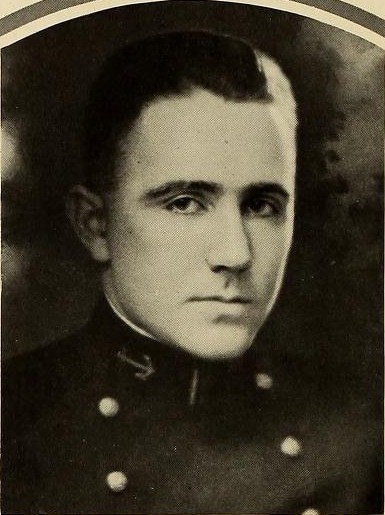
William Matthews Hobby Jr. (27 July 1899 – 13 November 1942) was a United States Navy officer from Sylvania, Georgia, a graduate of the Naval Academy in the class of 1923. He fitted out the destroyer Anderson at Kearny, New Jersey, and commanded her from her commissioning on 19 May 1939 until March 1941. As the battleship Oklahoma's first lieutenant and damage-control officer he was aboard when she capsized at Pearl Harbor on 7 December 1941, and his captain recommended his work in the salvage and rescue that followed for special notice. Eleven days before his death he became executive officer of the light cruiser Juneau. She was damaged in the night battle off Guadalcanal on 12–13 November 1942 and, on the morning of the thirteenth, was struck by a torpedo from the Japanese submarine I-26, exploded, and disappeared in seconds. Only ten of her crew were found alive. Hobby was forty-three. A fast transport, USS William M. Hobby (APD-95), was named for him.
He was born on 27 July 1899 in Sylvania, Georgia. His mother, Kathleen Johnston Hobby, died in 1900, when he was an infant. Researcher notes on the Naval Academy's Virtual Memorial Hall page record that he and a sister, also named Kathleen, lived that year with their grandparents, Margaret and Ronald Johnston, in Gwinnett County. His father, a newspaperman and tax collector, married Mamie Lou Kittles in 1903. By 1910 the household in Sylvania included William, aged ten, a younger brother Wensley, aged eight, another brother Peter, aged three, and a sister Evelyn, aged one, who later became Mrs. John Mills Jr. His sister, Miss Catherine Hobby, later sponsored the ship named for him.
When he registered for the draft on 12 September 1918, he was a surveyor in Sylvania, described in the notes as of medium height and build, with blue eyes and brown hair. His father died in 1932, and Mamie Lou took over the newspaper and the tax collector's duties. The notes do not say where William went to school.
He was appointed a midshipman from the First Congressional District of Georgia on 20 June 1919, at the age of nineteen.
The 1923 Lucky Bag calls him "Bill" and "The Governor," and records class baseball in his third-class and second-class years, numerals in his third-class year, and class football in his fourth-class year. The sketch is the portrait of a gambler and a self-deprecating student: "BILL is a born gambler. The click of chips is as music to his ears. 'Is there a Nav P-work tomorrow?' Whitey sends a Plebe around to make it five handed, and books are forgotten." He liked to give the impression that he was failing: "Invariably, toward the end of the month, we hear him bemoaning his fate." His classmates did not believe him, "in spite of our knowledge of his ways," because "the ease with which he gets by makes him reckless, and, sooner or later, he oversteps the bounds of possibility." In the spring he left "the radiator for the diamond."
He graduated in 1923 and was commissioned an ensign. The Navy's biographical sketch and the Navy Directories give the sequence of his next fifteen years. His first sea duty was in the battleship Oklahoma, from June 1923 to April 1925. He then took a brief course of aviation instruction at Pensacola, Florida, and on 21 November 1925 reported to the destroyer Kidder, in which, the sketch says, he earned the Second Nicaraguan Campaign Medal. The directories list him there as an ensign and, from October 1926, a lieutenant (junior grade).
From late December 1927 to June 1928 he took submarine instruction at New London, Connecticut. He went out to the Asiatic Station, reported to the submarine tender Canopus on 10 August 1928 and joined the submarine S-37 ten days later. The directories place him in the S-41 by April 1929 and through 1930, and in the S-30 from October 1930 to January 1931. From May 1931 to June 1933 he was at the Naval Academy; he is listed there as a lieutenant (junior grade) and, from October 1932, a lieutenant. In July 1933 he went to the new submarine Cachalot, in which the directories carry him until early 1935, and then to the cruiser Richmond (April 1935) and the battleship Tennessee (October 1935 through 1936). The sketch adds a tour in the training ship Wyoming into the summer of 1938; the directories list him at the Naval Academy and its receiving ship from January 1937 through January 1939, when he is shown as a lieutenant commander. Navy records on uboat.net date his lieutenant commander's rank to 1 July 1938.
That is a career of fifteen years divided between battleships, destroyers and submarines, with two tours teaching or training young men at Annapolis. The sources examined here do not say whether he married, or when. The Virtual Memorial Hall notes record only that his wife was listed as next of kin. They do not give her name.
On 11 May 1939 he reported to the Federal Shipbuilding and Dry Dock Company at Kearny to supervise the fitting out of the new Sims-class destroyer Anderson (DD-411) and to become her first commanding officer. He was thirty-nine. Anderson was launched on 4 February 1939, delivered at the New York Navy Yard on 18 May, and commissioned on 19 May 1939, "Lt. Cmdr. William M. Hobby, Jr., in command." She was the first of her class to be placed in commission, and the ship's official history records the ceremonial first weeks: a landing party in the New York Flag Day parade on 14 June; a run down the Potomac, with passing honors to Mount Vernon, to the Washington Navy Yard on 10 July; an informal inspection the next day by the Chief of Naval Operations, Admiral Harold R. Stark, and other senior officers; a welcome at Wilmington, North Carolina, the hometown of the admiral for whom she was named.
Her shakedown in the summer of 1939 took her to San Juan, the Canal Zone, Bermuda, St. John's, Newfoundland, and Montreal, where the outbreak of war in Europe found her moored to the Laurier Dock on 1 September. On 8 September, on the way back to Newport, she sighted a Norwegian merchantman and was circled at low altitude by a plane identified from its wing markings as British, probably Canadian. She completed her shakedown at Newport on 9 September 1939, and from 1 October through the end of January 1940 she was at the New York Navy Yard for post-shakedown repairs and alterations.
In the spring of 1940 she went to the Pacific. The ship's history follows her to San Diego (1 May), the Neutrality Patrol off southern California, and on 20 May a small act of seamanship: she called away her fire and rescue party for a tug flying a distress signal, which turned out to be lost and in need of nothing but the course to San Nicolas Island. In June she served as plane guard for the carriers Yorktown and Enterprise. On 22 June Commander Allan E. Smith reported aboard as Commander, Destroyer Division 3, and on 25 June she sailed for Hawaii with Enterprise and five other destroyers. For the next five months she operated out of Pearl Harbor and Lahaina Roads, visiting Palmyra and Christmas Island and interspersing patrols with gunnery and torpedo practice and drydocking. After an overhaul on the West Coast she went back to Pearl Harbor in January 1941, and in March, as plane guard for Yorktown, searched for the wreckage of two torpedo planes that had collided in the air on the seventeenth.
Hobby was detached from Anderson on 22 March 1941. Four days later he rejoined the Oklahoma, the ship of his first tour in 1923, as damage-control officer and first lieutenant. The ship that he had left as an ensign was moored at Pearl Harbor on the morning of 7 December 1941, outboard of the Maryland at Berth F-5, when the first torpedoes struck. He was forty-two.
The executive officer's report, written at the West Loch ammunition depot on 16 December, is the only eyewitness account of Hobby that the sources examined here preserve. Commander Jesse L. Kenworthy Jr., the ship's senior officer on board, had started down a ladder to his office when the first alarm came and ran up to the upper deck; he felt a heavy shock and a loud explosion, and the ship began to list to port. Two more explosions followed, and then a fourth, and by then the Oklahoma was listing twenty-five to thirty-five degrees and still going over. Kenworthy climbed over the boat deck to the starboard side. "As I reached the starboard side," he wrote, "I met Lieutenant Commander HOBBY, the First Lieutenant, and with him concluded that the ship was fast becoming untenable and that an effort should be made to save as many men as possible." The word was passed for all hands to abandon ship, over the starboard side, to climb and walk over the side and onto the bottom as she rolled. The ship settled with part of her keel and starboard propeller shaft out of the water. Men who had gone into the water swam to the Maryland, and boats took the rest out of the water.
After that, according to the report of the ship's captain, Captain H. D. Bode, Hobby became "the senior officer of the Oklahoma engaged in the salvage work." Bode forwarded Hobby's "Report of Rescue and Salvage Work," dated 12 December 1941, together with a list of the personnel engaged in it, with a note that the report and "the commendable work of that officer himself" were "submitted for consideration as deserving of special notice or commendation." Hobby's own report was not among the sources examined here, and so what he did, hour by hour, on the overturned hull is not preserved. The recommendation is.
After Pearl Harbor, the Navy's sketch says, he served briefly in the Twelfth Naval District before joining the new battleship Washington (BB-56) on 3 January 1942. He acted as her navigator until he relieved Commander Walter E. Moore as executive officer of the light cruiser Juneau at Espiritu Santo on 2 November 1942. Uboat.net records his temporary rank as commander from 1 January 1942 and his permanent rank from 30 June 1942.
The Juneau was an Atlanta-class light cruiser, commanded by Captain Swenson. In the second week of November she was part of Rear Admiral Richmond Kelly Turner's convoy bringing reinforcements to Guadalcanal. She arrived on 12 November and took station as a screen for the transports. In the afternoon, according to the ship's official history, some thirty Japanese planes attacked the task force and the Juneau alone claimed six torpedo planes shot down. That night, as part of Rear Admiral Daniel J. Callaghan's small force, she fought Vice Admiral Hiroaki Abe's bombardment group in the dark. The history says she fired her 5-inch and 20-millimeter guns and was struck on her port side by a torpedo from the destroyer Murasame, "below the armor belt and above the rolling chocks." One of her medical officers recalled "a terrific jolt" that "buckled the deck just aft of turret eight." She lost her steering and nearly collided with the Helena, but she withdrew. Hobby had been her executive officer for ten days.
By dawn she was steaming on a single screw through Sealark Channel and joined the San Francisco, the Helena and three destroyers for the passage to Espiritu Santo. She was ten to twelve feet down by the bow and listing. At about eleven in the morning of 13 November the Japanese submarine I-26 fired three torpedoes meant for the San Francisco. The second struck the Juneau on her port side, amidships, near her previous injury. A survivor recalled that "decks were almost awash" even before the torpedo struck. "Within seconds of the hit a massive explosion rocked Juneau"; it was believed that her magazine had ignited. Eyewitnesses on the other ships said the cruiser was gone in about twenty seconds and that no one could have survived. Of the 693 men aboard, about 115 were afterward estimated to have reached the water. Ten survived to be rescued, between 19 and 20 November. The five Sullivan brothers were among the dead. Captain Gilbert C. Hoover of the Helena, the senior officer present, had ordered the group to press on without stopping to search, for fear of the submarine; that decision was questioned by his superiors later.
Hobby was one of those who died. He was forty-three. The sources examined here contain no word of where he was in the ship at the moment of the explosion.
There was no after. His body was not recovered. The Navy named the Charles Lawrence-class fast transport William M. Hobby (DE-236, redesignated APD-95) for him. She was laid down at Charleston Navy Yard on 15 November 1943, floated out on 2 February 1944, and christened and commissioned there on 4 April 1945, sponsored by his sister, Miss Catherine Hobby, with Lieutenant Commander Frank N. Christiansen of the Naval Reserve in command. She arrived in the Pacific too late for combat. She trained underwater demolition teams in Hawaii in July 1945, embarked a team, reached Manila in September, and carried another team to the Inland Sea in October to reconnoiter the landing beaches at Hiro Wan and Mitsuhama ahead of the occupation troops. She was decommissioned on 6 April 1946, struck in 1967, and transferred to South Korea, where she served into 1979.
The Naval Academy's researcher notes record that his wife was listed as next of kin, that his brother Wensley and sister-in-law Neil named their son, born in 1935, William III, and that there is a memorial marker for him in Georgia. The sources examined here do not name his wife, and do not mention children.
What remains is a yearbook sketch of a gambling, baseball-playing Georgia midshipman with a stogie and a flair for gloomy forecasts about his marks, a plain official record of the sea tours of an officer who commanded the first of a new class of destroyer, and one paragraph in another man's report that shows him at the rail of a rolling battleship deciding with his captain's executive officer to get the men off.