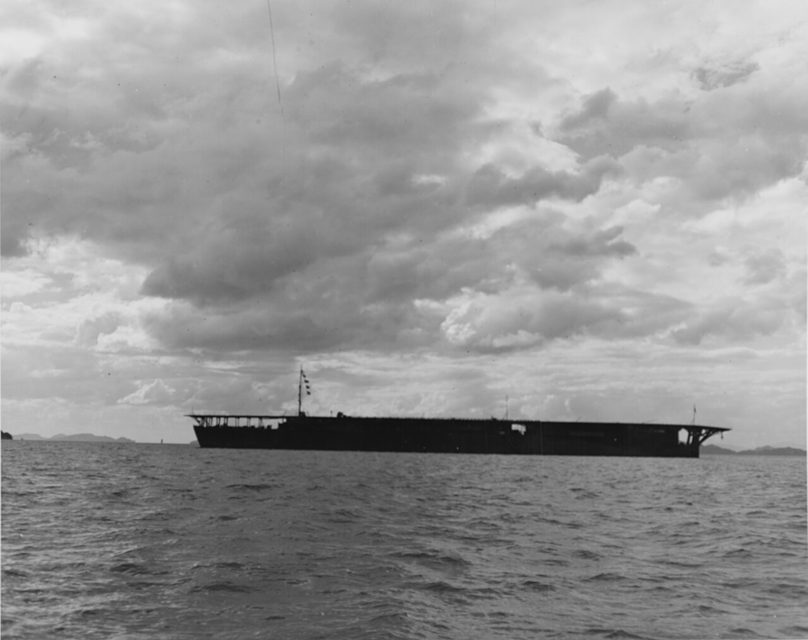
Hosho (鳳翔, flying phoenix) was the first purpose-built aircraft carrier commissioned. Asano Shipbuilding laid her down at Tsurumi on 16 December 1920. She was launched on 13 November 1921, towed to Yokosuka, and commissioned on 27 December 1922, before Hermes. In 1924 the island and the tripod mast came off. They blocked the flight deck. Through the rest of the 1920s she was the ship on which the navy learned how to fly from a deck.
In February 1932 she was off the Yangtze with Kaga. On 5 February her fighters flew the navy's first air combat. Later that month her aircraft struck Chinese airfields. In September 1935 a typhoon during the Fourth Fleet maneuvers damaged the flight deck. In 1937 she was off Shanghai and then Canton. Ryujo was with her. In December 1940 an investigation found she could not operate the Zero, the Val, or the Kate in combat. She remained a training carrier.
Captain Kaoru Umetani had her from 5 September 1941. On 8 December she left the Inland Sea with the Main Body, and with Zuiho, to stand by for the carriers returning from Hawaii. She was not at Pearl Harbor. On 10 December she turned the deck lights on after dark to recover aircraft, lost the fleet, and was found the next morning. She was back at Kure on 12 December.
On 29 May 1942 she sailed for Midway with the Main Body, astern of Yamato, Nagato, and Mutsu, with eight old Type 96 biplane torpedo bombers. She was not in the carrier fight. On 5 June one of those aircraft found the abandoned Hiryu and photographed her, with men still aboard. Tanikaze was sent to her and did not find her. Hosho was not sunk. She went back to training pilots in the Inland Sea, usually with the destroyer Yukaze.
On 19 March 1945 seven aircraft put small bombs into the after flight deck. Six men were killed. The damage was light and was repaired. That attack is not credited to one plane. On 24 July she was still at Kure for the raid on the harbor. The record of any further damage is that it was slight.
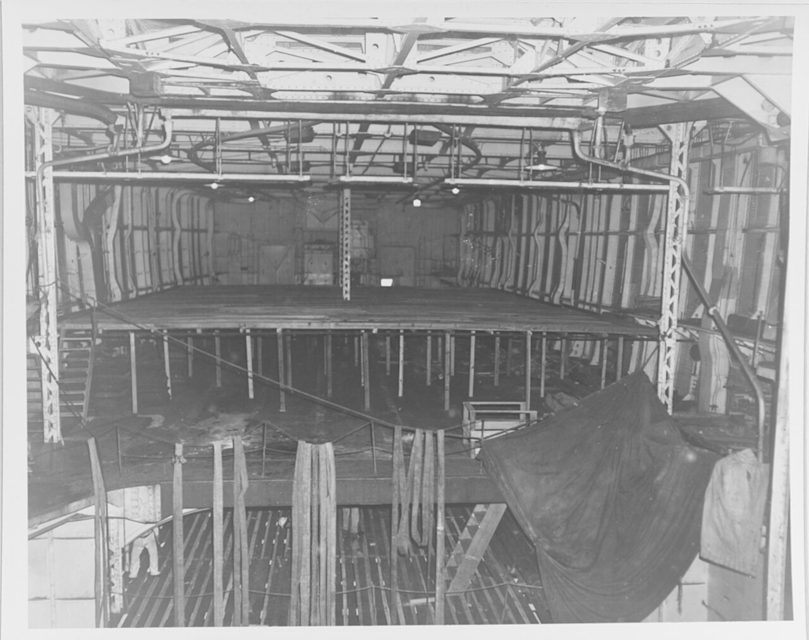
On 3 October 1945 the fighting was over, and getting people home had only started. About 6.6 million Japanese servicemen and civilians were still outside the home islands, among them about three million in the armed forces, from China and Korea out to islands the war had gone past. Captain Kunizo Kaneoka had had her since 20 September. The hangar was given a temporary deck so men could sleep where aircraft had been kept. The Navy photographs of that work are dated 13 October. The movement record says she had already left Kure on 10 October with the cruiser Kashima. Those two dates do not agree.
The same record has her at Wotje on 16 October, where she took about 700 people, and then bound for Eniwetok. On 22 October she was at Jaluit and took 311 more. On 3 November she reached Uraga with those 1,011. She was struck from the Navy list on 5 October 1945 and kept for this work. That winter the flight deck over the forecastle was cut away so the bridge could see. She was withdrawn from the repatriation list on 16 August 1946, transferred to the Home Ministry on 31 August, and broken up by 1 May 1947 at Hitachi Zosen, Sakurajima.