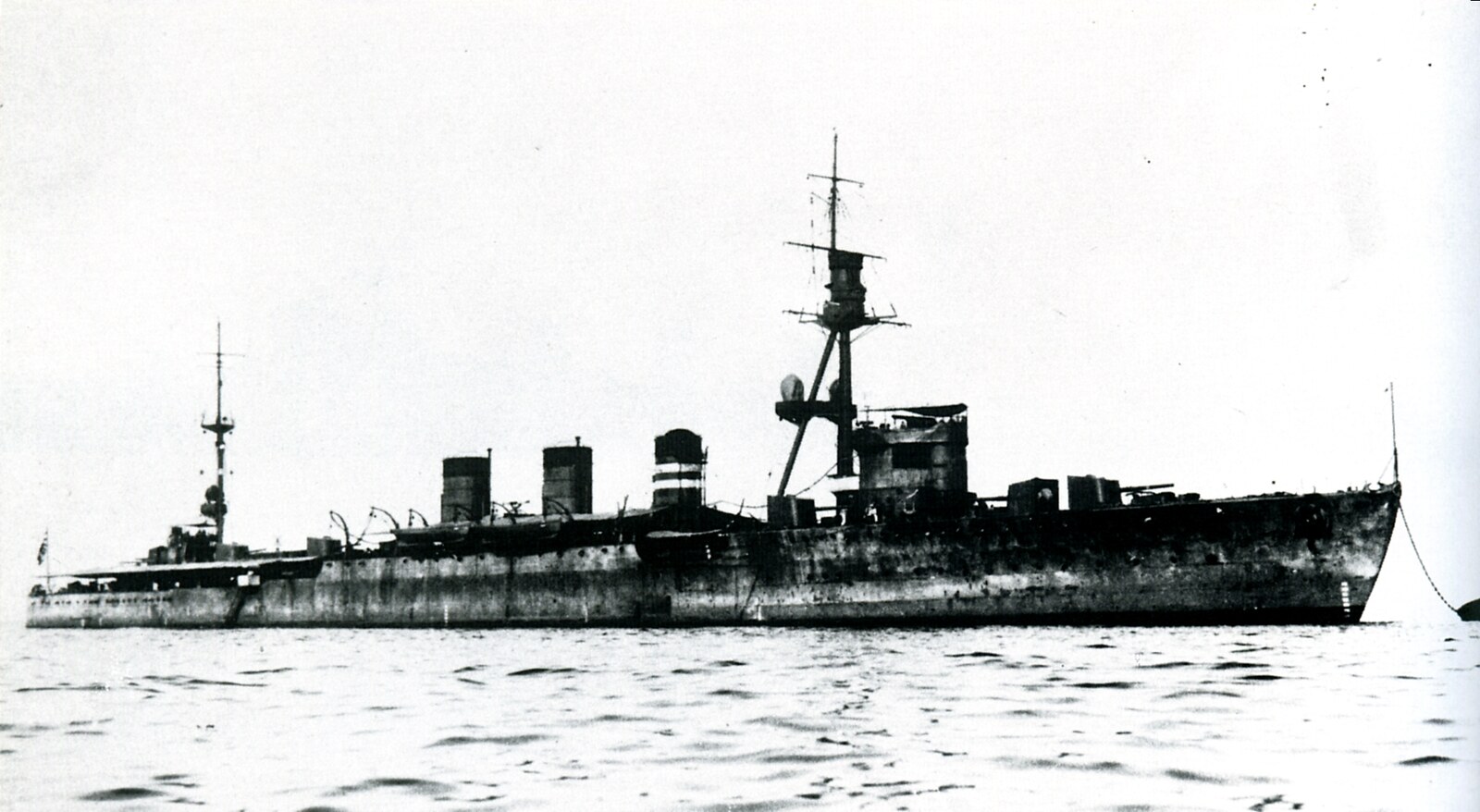
Oi was a Kuma-class light cruiser, named for the Oi River in Shizuoka. Kawasaki laid her down at Kobe on 24 November 1919 and launched her on 15 July 1920, and she was completed on 3 October 1921. Among her captains between the wars were Nishizo Tsukahara and Kiyohide Shima, who both later held high command.
In August 1941 she was ordered to Maizuru to be rebuilt as a torpedo cruiser like her sister Kitakami. The plan called for eleven quadruple mounts, but only ten were available, so she got forty tubes in two rows of five on each side. The work was finished on 30 September 1941, a month after Captain Nobuei Morishita took command. For the first months of the war she stayed in the western Inland Sea as a guardship for the battleships, and at Midway in June 1942 she and Kitakami sailed with the Aleutian screening force and saw no action. Captain Shigeichi Narita had taken command on 10 April.
In August and September 1942 she was converted again into a fast transport, with six torpedo mounts, landing barges, depth-charge rails and more antiaircraft guns. She carried the 4th Maizuru Special Naval Landing Force to Truk and men to Rabaul. Narita fell ill and was relieved by Captain Takeo Nagai on 3 October, and he later died. Captain Shinshiro Soma took command at Kure on 24 December. In January and February 1943 she and Kitakami carried the 20th and 41st Divisions from Korea and Tsingtao toward New Guinea. From May she was in the Netherlands East Indies, where she stood guard at Surabaya, carried troops, and was bombed with Kuma, Kinu and Kitakami at Makassar on 23 June. Captain Shigezo Kawai took command on 23 July 1943, and Captain Katsuo Shiba on 12 February 1944.
In late February 1944 she sailed from Singapore with Kinu and three destroyers to escort Tone, Chikuma and Aoba at the start of their raid into the Indian Ocean. On 23 April, in the Makassar Strait south of Balikpapan, the destroyer Amagiri, steaming about 600 meters off her starboard side, hit a mine and sank.
On 19 July 1944 she was in the South China Sea with the destroyer Shikinami, about 570 miles south of Hong Kong, in heavy weather. Commander Reuben T. Whitaker in USS Flasher dived, set up, and fired four stern torpedoes from 1,400 yards. Two hit Oi on the port side aft at 1111. One was a dud. The other flooded her after engine room. Shikinami drove Flasher deep with depth charges, and a second spread of four from Flasher at 1326 missed. Oi listed to port and settled by the stern, and at 1725 she sank. Shikinami rescued Captain Shiba and 368 men, and 153 were lost. She was struck from the Navy List on 10 September 1944. Shiba was later one of the Navy's representatives at the surrender aboard USS Missouri.
A note on sources. This history follows the Tabular Record of Movement for Oi by Bob Hackett and Sander Kingsepp at combinedfleet.com. The list of captains in the Japanese Wikipedia article on Oi agrees with it. Only one photograph of the ship was found with a clear public-domain status, and it dates from 1923, before her wartime rebuildings.