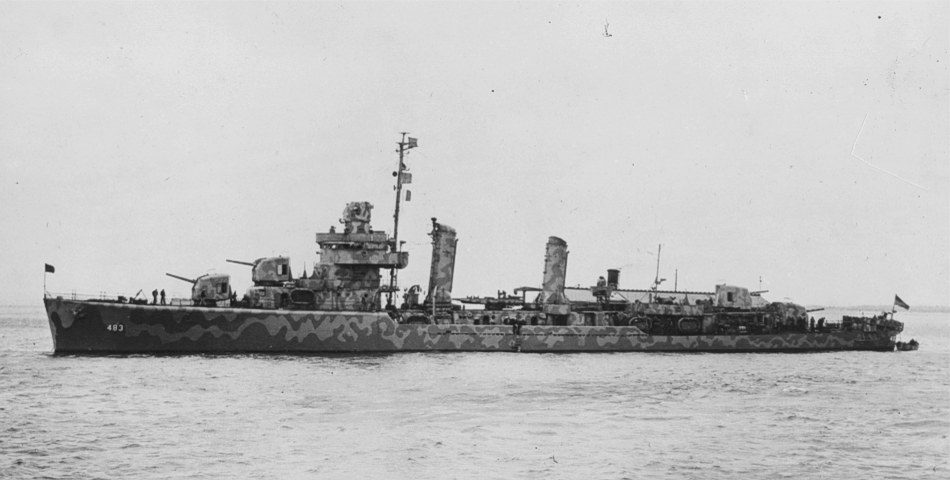
Aaron Ward was a Gleaves-class destroyer, the second Navy ship named for Rear Admiral Aaron Ward. Federal Shipbuilding and Dry Dock laid DD-483 down at Kearny on 11 February 1941. She was launched on 22 November 1941, sponsored by the admiral's daughter, Hilda Ward, and commissioned on 4 March 1942, Commander Orville Francis Gregor in command.
She displaced about 1,630 tons, and about 2,060 tons fully loaded. She was 348 feet 4 inches long. On about 50,000 shaft horsepower she could make about 35 knots. She carried four 5-inch/38 guns, 40 mm and 20 mm anti-aircraft guns, five 21-inch torpedo tubes, and depth charges. The complement was about 208.
After shakedown out of Casco Bay and fitting out at the New York Navy Yard, she sailed for the Pacific on 20 May 1942 by the Panama Canal. At Midway she screened Vice Admiral William S. Pye's Task Force 1, the old battleships and the escort carrier Long Island, well east of the carrier fight, and then went back to the West Coast. On 30 June she left for Hawaii and the South Pacific with Task Force 18.
From August 1942 she escorted the ships that were feeding the fight for Guadalcanal. On 5 and 6 August, convoying the oiler Cimarron toward Noumea, she depth-charged two sound contacts. Postwar accounting did not confirm either as a kill. On 15 September she was nearby when the carrier Wasp was torpedoed and sunk by the submarine I-19. On 20 October she stood by the heavy cruiser Chester after I-176 torpedoed her, attacked the submarine without result, and escorted Chester to Espiritu Santo.
She also worked close inshore. On 17 October she shelled Japanese positions near Lunga for about three hours and drove off bombers. On 30 October, with the light cruiser Atlanta and three other destroyers, she fired 711 rounds of 5-inch at Japanese positions. On 11 and 12 November she screened transports unloading off Guadalcanal and claimed several aircraft damaged or shot down.
That night she was one of eight destroyers and five cruisers under Rear Admiral Daniel J. Callaghan. They turned back into Ironbottom Sound against a Japanese bombardment force built around the battleships Hiei and Kirishima, the light cruiser Nagara, and fourteen destroyers. Aaron Ward was at the rear of the American column. Gregor still had her.
In the melee she fired about ten salvos at a ship believed to be a battleship. Torpedoes passed under her. Barton blew up nearby. She then engaged another Japanese ship, possibly the destroyer Akatsuki, and fired about twenty-five salvos. Akatsuki was sunk that night. That sinking is not pinned to Aaron Ward. Her director was hit and the guns went to local control. She took nine direct hits. Shells wrecked the director, the rangefinder, the radar, the searchlights, and the foremast, and flooded the forward engine room. She lost steering about 0225 and went dead in the water about 0235. Fifteen men were killed and fifty-seven were wounded.
The crew used a gasoline pump to get salt water into the boilers and got a little way on. At daylight the tug Bobolink took her in tow. The crippled battleship Hiei fired several salvos that straddled her. Aircraft from Henderson Field drew Hiei off. She reached Tulagi, near Makambo Island, about 0830. Temporary repairs followed. She reached Pearl Harbor on 20 December 1942.
She rejoined the fleet on 6 February 1943. Commander Frederick Julian Becton relieved Gregor on 18 February. On 20 March she helped drive off an air attack on a convoy. On 7 April, in the raid that opened Operation I-Go, she was covering LST-449 in Ironbottom Sound, off Togoma Point, Guadalcanal. Lieutenant (junior grade) John F. Kennedy was a passenger on that landing ship. Three aircraft came out of the sun and dive-bombed her. One bomb hit the engine room and cut power to the 5-inch and 40 mm mounts. Two near misses holed her below the waterline, one into the forward fireroom and one on the port side near the after engine room, and she lost steering. A second trio of dive bombers then scored more near misses after she had lost power and steering. The crew kept firing under local control. The planes are not credited to one unit.
U.S. after-action reports, the Dictionary of American Naval Fighting Ships, and Pacific Wrecks identify those attackers as Aichi D3A2 dive bombers, called Vals. Those accounts often tie the strike to the carrier Junyo. Mitsubishi G4M level bombers, called Bettys, were not the aircraft that put her down. Japanese records do not fully match a large Val strike. Some later write-ups say part of the formation may have been Army planes, misidentified as Vals. A fixed landing gear can look the same at a glance.
Twenty men were killed, seven were missing, and fifty-nine were wounded. The submarine rescue ship Ortolan and the tug Vireo tried to tow her onto a shoal near Tinete Point, on Nggela Sule, Florida Island. At 2135 she sank stern-first in about forty fathoms, about six hundred yards short of the beach, near 9°10′S, 160°12′E.
The wreck was found on 4 September 1994. She lies upright. The bow and the stern were bent where they hit the bottom, and the damage from that last attack is still visible. The Dictionary of American Naval Fighting Ships credits her with four battle stars. A note on that transcription says the fourth star belongs to the later Aaron Ward, the minelayer DM-34, and that correction was not checked against the 1953 award manual. Admiral William F. Halsey later praised the crew's fight to save her after the November battle.
She is DD-483. An earlier destroyer of the name, DD-132 of the Wickes class, went to Britain as HMS Castleton. A later one, DD-773 of the Allen M. Sumner class, was hit by kamikazes off Okinawa on 3 May 1945 and survived.