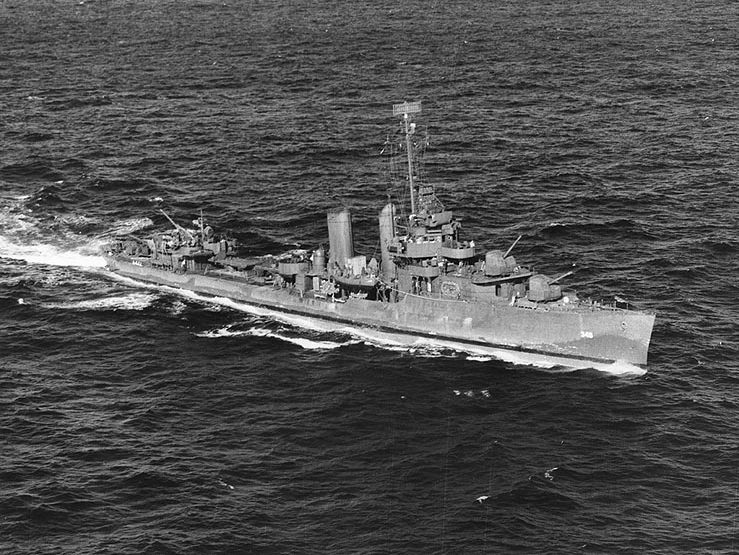
Farragut was named for David Glasgow Farragut. She was the name ship of the eight Farragut-class destroyers, DD-348, the first new destroyer design after the ships of the First World War. Bethlehem Shipbuilding laid her down at the Fore River yard in Quincy on 20 September 1932, launched her on 15 March 1934, and the Navy commissioned her on 18 June 1934. Mrs. James Roosevelt sponsored the launch. Elliott Buckmaster had her. Her first year was training and maneuvers out of Norfolk and in the Caribbean. In the spring of 1935 she took President Roosevelt aboard at Jacksonville and went with the presidential party on a cruise to the Bahamas. That year she shifted to the Pacific and became flagship of Destroyer Squadron 20 at San Diego. From late 1939 she was based at Pearl Harbor, and she spent more of her time screening carriers. All eight ships of the class were in Pearl Harbor on 7 December 1941.
George Porter Hunter had her from 15 April 1941. On the morning of the attack she was nested with other destroyers in East Loch. Ensign James Armen Benham, the engineering officer and the senior officer on board, got her underway. She kept up her gunfire while she went out the channel. A strafing run did slight damage topside. She was not sunk. Benham was later awarded the Bronze Star for that morning.
Through the first months of 1942 she patrolled for submarines and escorted convoys between Hawaii and the West Coast. In May she sortied with Lexington (CV-2) and then joined the combined force under Rear Admiral Frank Jack Fletcher. At the Coral Sea she was in the screen. On 7 May the ships came under air attack. She was not hit, and she was not sunk.
In August she screened Saratoga for the landings on Guadalcanal and Tulagi. She stayed in the eastern Solomons and was in the carrier screen on 24 and 25 August, when the Japanese tried to reinforce the island. Hunter left her on 25 August. Henry Dirk Rozendal took her that day. She went on with patrol and escort for Guadalcanal.
After an overhaul she moved to the Aleutians in April 1943. In May she screened transports for the landings on Attu and made depth-charge attacks on a submarine. She is not credited with a sinking. She bombarded Kiska and blockaded the island. Edward Franklin Ferguson had her from 21 June. On 26 July she was with the force that fired on radar contacts west of Kiska. There were no ships there. In August she supported the landings, after the Japanese had already left.
From late 1943 she screened carriers for the Tarawa landings, then for the Marshalls, and in April 1944 for the landings in the Hollandia area. Charles Conway Hartigan took her on 25 May 1944. She was off Saipan on 11 June. She screened the carriers, bombarded Saipan and Guam, and stood radar picket during the Philippine Sea fight on 19 and 20 June. She covered the underwater demolition teams at Agat and bombarded Rota. None of that shore fire is a ship sunk by her.
After another overhaul she screened oilers for the fast carriers before the landings at Lingayen Gulf, then for Iwo Jima and Okinawa. She stood radar picket off Okinawa and escorted convoys between Ulithi and Okinawa. She left Saipan in August 1945 and reached the Brooklyn Navy Yard late in September. Hartigan still had her when she was decommissioned on 23 October 1945. She was struck on 28 January 1947 and sold for scrap on 14 August 1947. Fourteen battle stars. Hull and Monaghan were lost in the typhoon of 18 December 1944. Worden had already been lost, grounded at Amchitka on 12 January 1943. Farragut was still afloat at the surrender.