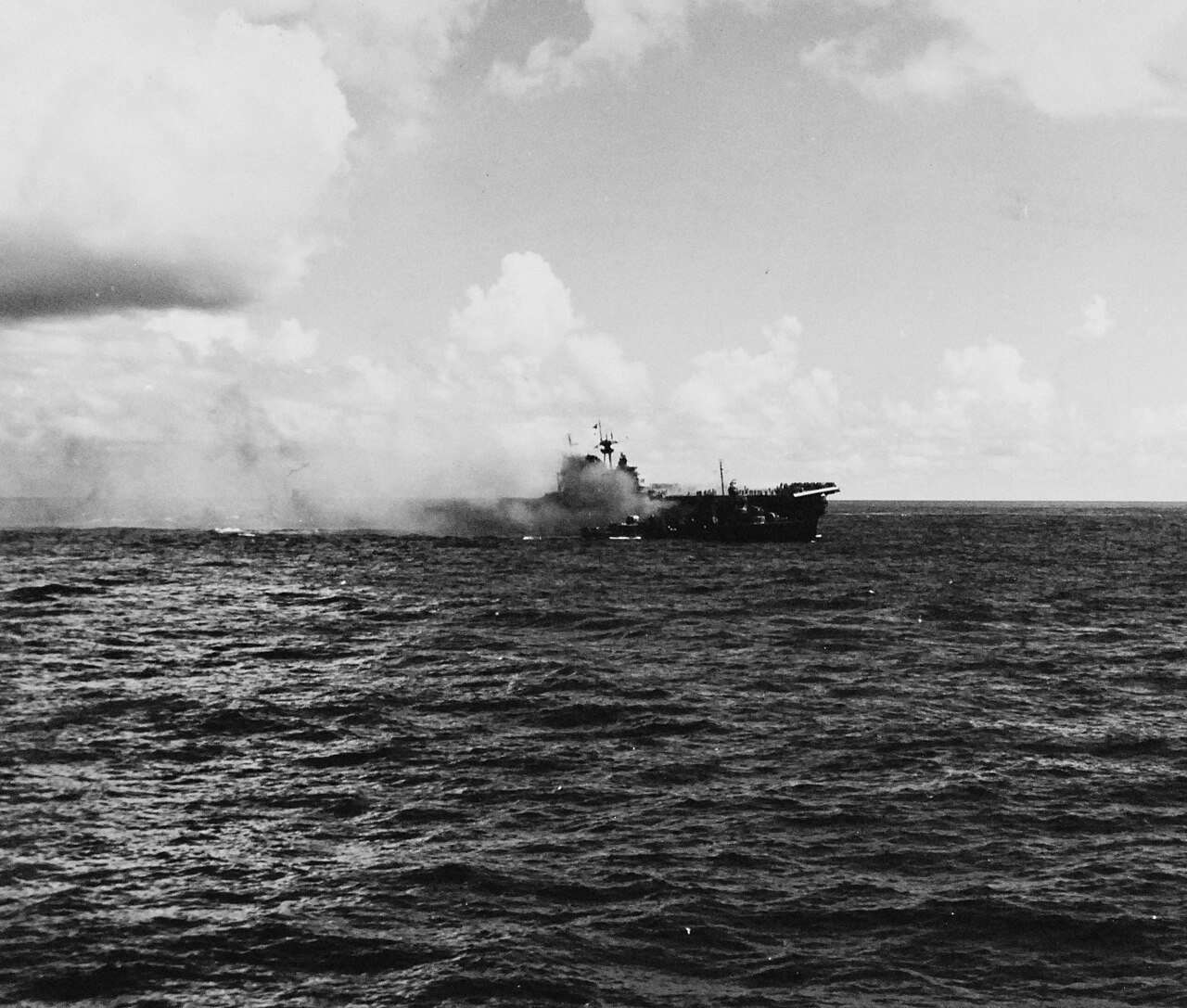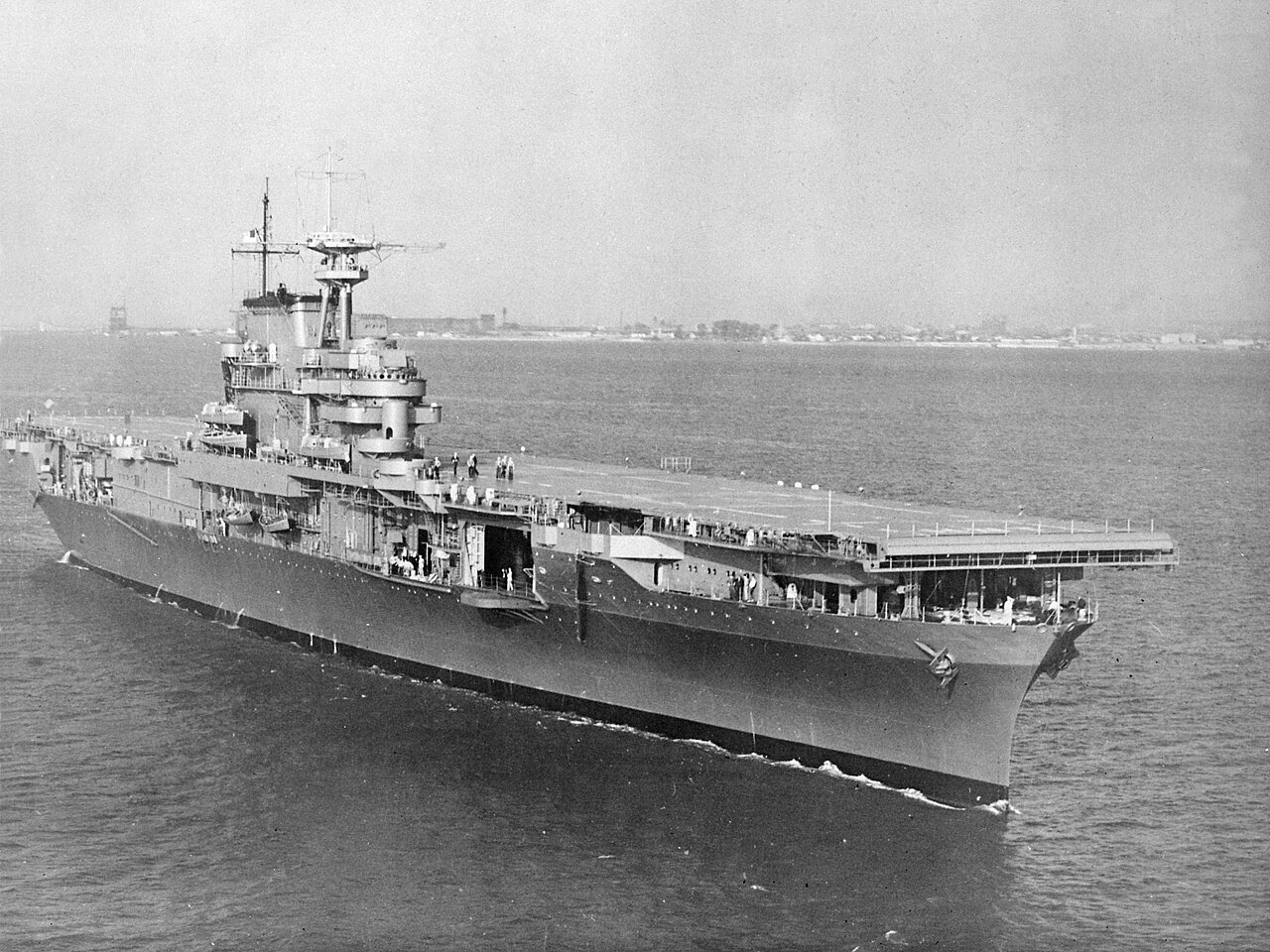
The ship that sank is USS Hornet (CV-8), the Yorktown-class carrier that launched the Doolittle Raid, fought at Midway, and went down at Santa Cruz. The museum at Alameda is her namesake successor, CV-12.
A year and a week
Keel laid at Newport News on 25 September 1939. Launched 14 December 1940. Commissioned 20 October 1941, a few weeks before Pearl Harbor. Standard displacement about 20,000 tons, flight deck 770 feet on the waterline. She was the last U.S. fleet carrier finished before the war.
Captain Marc Mitscher had her first. Captain Charles P. Mason had her last.
Tokyo
In April 1942 she steamed west with sixteen Army B-25s lashed to the flight deck, Lieutenant Colonel James H. Doolittle's crews riding a ship that was not built for bombers. On 18 April, still short of the planned launch point and sighted by a Japanese picket, she launched them anyway. The raid did little material damage. It told the country the war had a way back, and it pulled Japanese carriers toward Midway.
Midway
On 4 June 1942 her dive bombers missed the enemy. Her torpedo squadron did not. Fifteen TBD Devastators of Torpedo Squadron 8, Lieutenant Commander John C. Waldron, found the Japanese carriers and went in without fighter cover. They were shot down one by one. Ensign George Gay was the only pilot who lived to see the water. The attack pulled Japanese fighters down to the deck. Dive bombers from Enterprise and Yorktown found three carriers open and burned them. Hiryu went the next day.
Torpedo Eight received the Presidential Unit Citation. Most of the men named on it were already dead.
Last carrier in the slot
After Eastern Solomons, Enterprise was damaged. Saratoga took a torpedo. Wasp was sunk on 15 September. For weeks Hornet was the only U.S. fleet carrier left in the South Pacific. She covered Guadalcanal until 24 October, then joined a repaired Enterprise to meet a Japanese carrier-battleship force coming south.
Santa Cruz, 26 October 1942
No surface ship of either fleet saw the other. The fight was aircraft.
Enterprise planes hit Zuiho. Hornet aircraft damaged Shokaku and the cruiser Chikuma. While her air group was away, dive bombers and torpedo planes from Shokaku, Zuikaku, and Junyo found Hornet.
The Bureau of Ships war-damage report is blunt: three bombs, two torpedoes, and two aircraft that crashed into her in the morning attack. A Val hit the flight deck. The leader from Shokaku, already dying, flew his plane into the island. Two torpedoes opened the starboard side. Power died. She listed. Fires were knocked down in about an hour. Cruiser Northampton got a tow.
In the afternoon the Japanese came back. Another torpedo to starboard. More bombs. The list went to 18 degrees. She was abandoned. Captain Mason was the last man off.
Destroyers Mustin and Anderson were ordered to sink her so the Japanese would not have her. Nine torpedoes and more than 360 rounds of 5-inch. She burned and stayed up. After dark, destroyers Makigumo and Akigumo put four 24-inch Long Lances into the hull. She sank at 0135 on 27 October, off the Santa Cruz Islands.
Captain Mason's count: 2,512 aboard at the start of the attack; 124 dead on the ship; eight or nine more from wounds; nineteen of the air group missing.
After
The name came off the Navy List on 13 January 1943 and went onto a new Hornet, CV-12, which the survivors had already asked for. CV-8 received four battle stars. Santa Cruz was a Japanese tactical win and a bill they could not pay twice: they lost so many aircrews that their carriers did not fight again as a force for nearly two years. Guadalcanal held.
The wreck was found in 2019, more than 17,000 feet down, east-northeast of Guadalcanal. The flight deck that launched Doolittle is still there.