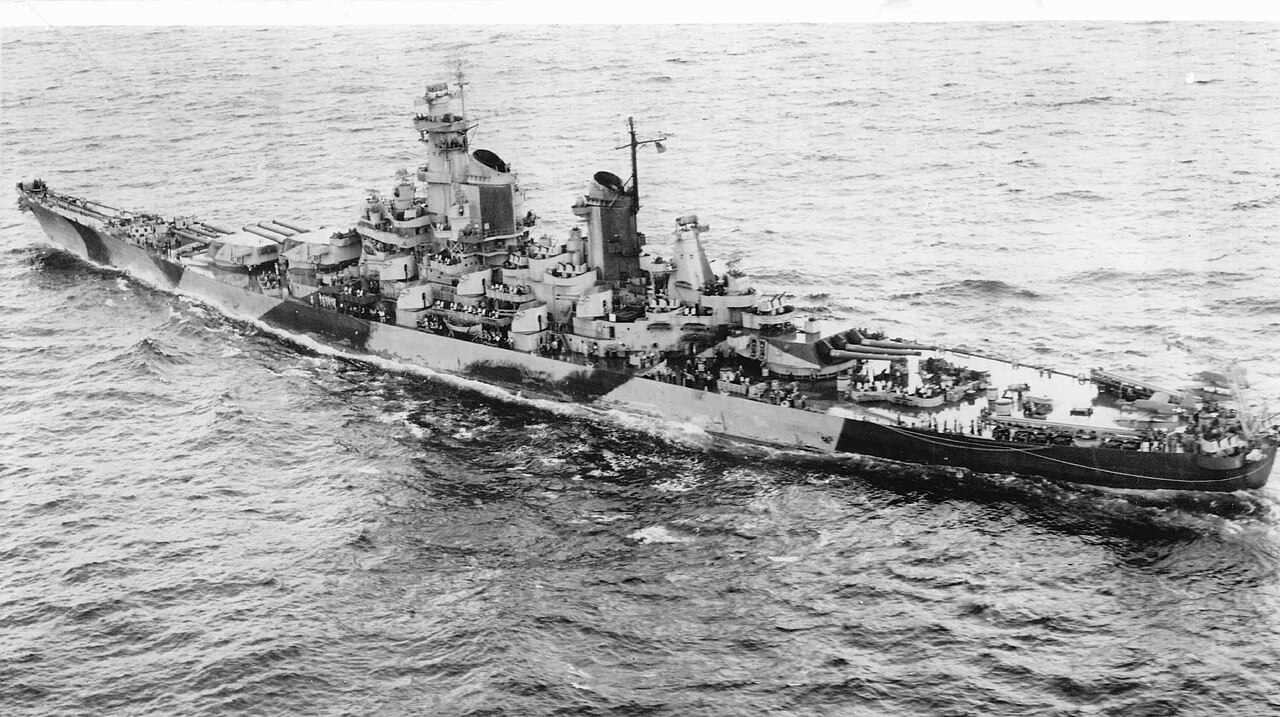
There were earlier Iowas. This is the one people mean: USS Iowa (BB-61), lead ship of the last class of U.S. battleships, now moored at San Pedro as a museum.
The last class
She was ordered 1 July 1939 and laid down at the New York Navy Yard on 27 June 1940. Ilo Wallace, wife of the vice president, sponsored the launch on 27 August 1942. Commissioning was 22 February 1943, Captain John L. McCrea in command.
The class was the end of the line. Iowa, New Jersey, Missouri, and Wisconsin were finished. Illinois and Kentucky were not. Designed displacement was 45,000 tons; full load ran far higher. Length 887 feet 3 inches, beam 108 feet 2 inches so she could pass the Panama Canal, nine 16-inch/50 guns, twenty 5-inch/38s, and a designed speed of 33 knots. That speed was the point. She could stay with the fast carriers.
Atlantic, then the Pacific
Shakedown was on the East Coast. In August 1943 she went to Argentia in case Tirpitz came out. In November she carried President Franklin D. Roosevelt, Secretary of State Hull, and the Joint Chiefs toward Casablanca on the first leg of the Tehran Conference. During an escort exercise on that crossing, destroyer William D. Porter accidentally fired a live torpedo at her. Iowa turned and the fish exploded in her wake. The president was still aboard.
She was the only ship of her class to serve in the Atlantic in the war. On 2 January 1944 she sailed for the Pacific as flagship of Battleship Division 7.
Combat debut was the Marshalls. Then the pattern that defined the fast battleships: screen the carriers, bombard when an island needed breaking. Saipan and Tinian, 13–14 June 1944. On 19 June, in the Battle of the Philippine Sea, she stood in Admiral Lee’s battle line while Task Force 58 broke the Japanese air attack. She was in the Palaus and Leyte operations, including Leyte Gulf, then an overhaul, then Okinawa and the last strikes on Japan.
She entered Tokyo Bay on 29 August 1945. On 2 September she was Admiral Halsey’s flagship for the surrender ceremony held aboard her sister Missouri. She left the bay on 20 September, reached Seattle on 15 October, went back to Japan in January 1946 as Fifth Fleet flagship, and decommissioned on 24 March 1949.
Nine battle stars for the war.
Korea
North Korea’s invasion put her back in commission on 25 August 1951. In April 1952 she became flagship of Vice Admiral Robert T. Briscoe, Commander Seventh Fleet, and went to the gun line. She fired more than twice the number of shells she had fired in the Second World War. Crews called her the Grey Ghost and the Big Stick. Two more battle stars. After the deployment she shifted to the Atlantic, made European and midshipman cruises, stood in the International Naval Review at Hampton Roads in June 1957, and decommissioned at Philadelphia on 24 February 1958.
The 1980s
The Reagan 600-ship Navy pulled all four Iowas out of mothballs. Iowa was modernized with Tomahawk, Harpoon, Phalanx CIWS, and new electronics, and recommissioned on 28 April 1984. She kept the three 16-inch turrets. She worked the Caribbean, Northern Europe, the Baltic, hosted President and Mrs. Reagan in 1986, and in 1987–88 went into the North Arabian Sea for Operation Earnest Will, escorting reflagged tankers.
On 19 April 1989, during a gunnery exercise northeast of Puerto Rico, Turret Two exploded. Forty-seven men were killed. The center 16-inch gun had five bags of powder in an open breech behind a 2,700-pound projectile. Investigations did not produce a cause the Navy closed as fact. The turret was never restored to firing condition.
She served as Sixth Fleet flagship that autumn and was decommissioned for the last time on 26 October 1990. Across three commissions she had about nineteen years of active service inside a span of forty-seven. Struck on 17 March 2006, she was donated to the Pacific Battleship Center and opened at Berth 87, Port of Los Angeles, in 2012.
She carried a president to a wartime conference, screened the carriers across the Pacific, stood in Tokyo Bay at the surrender, went back for Korea, came back again with missiles on the old hull, and lost forty-seven men in a turret that is still aboard. The motto on the ship is Iowa’s: Our liberties we prize, our rights we will maintain.