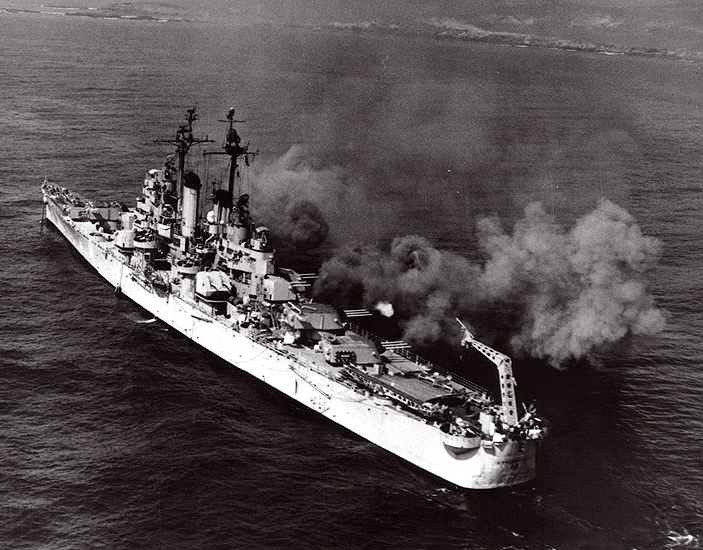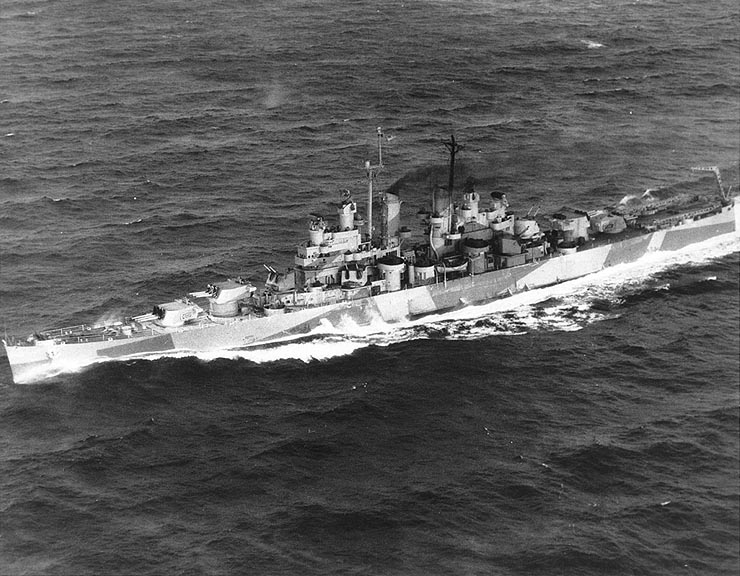
Springfield (CL-66) was a Cleveland-class light cruiser, the third Navy ship of the name, named for Springfield, Massachusetts, and Springfield, Illinois. Bethlehem Steel Company laid her down on 13 February 1943 at its Fore River yard in Quincy. She was launched on 9 March 1944, co-sponsored by Mrs. Angelina Agnes Bertera, the mother of four sons in the Navy, and Miss Norma McCurley, winner of the best essay on the subject "The U.S. Navy." The Navy commissioned her at Boston on 9 September 1944. NavSource lists Captain Felix Leslie Johnson from that day until 15 May 1945. DANFS names Capt. Felix L. Johnson at commissioning. The hull line gives 10,000 tons, a length of 610 feet 1 inch, a beam of 66 feet 6 inches, a mean draft of 20 feet, 31.6 knots on trial, a complement of 1,319, twelve 6-inch guns, twelve 5-inch guns, twenty-four 40-millimeter guns, twenty-one 20-millimeter guns, two catapults, and two or three aircraft.
On 7 November 1944 she left Boston on her maiden voyage and put in at Norfolk two days later. After gunnery practice in Chesapeake Bay she went south and arrived in the Gulf of Paria, Trinidad, on 21 November. Shakedown there lasted until 21 December, and she sailed back to Boston. She left Boston again on 10 January 1945 for exercises off Bermuda, cleared for Norfolk on the 13th, and stayed for upkeep and gunnery until 23 January. That morning she joined Task Group 21.5 off Thimble Shoal Channel to accompany Quincy (CA-71) on the first leg of the voyage to Malta carrying President Franklin Delano Roosevelt toward the Yalta conference. On 28 January, about 300 miles south of the Azores, another group relieved Task Group 21.5. Springfield headed for the Panama Canal, transited on 5 February, and reached Pearl Harbor on the 16th.
Five days at Pearl Harbor went to stores, ammunition, and antiaircraft practice. She stopped at Eniwetok on 2 March 1945, reached Ulithi on the 6th, stood out on the 14th, and joined the Fast Carrier Task Force, Task Force 58, the next day. For two and a half months she cruised with that force. After a raid on Kyushu and Honshu on 18 and 19 March, the carriers turned to Okinawa. From 23 March until 1 April she helped ward off air attacks while the planes weakened the island's defenses, and on 27 and 28 March she bombarded Minami Daito Shima. After the assault of 1 April her mission stayed the same: protect the carriers, east and southeast of Okinawa, for almost two months. Her guns destroyed at least three suicide planes. On 17 April, just after she had splashed one, a kamikaze missed and hit the water 50 yards away. On 10 and 11 May she left the screen to bombard Minami Daito again. From 23 March to 28 May she left the Okinawa area only once, on 13 and 14 May, when Task Force 58 struck air bases on Kyushu. NavSource relieves Johnson on 15 May 1945, while she was still on that cruise, and lists Captain Thomas Joseph Kelly from that day until 12 March 1946.
On 27 May 1945 the Fifth Fleet became the Third Fleet when Admiral William F. Halsey, Jr., relieved Admiral Raymond A. Spruance. Three days later Springfield anchored in San Pedro Bay at Leyte. A month later she joined Task Force 38. The carriers hit Tokyo on 10 and 11 July, northern Honshu and Hokkaido on the 13th and 14th, and ran an anti-shipping sweep along Honshu on the night of 14 and 15 July. Two days later they hit Tokyo and Yokohama. Planes bombed Nagato and Haruna on 18 July and pounded Kobe and Kure on 24, 25, and 28 July. On the night of 24 and 25 July Springfield bombarded shore installations on southern Honshu. Tokyo was hit again on 30 July. On 9 and 10 August the force bombed northern Honshu and Hokkaido, and three days later the carriers sent planes against Tokyo for the last raid of the war. Hostilities ended on 15 August.
She entered Sagami Wan with Task Force 35 and anchored on 27 August. On 30 August she covered the entry of Task Force 31 into Tokyo Bay and the occupation of Yokosuka, then returned to the anchorage. She entered Tokyo Bay on 3 September. On 20 September the Third Fleet became the Fifth Fleet again when Spruance returned. She stayed in the Far East until early January 1946 and visited Sasebo and Yokosuka, Shanghai, Taku, Tsingtao, and Chinwangtao, and Jinsen (Inchon). On 9 January she left Tsingtao and reached San Pedro, California, on 25 January, on the way to the naval shipyard at Mare Island. DANFS next has her back at San Pedro on the 15th, without restating the month, and on the west coast until 1 November 1946.
She reached Guam on 15 November 1946 and operated in the Marianas, mostly between Guam and Saipan, until 19 February 1947. She stopped at Kwajalein from 25 to 27 February, was at Pearl Harbor from 11 to 18 March, and arrived at San Pedro on 24 March. NavSource lists Captain John Phillip Womble Jr. from 12 March 1946 to 23 October 1946, and Captain Robert Edward Jasperson from 23 October 1946 until June 1948, with no day in that June. She operated on the west coast for just over 18 months, then went to the Far East again and reached Yokosuka on 3 November 1948. NavSource lists Captain Frank Monroe Jr. from June 1948, with no day he took command, until 28 September 1948; Commander John Sim Slaughter from 28 September to 9 October 1948; and Captain Frederick Moosbrugger from 9 October 1948 to 1 December 1949. With the Seventh Fleet until mid-May she visited Sasebo, Yokosuka, Kure, Tsingtao, Shanghai, and Okinawa, and for the first time Hakodate, Otaru, and Hong Kong. She returned to the west coast on 1 June 1949. Three and a half months later she began inactivation overhaul. In January 1950 she joined the San Francisco Group of the Pacific Reserve Fleet. NavSource lists Slaughter again, as commander, from 1 December 1949 to 30 January 1950, and marks her decommissioned on that January day. DANFS gives the month, January 1950, and not the day. She earned two battle stars for World War II.
She remained at San Francisco until March 1959, then was towed by way of the Panama Canal to Boston. On 15 May she returned to Fore River to be converted to a Providence-class Terrier guided-missile cruiser and was redesignated CLG-7. The work took more than three years, the last three months of it at the Boston Naval Shipyard. She was recommissioned at Boston on 2 July 1960. She served as flagship of the Sixth Fleet and later of the Second Fleet. She was decommissioned on 15 May 1974, reclassified CG-7 on 1 July 1975, stricken from the Naval Vessel Register on 31 July 1978, and sold on 1 March 1980. She was not sunk.
A note on sources. The narrative follows the Naval History and Heritage Command Dictionary of American Naval Fighting Ships entry for Springfield III (CL-66), updated by Robert J. Cressman on 22 June 2026. Commanding officers through the first decommissioning, and their dates, are the NavSource list for CL-66. Captains of the guided-missile recommissioning are not carried here. DANFS names Capt. Francis D. Boyle at the 2 July 1960 recommissioning and does not give the day in January 1950 when she joined the San Francisco group. NavSource dates that decommissioning 30 January 1950, the day it relieves John Sim Slaughter. Jasperson's relief and Monroe's assumption are printed only as June 1948. A Wikipedia biography of Frederick Moosbrugger says he commanded Springfield from June 1949 to January 1950. NavSource dates him from 9 October 1948 to 1 December 1949. The sentence that she returned to San Pedro "on the 15th" does not restate the month. HyperWar names the ship for the many American places called Springfield rather than for the Massachusetts and Illinois cities, prints the beam as 66 feet 3 inches and the draft as 24 feet 7 inches, and arms her with twenty-eight 40-millimeter guns and no 20-millimeter guns, catapults, or aircraft. The current hull line is used above. HyperWar shortens the sponsors to Mrs. Angelina Bertera and Miss Norma McCurley, prints Jinsen without the bracketed Inchon, says navy yard rather than naval shipyard at Mare Island, and ends, as of February 1975, with the ship still berthed at Philadelphia. It has no CG-7 reclassification, no strike, and no sale. Digitized copies of the current entry print "guided mkissile," "Norfok," and "ito enable" in the later career. Those sentences are not used above.